
Wellness culture profits from exhausted women. A free, science-backed album gives them their power back
Welltory is turning exhaustion into healing
-2.jpg)

.webp?2026-05-20T11%3A51%3A42.338Z)
Let's say it plainly: American women are running on empty, and everyone is pretending not to notice.
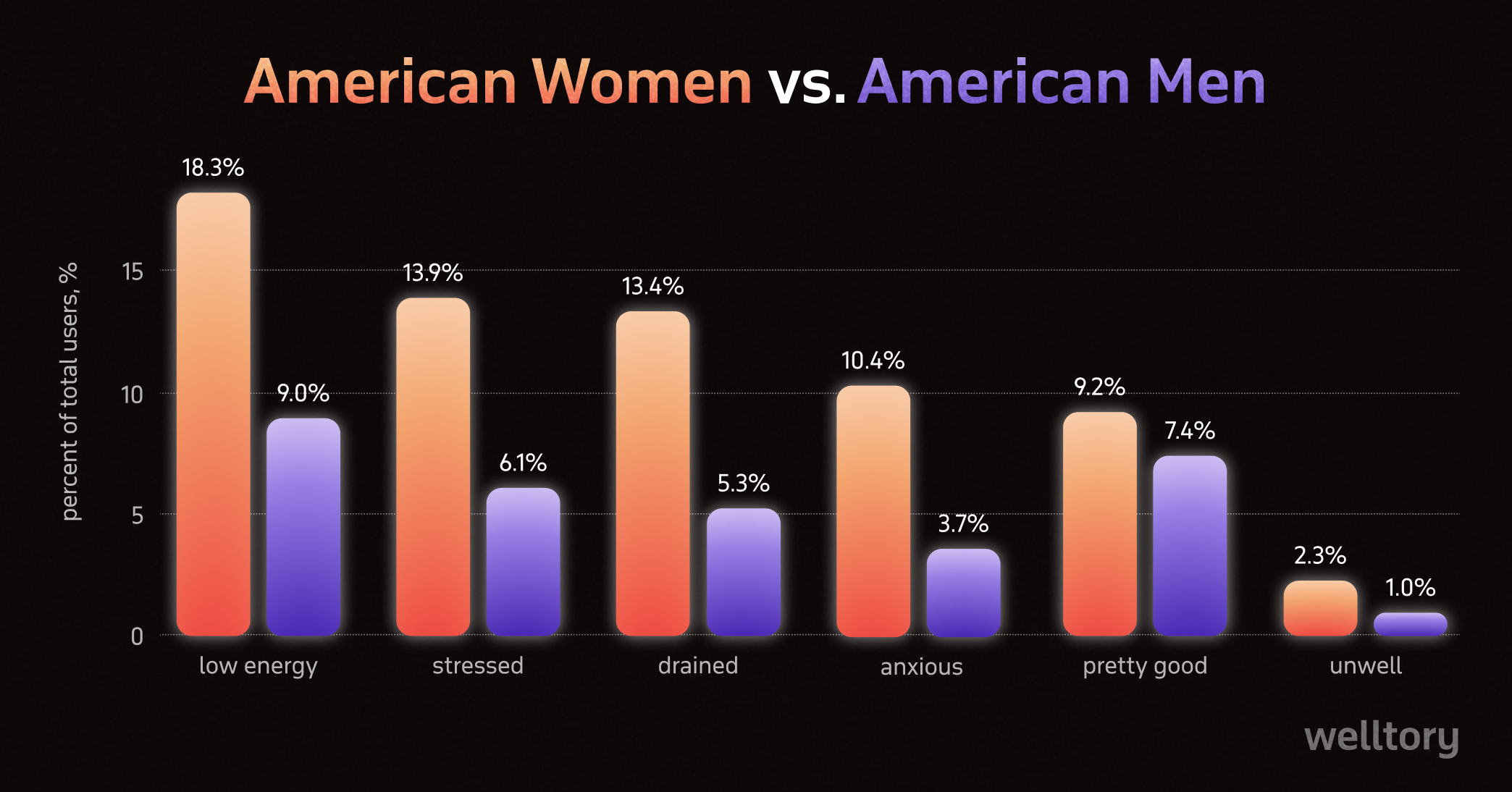
Analysis of data from 16 million Welltory users — including 8 million women — reveals something that should be a national emergency: American women reporting stress, anxiety, exhaustion, and energy depletion at 2x the rate of American men.
Not "a bit off." Not "a little tired." Depleted. Hollowed out. Barely functioning while shouldering the crushing weight of careers, households, caregiving, emotional labor, and the mental load that no one else can see but everyone depends on.
And what does the $4.5 trillion wellness industry offer these exhausted women? More work.
More apps to manage. More classes to schedule. More routines to optimize. More products to buy. More self-improvement to squeeze into the 15 minutes between putting kids to bed and collapsing yourself.
The system that's crushing women is selling them the "cure." And the cure requires the one resource they don't have: more of themselves.
We're done with that.
We release a free album that doesn't ask women to add one more thing to their impossible load. Instead, it transforms the labor that's already breaking them into the practice that could save them.
A weekend pilot study of 61 active beta testers who volunteered their data validated the mechanism, showing statistically significant results across every measure.
The album is available on Spotify and Apple Music.
The data everyone's ignoring: women are not okay
For years, Welltory has been tracking stress, energy, and wellbeing across 16 million users in over 100 countries. We've analyzed heart rate variability, sleep patterns, activity levels, and self-reported wellbeing data at a scale few organizations can match.
The numbers are brutal. And they tell a story that no one wants to acknowledge.
American women are experiencing systemic collapse:
- Low energy: 18.3% of women vs. 9.0% of men (2x higher)
- Stressed: 13.9% of women vs. 6.1% of men (2.3x higher)
- Drained: 13.4% of women vs. 5.3% of men (2.5x higher)
- Anxious: 10.4% of women vs. 3.7% of men (2.8x higher)
Meanwhile, men report feeling "pretty good" at nearly the same rate as women, while doing significantly less unpaid labor.
This isn't a personal failing. This is structural extraction masquerading as equality.
And Welltory's data shows that women's bodies are screaming warnings that everyone is ignoring.
What Welltory knows about stress (that most apps don't)
Before we go further, you should know what we do.
Welltory isn't another meditation app selling you calm. We're a health and wellness platform built on 7+ years of research and 16 million users' worth of physiological data.
We measure stress through heart rate variability (HRV) — the gold-standard biomarker that reflects your autonomic nervous system's state. Not chakras. Not self-reported "how stressed do you feel?" metrics. Actual physiological stress response captured through your body's data.
HRV has been validated in thousands of peer-reviewed studies as a reliable indicator of stress, recovery, and cardiovascular health. It's what cardiologists use. What research institutions use. What elite athletes use to optimize performance.
Our platform integrates with wearables and uses AI to analyze patterns across:
- Sleep quality and recovery
- Activity and movement
- Stress resilience and energy levels
- Lifestyle factors and their impact on wellbeing
We've processed billions of data points and published peer-reviewed research. We know what stress looks like in the body. We know what recovery looks like. And we know that traditional "stress management" approaches aren't working for women, because the data shows women aren't recovering.
Which is why we built something different.
The lie wellness culture tells women
Here's what nobody says out loud: The wellness industry profits from women's exhaustion.
Women perform 75% of the world's unpaid care and domestic work globally. In America, where we pretend we've achieved equality, the gap is even starker. Even in dual-income households where both partners work full-time, women do significantly more housework, childcare, emotional labor, and household management.
The "second shift" isn't theory — it's documented, quantified, and slowly killing the women trapped in it.
But wellness culture has a solution: Just add more.
Can't sleep? Download a meditation app and commit to 20 minutes of guided practice every night, right after you finish help with homework and answer work emails.
Stressed? That yoga class will help. Just carve out 90 minutes 3 times a week, plus commute time, plus finding childcare, plus the mental energy to actually show up.
Exhausted? You need a morning routine. Wake up an hour earlier for journaling, affirmations, and stretching. Also, maintain a gratitude practice. And meal prep on Sundays. And maybe see a therapist weekly.
The message is always the same: You need to add more to your already impossible schedule to fix the exhaustion caused by your already impossible schedule. Your body's collapse is a personal failure. And the solution requires more time, more energy, more optimization of a system that's fundamentally broken. It's not a solution. It's gaslighting disguised as self-care.
Dr. Emily Nagoski, who literally wrote the book on burnout, says it plainly: "Women aren't burning out because they're doing it wrong. They're burning out because the game is rigged."
The radical reframe: your kitchen sink is a lifesaver
Stop thinking about housework as the problem. Start thinking about it as the solution that's been hiding in plain sight.
.png?2026-05-04T16%3A58%3A17.437Z)
It works through a measurable neurological mechanism validated in longevity research but never used in modern domestic labor. We call this mechanism "interoceptive awareness through mindful movement."
When you bring sustained attention to physical sensation during routine movement — water temperature while washing dishes, the weight of laundry, the rhythm of chopping vegetables — you activate the same biological pathways that keep centenarians in Blue Zones healthy into their 90s.
This isn't woo. A comprehensive PMC study on Sardinian centenarians found that habitual daily activity and traditional household labor had stronger correlations with functional ability and longevity than diet.
Read that again: The housework predicted long, healthy life better than what they ate.
The Mediterranean grandmothers living past 100 aren't doing hot yoga or intermittent fasting. They're cooking, cleaning, gardening — mundane, repetitive, "invisible" labor. The kind of work women are told doesn't count as real wellness.
The difference is that they're present in it. American women are dissociated from it.
And that dissociation, that constant mental absence from your body while your hands do the work, is part of what's killing you.
We tested it. It worked. Here's the proof
We designed a pilot study to answer one question: Can you deliberately activate longevity mechanisms through the housework women are already doing?
The study:
- N=61 participants (active beta testers who publicly agreed to share their data)
- Duration: One weekend (72 hours)
- Intervention: Audio tracks guiding mindful attention during routine activities women already do: dishes, shopping, cleaning, cooking
- Measures: A Mindfulness Questionnaire based on the modified Toronto Mindfulness Scale (the gold standard universities use)
- Design: Pre-post within-subjects (no control group in this pilot)
The results:
.png?2026-05-04T17%3A01%3A06.667Z)
Strongest effect: Body awareness (d = 0.35, p = 0.008), meaning the average participant moved from the 50th percentile to the 64th percentile in body awareness in one weekend.
These effect sizes (d = 0.24-0.35) match peer-reviewed predictions for brief interventions, validating that it works using the same measures research institutions use.
One participant said it perfectly: "It was like remembering I have a body, not just a to-do list."
That's what chronic stress steals from you — the ability to inhabit your own body. You become a disembodied task manager, disconnected from sensation, overriding every signal your body sends until you can't hear them anymore.
This intervention reverses that. In 72 hours. Using activities you're already doing.
Zero extra time. Zero cost. Measurable results.


Discounts for blog readers: up to 36% off
See wwhat affects your energy, stress, sleep, and daily state with Welltory
Why body awareness is the key to everything
The strongest effect in our study was body awareness, and that's not accidental.
Chronic stress systematically disconnects you from your body. You stop noticing hunger until you're shaking. You ignore exhaustion until you collapse. You override pain, discomfort, and every early warning system your body has because you don't have time to listen.
"When you're in survival mode — which most American women are — you stop being embodied," explains Dr. Anna Elitzur, the study's lead researcher and psychiatrist. "You become a machine executing tasks. And machines break down."
Movement-based mindfulness rebuilds the neural pathways between your brain and body. It restores interoceptive awareness — your ability to sense what's happening inside you.
Studies in Nature Aging show that physical activity combined with social involvement predicts health outcomes better than dietary factors. A 2022 Nature Molecular Psychiatry study found that perceived stress decreased by 32% through interventions combining purposeful movement with connection — aka daily activities done with presence.
When you wash dishes with full attention to sensation, you're not just cleaning. You're:
- Rebuilding agency over your attention (instead of being hijacked by anxiety spirals)
- Restoring body literacy (learning to read your own signals again)
- Transforming necessity into choice (you have to wash dishes, but how you experience that moment is yours)
One participant described it as "remembering I'm a person, not a productivity unit."
The album: we made music for people who live in 2025
Most guided meditations sound like relics from a monastery in 1973 with singing bowls and ancient mantras, reinforcing the message that wellness requires removing yourself from your actual life.
We rejected that entirely.
On October 31st, we're releasing a free album of what we're calling "meditation designed for people who actually live in the modern world and listen to modern music."
.png?2026-05-04T17%3A03%3A05.534Z)
9 tracks. 250 minutes.
- Lo-fi hip-hop for cooking (because you're not in a monastery, you're in a kitchen in 2025)
- Liquid drum & bass for movement (participants reported entering trance states)
- Electronic production layered with live instruments
- A rap section about being present (because why the hell not)
The music is built on science, and every track was designed with specific neurological states in mind. Rhythm and repetition mirror the natural patterns of household activities: the steady pace of dishwashing, the rhythmic folding of laundry, the cyclic nature of meal preparation. The beats sync with movement, making it easier to stay present without effort.
Genre diversity prevents habituation. Your brain stops noticing background noise after 3–4 minutes. By shifting sonic textures while maintaining mindful guidance, we keep your attention engaged without demanding it.
The tone of carefully crafted custom voices shifts subtly based on whether you're doing active movement (cleaning) or quieter tasks (folding laundry). After producing 20+ hours of AI voice content, we cracked the code on making synthetic guidance sound genuinely human.
"What we made isn't meditation," says Evgeny Teilor, our functional music expert. "It's more like attention navigation through sound. Everything — the music, the rhythm, the voice, the sonic space — is designed so you gradually stop listening and start feeling. Eventually, the sound isn't something outside you anymore. It becomes part of the experience itself."
The philosophy: You don't need to pretend you're in Bali. You can be exactly where you are: in 2025, exhausted, in your actual bathroom, cleaning your actual sink, and still access the mechanism that restores you.
The uncomfortable truth
Here's what this really means: The solution to women's exhaustion isn't more self-care. It's self-awareness.
You still have to do the dishes, the laundry, the cooking, the endless maintenance of other people's lives. But those 3 hours a day you spend on housework can be 3 hours of neural pathway repair instead of 3 hours of dissociated autopilot.
That's 21 hours a week and 1,092 hours a year reclaimed not by doing more, but by being present in what you're already doing.
Try it. Track it. See if it works.
The album is free. Stream it now on Spotify and Apple Music.
Use it during:
- Dishes, laundry, cleaning
- Shopping
- Cooking
- Any repetitive activity where you can bring attention to movement
Track yourself before and after:
- How do I feel emotionally?
- How connected am I to my body?
- How do I experience the activity itself?
Our pilot study says over half of the people improve measurably. You might be one of them.
.png?2026-05-04T17%3A05%3A00.450Z)
______________
Study details: Adapted Toronto Mindfulness Scale, N=61 participants, 3-day pre-post design, all improvements p<0.05, effect sizes d=0.24-0.35 consistent with brief intervention literature. Pilot study, no control group, larger RCT planned. Data insights based on analysis of 16 million Welltory users, including 8 million women.
Was this helpful?
Ask AI for a summary of page


Written by Anna Elitzur
Medical doctor and mental health expert at Welltory. With expertise in behavioral health, AI in healthcare, and psychological systems design, she explores innovative ways to improve well-being through science, data, and technology.
Written by Irina Motovilova
Welltory’s brand and community lead. A hyperpolyglot specializing in UX writing and content strategy, she builds global communities and creates content people actually want to read.