

Short answer
Weaponized incompetence is doing a shared task badly, or saying you can't do it, so that someone else ends up doing it. If it happens once with a new skill, that is a learning curve; if the same jobs keep landing back on one person for weeks, it is a pattern. In US time-use data, 47.9% of women did housework on an average day, against 23.8% of men.
If you are the one who holds the list and you feel wiped out on days when you "didn't do anything", that is not a character flaw and not weakness. Remembering, planning and checking are work, even when nobody counts them. Before you blame yourself, check what your body already recorded: broken nights, stressful evenings, a Battery that never quite refills at the weekend.
Note: this article explains a relationship and workload pattern and is not medical or psychological advice. Persistent exhaustion, low mood or broken sleep deserves a conversation with a clinician, and if a relationship involves fear, threats or control, contact the National Domestic Violence Hotline (1-800-799-7233, or text START to 88788).
What is weaponized incompetence?
The scene is familiar. One person is asked to load the dishwasher or book the dentist, and the result is so poor — or the questions so endless — that the other person sighs and does it themselves. Next time, nobody asks.
The "weaponized" part is about the effect, not always the intent. Some people do this knowingly: they have learned that a half-hearted attempt gets them out of a chore they dislike. Many more do it without a plan. They were never expected to learn the task, they assume someone else will catch the mistakes, and they are right, because someone always does.
The term is new and comes from social media; the pattern is not. There is no research scale called "weaponized incompetence", and it is not a diagnosis. What does exist is a solid body of evidence about who does the planning and remembering in a household, and what carrying it does to people.
A few examples of what it can look like in practice:
"Just tell me what you need from the shop" — every week, so the list-making never moves.
"You're so much better at talking to the school."
Asking where the plates go in a kitchen you have shared for six years.
At work: "I'm hopeless with spreadsheets", said by the same colleague every quarter, so the reporting always lands on one desk.
The core marker is repetition plus a one-way flow. Anyone can be bad at a task. What turns it into a pattern is that the task keeps flowing back to the same person, and the person who is "bad at it" never becomes less bad.
It is not limited to heterosexual couples. It shows up between roommates, siblings caring for a parent, same-sex partners and colleagues. Gender shapes who is expected to pick up the slack, but the mechanism is about how responsibility moves between people.
What weaponized incompetence is not
The term is now used as an accusation, and accusations land badly when they are wrong.
A real skill gap. If someone grew up never cooking, their first twenty dinners will be mediocre. That is learning, not sabotage. The test is whether the gap is closing: are they asking fewer questions in month three than in week one?
ADHD and other differences in executive function. Forgetting appointments, losing track of multi-step tasks and underestimating time are core features of ADHD, not a tactic. That does not mean the other partner has to absorb all the planning forever — it means the fix looks different: shared calendars, reminders, clear ownership of fewer tasks rather than vague promises about many.
Depression, burnout or illness. When someone stops doing their share because getting through the day already takes everything they have, the problem is the illness. Low energy, loss of interest and slowed thinking can look exactly like not caring. If a partner who used to pull their weight has slowly stopped, ask how they are before asking about chores.
Different standards. Sometimes the "incompetent" partner's version is simply different — towels folded in halves rather than thirds. If the job is done, insisting on your way can quietly keep the task yours.
The distinction is not about whether a task is done well on day one. It is about whether responsibility is being shared or bounced back.
What is the mental load?
The mental load is the thinking part of running a life: noticing that the milk is low, knowing when the vaccination is due, remembering whose birthday is next week, and keeping an eye on whether any of it actually happened.
The clearest research framework comes from sociologist Allison Daminger. In American Sociological Review in 2019, she reported 70 in-depth interviews with members of 35 couples and broke household "cognitive labour" into four parts: anticipating needs, identifying options, deciding among them, and monitoring the results (doi.org).
Her finding was specific. Women did more of the cognitive labour overall, especially anticipating and monitoring — the parts that never end and that nobody sees. Decision-making, the part most linked to power and influence, was split much more evenly. In other words, one partner often does the noticing, researching and chasing, and then both "decide" together. From the outside it looks shared.
Later work put numbers on it. A 2024 study in Archives of Women's Mental Health by Elizabeth Aviv, Darby Saxbe and colleagues surveyed 322 mothers of young children across 30 household tasks. Mothers reported doing about 73% of the cognitive labour and about 64% of the physical labour — and the gap was consistently wider for the thinking part than for the doing part (doi.org; USC Dornsife).
A theory paper by Liz Dean, Brendan Churchill and Leah Ruppanner in Community, Work & Family described the mental load as having three features that make it especially draining: it is invisible, boundaryless and enduring (doi.org). It has no shift to end: you can sit on a train, apparently resting, while running through tomorrow's pick-up plan.
Same-gender couples are a useful comparison, because gender cannot explain away the pattern. A 2023 qualitative study in PLOS ONE interviewed 16 people in same-gender relationships and found they also did not split cognitive labour down the middle; they aimed for fairness rather than an even split. The tensions they described were familiar: one person becoming the "delegator" and the other the "delegatee", labour that went unnoticed, and expectations nobody said out loud (doi.org).
That delegator–delegatee dynamic is where weaponized incompetence lives. "Just tell me what to do" sounds generous, but it keeps the anticipating, identifying and monitoring with the person who has to do the telling.
Why am I so tired when I didn't do anything today?
Because you did. You just did the kind of work that leaves no visible trace.
Picture an ordinary Saturday. Nothing big happened. But you noticed the school form, remembered the car service, checked whether anyone had bought a present for Sunday's party, and planned dinner around one person's late shift. None of that feels like a task. All of it used attention.
Holding an unfinished to-do list in your head is a form of low-grade, continuous vigilance. Psychologists have a term for a related idea: perseverative cognition — worry and rumination that keep the body's stress systems switched on long after, or before, the actual event. In a review in the Journal of Psychosomatic Research, Jos Brosschot and colleagues gathered evidence that this kind of prolonged thinking is associated with higher cardiovascular, hormonal and immune activity, and argued that it is one route by which everyday stress gets into the body (doi.org).
Household planning is not anxious worry, but it shares the key feature: the mind keeps a thread open, and an open thread costs something even when you sit still.
The research on mothers makes the cost concrete. Lucia Ciciolla and Suniya Luthar surveyed 393 married or partnered mothers in the US for a 2019 paper in Sex Roles. Almost nine in ten said they felt solely responsible for organising the family's schedule, and about two-thirds said they were the one attentive to the children's emotional needs (doi.org; ASU News). Carrying more of that invisible responsibility was linked with feeling overwhelmed in the parenting role, feelings of emptiness, lower life satisfaction and lower satisfaction with the relationship — even after accounting for emotional and physical intimacy in the relationship.
Aviv's study found a similar picture: mothers who carried a larger share of cognitive labour reported more depression, stress, burnout and relationship dissatisfaction, and the cognitive share was more closely tied to their own psychological wellbeing than the physical share was (doi.org).
So you are not imagining the exhaustion. It is the cost of work that nobody, including you, has been counting. If the fatigue after ordinary days feels out of proportion, feeling overwhelmed by small tasks is often the same load, seen from a different angle.
Does housework count as exercise?
Partly, yes — this is the one place where chores give something back.
The US Physical Activity Guidelines recommend 150 to 300 minutes a week of moderate-intensity activity for adults, and they count any activity at that intensity, not only sport. The 2018 update, summarised in JAMA by Katrina Piercy and colleagues, also made the point that some activity is better than none and that people should move more and sit less through the day (doi.org). Moderate intensity starts at about 3 METs — three times the energy you use sitting quietly.
The reference book for these numbers is the Compendium of Physical Activities, last updated in 2024 in the Journal of Sport and Health Science (doi.org). Its household section puts:
general vacuuming at 3.0 METs,
general house cleaning at moderate effort at 3.3 METs,
mopping or scrubbing floors at moderate effort at 3.5 METs,
washing dishes at 2.0 METs,
folding laundry while standing at 2.3 METs.
So a brisk clean — vacuuming, mopping, scrubbing — sits in the moderate range. Dishes and folding sit below it. Carrying groceries upstairs is listed at 5.3 METs, which is close to vigorous.
How many calories does cleaning burn?
The Compendium's rough formula is METs × body weight in kilograms × hours. For a person weighing 70 kg, 30 minutes of vacuuming at 3.0 METs comes to about 105 calories in total. About 35 of those you would have burned anyway just being alive, so the extra cost is closer to 70. Mopping or scrubbing at 3.5 METs gives around 120 calories in the same half hour; washing dishes, about 70.
These are estimates, not measurements; your own number depends on your weight and pace. But the order of magnitude is useful: vigorous cleaning sits in the same moderate-intensity band the guidelines use for brisk walking — not a gym session, and not nothing.
The activity gap inside one household
The latest American Time Use Survey, released by the Bureau of Labor Statistics in June 2026 with data for 2025, shows how unevenly this falls (BLS).
On an average day, 47.9% of women did housework such as cleaning or laundry, compared with 23.8% of men. For food preparation and clean-up, it was 72.2% of women and 57.9% of men. On the days they did any household activities, women spent an average of 2.8 hours on them and men 2.1 hours. Men, meanwhile, spent more time in leisure and sports: 5.6 hours a day against 4.8 hours for women.
Put those numbers next to each other and a slightly uncomfortable picture appears. In many households, one person spends the evening on their feet — clearing, wiping, folding, carrying — and the other spends it sitting. The first person gets the movement. They also get the planning, the interruptions and the least time to sit down. The second gets rest, and a sedentary evening.
Neither is ideal. Housework is movement, but not recovery: it comes in bursts, often while supervising children or answering messages, and rarely with the sense of having finished. And long sedentary evenings carry a health cost of their own. A fairer split is not a sacrifice for the person who does less. It is movement they are currently missing.
Caring for others drains women more: what our data shows
New Welltory users can answer a short onboarding survey about how draining different parts of life feel, on a 0–5 scale. We looked at the answers of 12,378 users who reported their gender — 8,533 women and 3,845 men — and counted how many rated each area 4 or 5, meaning highly draining.
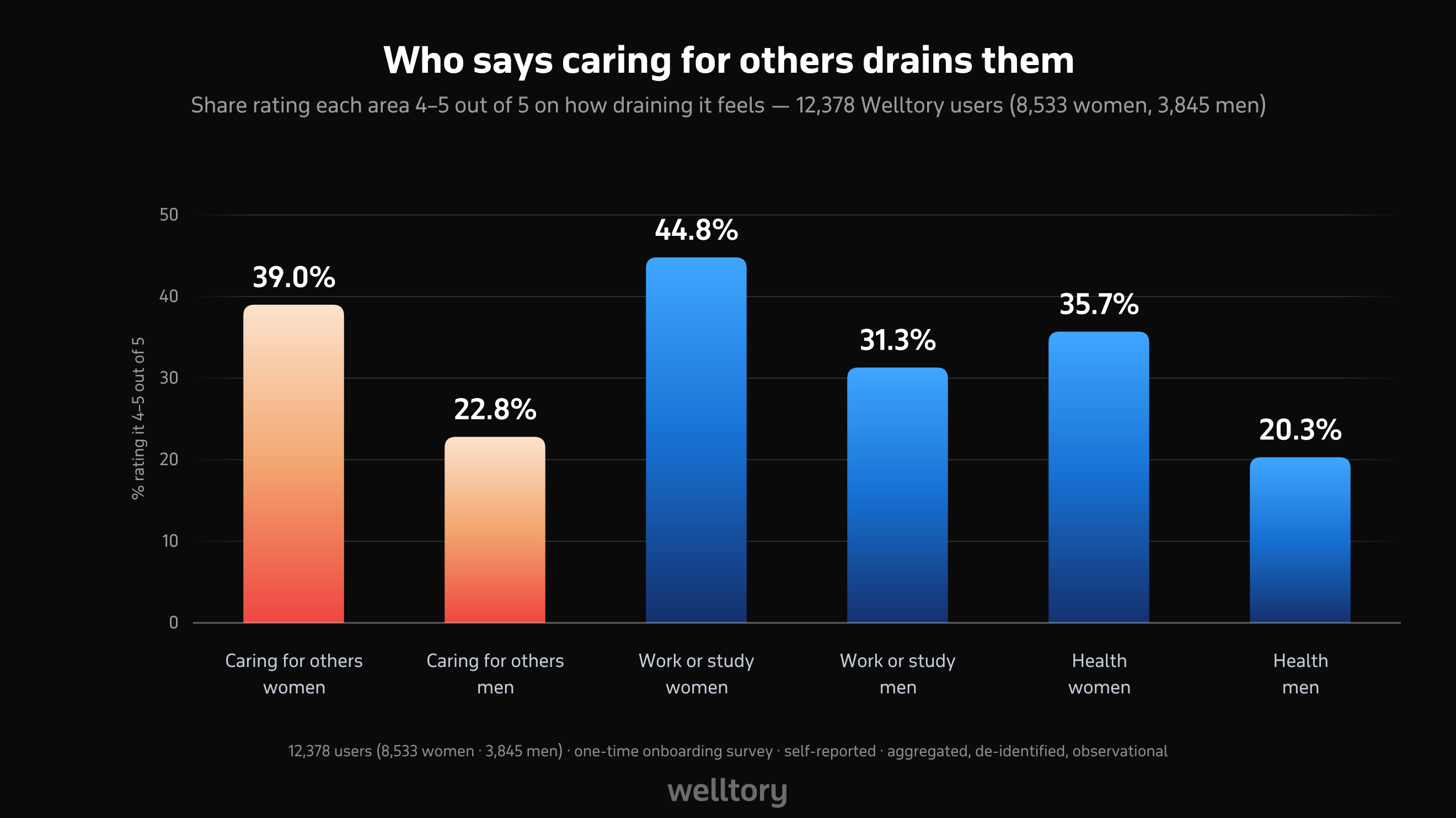
Caring for others was where the gap was widest in relative terms. 39.0% of women rated it highly draining, compared with 22.8% of men — a gap of 16.2 percentage points, with women about 1.7 times as likely to give it a top rating.
The same direction showed up everywhere else. For work or study, the figures were 44.8% of women against 31.3% of men. For taking care of their own health, 35.7% against 20.3%.
The overlap is the number we find most telling. 24.6% of women rated both work and caring for others as highly draining — about one in four. Among men, it was 12.1%, roughly one in eight. That is the group who finish one shift and start another, and who are most likely to be carrying the mental load described above on top of a job.
A note on the data. This is observational, self-reported information from a one-time onboarding survey, analysed only as aggregated and de-identified results. Welltory users are not a random sample of the population, and people who install a wellness app may well be more stretched than average. Women rated all three areas as more draining than men did, so part of the gap may reflect differences in how people report strain rather than differences in load. And the survey asks how draining an area feels — it does not measure who does which chores, or how many hours anyone spends on them.
What the numbers do say is modest but useful: if caring for others feels like a second job, a large share of people describe the same thing. It is not a private failure to cope.
What chronic low-grade load does to sleep and recovery
The mental load does not clock off at bedtime, and neither does the caring.
Sociologists David Maume, Rachel Sebastian and Anthony Bardo interviewed 25 working-class, dual-earner couples with children for a 2010 paper in Gender & Society (doi.org). Most of the men treated their role as provider as a right to longer, unbroken sleep. Most of the women, as primary caregivers, had their sleep shortened and interrupted by responding to family members during the night and early in the morning — and this held whether the women worked day shifts or nights. The authors described cumulative sleep debt and called sleep deficits "another manifestation of gender inequality".
When one person carries the household's background thinking for months, three things tend to follow. Falling asleep takes longer, because an open to-do list is exactly the kind of thought that returns when the lights go off. Sleep fragments, because being the one who hears the child, remembers bin night at 11 pm and gets up first breaks a night into pieces. And recovery never quite finishes, because rest days are also admin days, so Monday starts as tired as Friday ended.
It is the same shape as compassion fatigue in caregiving jobs, and as the cost of never fully logging off that we described in always-on culture: not one heavy day, but load that never gets a full stop.
None of this means your partner is doing it on purpose. It means the arrangement has a physiological cost, and the cost lands on one body.
How do you talk about weaponized incompetence without a fight?
Most arguments about chores go wrong in the same place: they become arguments about character. "You're lazy." "You're a control freak." Both people defend themselves, and the dishes stay where they are.
Pick a calm moment, not the moment of the overflowing bin. A conversation started in frustration is heard as an attack.
Describe the work, not the person. "I've noticed that I'm the one who tracks the kids' appointments, the food shop and the bills, and I'm running out of room in my head" is harder to argue with than "You never do anything."
Make the invisible part visible. Daminger's four stages are a useful tool here. Take one area — say, children's clothes — and list what it involves: noticing they have outgrown their shoes, finding options, choosing, ordering, checking they fit, returning the pair that did not. Many partners who "help" have only ever seen the ordering step.
Hand over whole tasks, not steps. This is the most important one. "Can you order the shoes?" keeps you as manager. "The kids' clothes are yours now — noticing, buying, returning, all of it" moves the whole thread.
Accept a different standard. If the task is now theirs, it will be done their way. Stepping back in to fix it — refolding the towels, redoing the shopping list — hands it straight back to you.
Agree to check in, not to monitor. A short weekly look at how the new split is going works better than silent tallying. Monitoring was the invisible job to begin with; do not keep it.
Ask what is getting in the way. If a partner keeps failing at a task, ask whether something else is going on — stress, low mood, ADHD, an exhausting job. The answer may change the plan, not the principle.
And for the partner hearing this for the first time: having been a delegatee doesn't make you a bad person. Most people in that position never saw the list. The useful response is not guilt; it is taking one whole thread and keeping it.
If nothing moves after several honest attempts, a couples therapist is a reasonable next step: a neutral third person can often say what neither partner can hear from the other.
When this is not about chores
Unequal housework on its own is common and fixable. It becomes a different problem when it sits alongside control. Warning signs include:
one partner controlling the money, or your access to it;
being cut off from friends or family, or made to account for your time;
checking your phone, messages or location;
punishing, sulking or threatening when things are not done "properly";
belittling you in front of others or the children;
feeling afraid of how the other person will react.
This pattern — a web of behaviours that limit someone's freedom — is sometimes called coercive control, and it is a form of abuse even when there is no physical violence. It is not something a chore chart can fix, and it is not your fault.
If any of this sounds familiar, the National Domestic Violence Hotline is free and confidential, available 24 hours a day: call 1-800-799-7233 or text START to 88788. They can help you think through options and safety, whether or not you want to leave. If you are ever in immediate danger, call 911.
How to bring this up with your doctor
The mental load is not a diagnosis. But its effects — exhaustion, poor sleep, low mood — are things a clinician can help with, and worth checking for other causes.
What to track for two weeks before the appointment:
how long you slept and how often you woke;
your energy on waking, on a simple 0–10 scale;
the days that felt heaviest, and what was on them;
mood, including any days of feeling flat, hopeless or tearful.
What to say, in one or two sentences: "I've been exhausted most days for several months. My sleep is broken, and I'm carrying most of the planning and caring at home on top of work." That gives the clinician both the symptom and the context.
What to ask:
"Could anything else be contributing to this tiredness, and are any tests worth doing?" Fatigue has many causes, from low iron to thyroid problems to sleep apnoea.
"Could this be depression or burnout, and what would help?"
"Is there a talking therapy or a couples service you would recommend?"
If you suspect ADHD in yourself or a partner: "How would we get an assessment?"
If you feel hopeless or have thoughts of harming yourself, do not wait for a routine appointment. In the US, you can call or text 988 to reach the Suicide & Crisis Lifeline at any time.
Before you blame yourself, check what your body already recorded
The feeling usually arrives first, and it arrives as a verdict about yourself. I'm bad at coping. Other people manage a job and a family. I'm tired for no reason. I'm turning into a nag.
Now look at what your body has been recording while you were thinking that.
The cause is often visible. It might be nights that are shorter or more broken than they used to be. Stress that peaks not during the working day but between six and ten in the evening, when the second shift begins. A Saturday that looks like a rest day on the calendar and like a workday in your heart rate. An energy level that sinks through the week and never fully recovers at the weekend.
That is not a personal failure. It is what a body does when it carries an unfinished list for months without a full stop.
So give yourself permission to stop treating this as a willpower problem, and change one thing. Just one: hand over one whole thread — the food shop, the kids' clothes, the bills — with the noticing and checking included. Not help with it. Ownership of it.
Then watch the trend for one to two weeks, not a single night. Are your evenings a little calmer? Is your sleep a little less broken on the days you are not holding that thread? If the answer is yes, you have evidence — for yourself, and for the next conversation. If nothing moves, that is information too, and a reason to look further with a clinician.
How Welltory helps — and what it cannot do
The limits first. Welltory is a general wellness product with no regulatory clearance. It does not diagnose anything, cannot see who does the dishes, and cannot tell whether a partner's behaviour is deliberate. It should not be used as evidence against anyone.
What it can do is show your own side of the picture, in numbers that are hard to wave away as "just in your head":
Sleep — how long you slept and how broken the night was.
Stress minutes — a physiological stress-load estimate from heart rate data, showing which hours carry the most.
Battery — an energy estimate that shows whether rest days actually restore you.
Resting heart rate and HRV — recovery signals, best read as trends against your own baseline.
Tags and notes — you can mark days with events, people or tasks, such as "hosted family", "bin night argument" or "partner took the school run". In My Patterns, Welltory can show which tagged situations tend to come before stressful stretches.
That last part is the most useful here. After two or three weeks of tagging, you may see that the evenings after a full solo bedtime routine, or the Sundays spent on admin, line up with your most stressful stretches — or you may find that the real drain is somewhere else, such as your commute or a particular kind of workday. If most of your fatigue seems to come from the job rather than the home, our piece on being tired after work every day looks at that side.
One caution: these signals are non-specific. A cold, a late coffee or a bad night's sleep for any reason move them the same way a heavy evening does. Read the pattern across weeks, not a single morning, and use it to inform a conversation — not to win one.
How we made it
Made with AI tools, then edited and fact-checked by the Welltory team. See our Editorial & AI policy.
Data analysis by Jane Smorodnikova, co-founder of Welltory and the person who built the methodology behind how we read physiological data.
Written by Tatsiana Yashyna.


Discounts for blog readers: up to 36% off
See what affects your energy, stress, sleep, and daily state with Welltory
This article is for educational purposes only and is not medical, psychological or legal advice. Weaponized incompetence and the mental load are descriptions of relationship and workload patterns, not diagnoses. Persistent exhaustion, broken sleep or low mood need assessment by a clinician, as they can have many causes. If a relationship involves fear, threats, monitoring or control, contact the National Domestic Violence Hotline at 1-800-799-7233 or text START to 88788; for a mental health crisis in the US, call or text 988. Welltory holds no regulatory clearance, is a general wellness product, and does not diagnose. Sources were retrieved on 29 September 2026.
Was this helpful?
Ask AI for a summary of page


Written by Jane Smorodnikova

The founder and CEO of Welltory. A recognized tech leader with two Master's degrees and experience at MIT, she has scaled Welltory to over 17 million users.
Written by Tatsiana Yashyna

Deputy COO at Welltory. With a background in medicine and years of working with health data, she translates research and real physiological signals — sleep, stress, heart rate, and hormones — into clear, evidence-based explanations that help people understand what their bodies are telling them.
References
- Daminger A. The cognitive dimension of household labor. American Sociological Review 2019;84(4):609–633. https://doi.org/10.1177/0003122419859007
- Aviv E, Waizman Y, Kim E, Liu J, Rodsky E, Saxbe D. Cognitive household labor: gender disparities and consequences for maternal mental health and wellbeing. Archives of Women's Mental Health 2025;28(1):5–14. https://doi.org/10.1007/s00737-024-01490-w
- Ciciolla L, Luthar SS. Invisible household labor and ramifications for adjustment: mothers as captains of households. Sex Roles 2019;81:467–486. https://doi.org/10.1007/s11199-018-1001-x
- Dean L, Churchill B, Ruppanner L. The mental load: building a deeper theoretical understanding of how cognitive and emotional labor overload women and mothers. Community, Work & Family 2022;25(1):13–29. https://doi.org/10.1080/13668803.2021.2002813
- McLean C, Musolino C, Rose A, Ward PR. The management of cognitive labour in same-gender couples. PLOS ONE 2023;18(7):e0287585. https://doi.org/10.1371/journal.pone.0287585
- Brosschot JF, Gerin W, Thayer JF. The perseverative cognition hypothesis: a review of worry, prolonged stress-related physiological activation, and health. Journal of Psychosomatic Research 2006;60(2):113–124. https://doi.org/10.1016/j.jpsychores.2005.06.074
- Maume DJ, Sebastian RA, Bardo AR. Gender, work-family responsibilities, and sleep. Gender & Society 2010;24(6):746–768. https://doi.org/10.1177/0891243210386949
- US Bureau of Labor Statistics. American Time Use Survey — 2025 results. News release, 25 June 2026. https://www.bls.gov/news.release/atus.htm
- Herrmann SD, Willis EA, Ainsworth BE, et al. 2024 Adult Compendium of Physical Activities: a third update of the energy costs of human activities. Journal of Sport and Health Science 2024;13(1):6–12. https://doi.org/10.1016/j.jshs.2023.10.010
- Piercy KL, Troiano RP, Ballard RM, et al. The Physical Activity Guidelines for Americans. JAMA 2018;320(19):2020–2028. https://doi.org/10.1001/jama.2018.14854

