
Energy vampires: how to tell who drains you, and what your body already knows
Energy vampire is not a scientific term, but the drain it describes is real: emotional contagion, social stress and the effort of staying on guard all leave a trace in the body. Sometimes the cause is a person, and sometimes it is a week that had already emptied you.

Short answer
An energy vampire is not a clinical or scientific term. It is a popular label for someone after whom you reliably feel drained, and that drain has measurable roots: emotional contagion, social stress and the effort of holding yourself together. If the drain follows one person across most meetings, look at that relationship; if everyone drains you for two weeks or more, look at your sleep and load first.
Before you blame yourself, check what your body already recorded. Feeling wiped out after certain people is not a character flaw and not weakness. It is a cost your nervous system pays, and it tends to leave a trace in your sleep, your stress load and your heart rate long before you find words for it.
Note: this article explains a popular idea and the research behind it. It is not medical or psychological advice and does not diagnose anyone, including the people in your life. If a relationship involves fear, control or harm, the section on control and abuse below lists where to get help.
What is an energy vampire, and is it a real thing?
The phrase comes from pop psychology and self-help, not from a research lab. You will not find "energy vampire" or "emotional vampire" in any diagnostic manual, and nobody has a blood test for it. People use it to describe a pattern: a certain friend, relative or colleague, and afterwards you feel flat, foggy or irritable for the rest of the day.
That the label is unscientific does not mean the experience is imaginary. What people call an energy vampire usually describes something real that research does study under less dramatic names: emotional contagion, social-evaluative stress, ambivalent relationships, emotional labour and caregiving strain. Each of these has a body of evidence behind it, and some of that evidence is physiological — blood pressure, cortisol, heart rate.
The problem with the label is what it does to the story. "Vampire" suggests a person who takes something from you on purpose. Usually that is not what is happening. The draining person may be anxious, grieving or overwhelmed themselves, or the drain may come from what you do in their presence: stay alert, manage their mood, hide your reactions. Those are efforts, and efforts cost energy.
So a more useful question than "is this person an energy vampire?" is "what happens to me around this person, and does it happen reliably?" That question can be answered. The label cannot.
The same person can also be draining in one season and easy in another — a friend mid-divorce, a parent after a diagnosis. A fixed label hides that.
What are the signs of an energy vampire?
Because this is not a diagnosis, the useful signs are about your side of the interaction, not a checklist for judging someone else.
You feel worse after, fairly consistently. Not once after a hard conversation, but most times.
You feel tense before. Dread before a call, rehearsing what you will say. Anticipation is part of the load.
The conversation runs in one direction. You listen, reassure and advise; your own news gets little room. Over months this turns a relationship into a service.
You monitor yourself closely. You choose words carefully, avoid certain topics and keep your face neutral. That kind of self-control is effortful, and the research below shows it has a physical cost.
Your boundaries do not hold. You say you have ten minutes and it becomes an hour. You decline, and the request comes back in a new form.
Recovery takes time. You need the rest of the evening, or the next morning, to feel like yourself again.
You notice these signs across different people, too. This one points somewhere else: if almost every interaction drains you lately, the person is probably not the main cause (more on that below).
None of these signs proves anything about the other person's intentions. They describe a cost to you, and that is reason enough to act.
Why do some people leave you so drained?
Several well-studied processes sit under the feeling. They often stack.
Emotions are contagious. Elaine Hatfield, John Cacioppo and Richard Rapson described emotional contagion as the tendency to automatically mimic another person's facial expressions, voice, posture and movements, and, as a result, to converge with them emotionally (doi.org). You do not decide to catch someone's anxiety; your face and body match theirs, and feelings follow.
Stress can pass from one body to another. In a study led by Veronika Engert, people simply watched someone go through a standard laboratory stress test — a mock job interview and mental arithmetic in front of a panel. Still, 26% of the observers showed a significant rise in cortisol, a hormone released under stress. When the person under stress was their romantic partner, that share was 40%; when it was a stranger, 10%. Watching through a one-way mirror produced a response in 30% of observers, and even watching on video did so in 24% (doi.org). The closer you are to someone, the more of their stress your body tends to take on.
Being judged is one of the strongest stressors there is. A meta-analysis by Sally Dickerson and Margaret Kemeny pooled 208 laboratory studies of stress and cortisol. The tasks that produced the largest cortisol responses, and the longest recovery times, were those that combined social-evaluative threat — the sense that others could judge you negatively — with a lack of control (doi.org). A relative who comments on your weight or a manager who critiques you in public recreates that combination in everyday life.
Mixed relationships can be especially hard on the body. Julianne Holt-Lunstad and colleagues fitted 102 healthy adults with ambulatory blood pressure monitors for 3 days, taking a reading 5 minutes into each social interaction. Interactions with people the participants felt ambivalent about — people who were both helpful and upsetting — came with the highest systolic blood pressure. Time with family and spouses, on average, came with lower readings (doi.org). In a later study of 107 adults who each brought a same-sex friend to the lab, people showed the greatest blood pressure reactivity when discussing a negative event with an ambivalent friend rather than a supportive one. Those who brought ambivalent friends also had higher resting heart rates and lower respiratory sinus arrhythmia, a measure related to heart rate variability (doi.org). The authors' reading was simple: people may not be able to fully relax around someone they cannot quite trust.
This is why the "energy vampire" is often a loved one: someone we care about and cannot predict.
Hiding your reactions costs you — and them. Emma Butler, James Gross and colleagues paired women who did not know each other and asked them to discuss an upsetting topic. When one partner was told to suppress her emotional expression, communication suffered and blood pressure rose — in the partner, and in a second study in both women. Suppression also reduced rapport (doi.org). Keeping a neutral face around a difficult person is reasonable in the moment. It is not free.
Emotional labour is a documented source of exhaustion. In service work, "surface acting" means displaying emotions you do not feel. A meta-analysis by Ute Hülsheger and Anna Schewe drew on 95 independent studies and found that surface acting and the clash between felt and required emotions were substantially linked to impaired well-being, including emotional exhaustion, with correlations between 0.39 and 0.48 (doi.org). Many people do the same at home, performing calm or patience for someone else.
Hostility has a measurable physical cost. In a hospital-based study of 42 married couples, Janice Kiecolt-Glaser and colleagues made small blister wounds and then had couples discuss a disagreement. Couples who behaved with consistently high hostility healed at 60% of the rate of low-hostility couples (doi.org). Repeated friction reaches the body, not only the mood.
Caring for someone is its own kind of load. A meta-analysis by Martin Pinquart and Silvia Sörensen integrated findings from 84 articles comparing caregivers of frail older adults with non-caregivers. Caregivers reported markedly more stress and more depression, with the biggest gaps among people caring for someone with dementia (doi.org). Sometimes the person who drains you is someone who needs you, and that deserves compassion for both of you. Our article on compassion fatigue covers what happens when that kind of care runs for months.
Five draining patterns, described as behaviours
Pop articles sort energy vampires into types: the narcissist, the victim, the drama queen. Labelling a person from the outside is guesswork, and clinical labels belong to clinicians. Behaviours are what you can observe and respond to.
The one-way conversation. Every talk centres on their problems. Often this comes from distress, not selfishness, but the cost to the listener is the same.
Constant criticism or comparison. Remarks about your choices, body, partner or job, often framed as concern or a joke: social-evaluative threat in small, repeated doses.
The permanent crisis. There is always an emergency that needs you now. Each may be real; the pattern drains you because you never get to stand down.
Unpredictable warmth. Kind one day, cutting the next — the ambivalent relationship from the blood pressure studies. You stay on guard because you cannot tell which version you will meet.
Guilt as a lever. "After everything I've done for you." This sits closest to control; when it comes with threats, isolation or fear, it is no longer a question of energy (see the section on control and abuse).
A draining pattern is not the same as a bad person. You can decide that a behaviour costs you too much without deciding who someone is.
Is it them, or are you just running on empty?
Here is the part most articles skip. Sometimes the "vampire" is not a person at all. It is a battery that was already low.
Tiredness lowers your tolerance for people. Short on sleep, ordinary demands feel heavier, and you may read your own depletion as something they did to you.
Stress stacks. A demanding week, a sick child, a bad night — each draws on the reserves you use to be patient. By Thursday, someone who would not bother you on a Sunday feels exhausting.
A simple test separates the two. Ask: does the drain follow the person, or does it follow the week?
If you feel drained after one specific person across good weeks and bad, rested nights and short ones, the relationship is worth looking at.
If you feel drained after nearly everyone, and it started around the time your sleep, workload or health changed, the problem is probably your reserves, not your people.
If both are true — a draining relationship during an already heavy stretch — they amplify each other, and easing either one helps.
This is not a reason to dismiss what you feel; it is a reason to check before acting on it. Cutting off a friend because of a month of short nights is hard to undo. Why your body keeps holding stress when you cannot relax explains how load accumulates in the background, and if the drain has become constant, the signs of burnout are worth reading next to this article.
What drains people most: what our data shows
When people join Welltory, they are asked how draining different areas of their life feel, on a scale from 0 to 5. We looked at the answers of 12,387 users and counted how many rated each area 4 or 5 — the top of the scale.
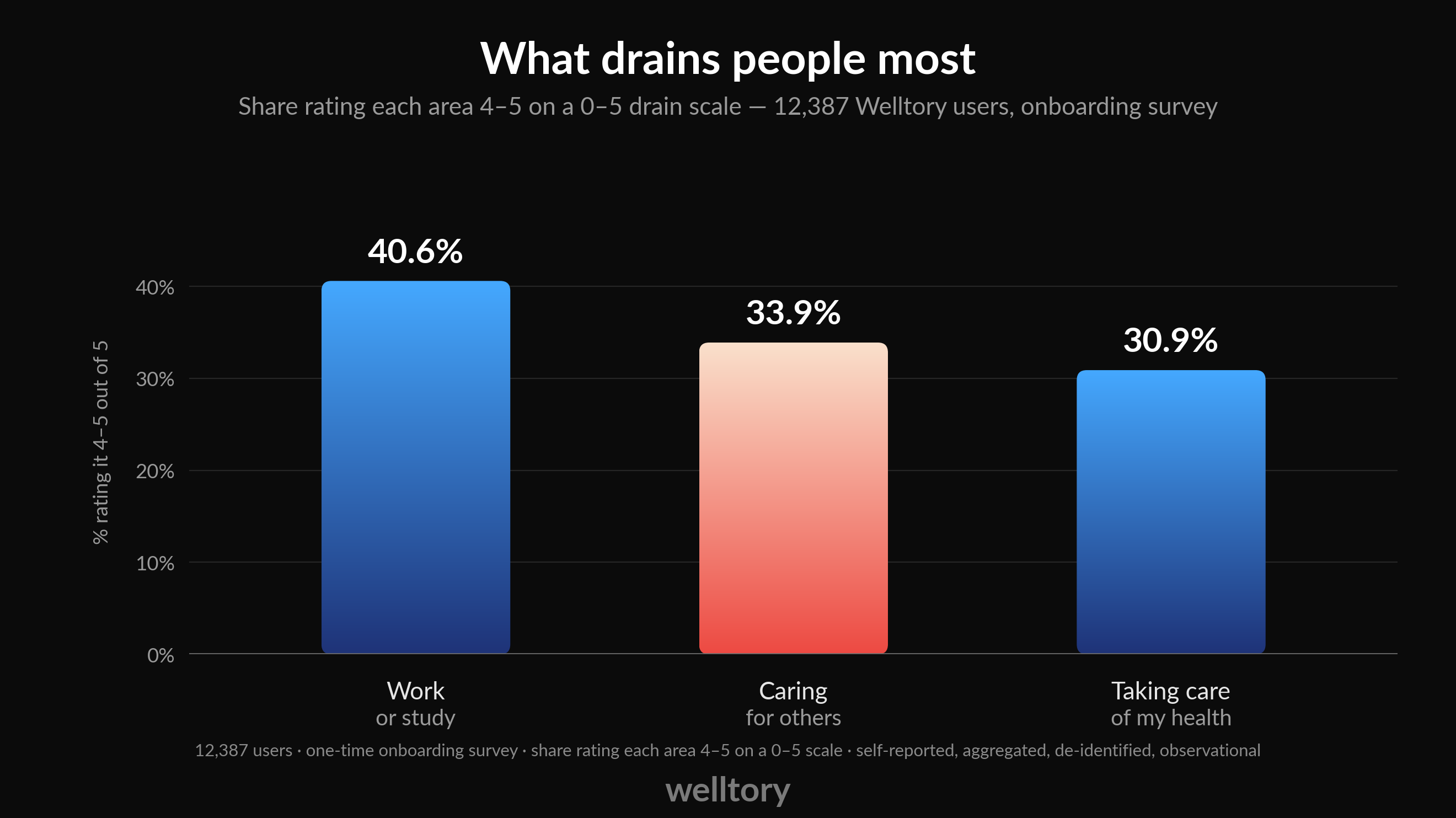
Work or study came first: 40.6% of people rated it highly draining. That is roughly two in five.
Caring for others came next, at 33.9% — about one in three. This is the area closest to what people mean by energy vampires: the parent who needs daily help, the partner in a hard stretch, the friend in crisis.
Taking care of their own health came third, at 30.9%. For many people, even the work of staying well — appointments, symptoms, routines — is a load in itself.
The overlap is where it gets interesting. 20.7% of people rated both work and caring for others as highly draining. One in five is carrying two heavy loads at once, so a hard conversation with a relative lands on what is left after the working day.
So when a particular person seems to drain you, part of the feeling may be them and part may be everything else you carry. Our data cannot separate those parts for any individual; it does show how common it is to carry several drains at once.
A note on the data. These are self-reported answers to a one-time onboarding survey, aggregated and de-identified; no individual answers are shown or shared. They describe how draining areas of life feel to people, not who, if anyone, is doing the draining, and they say nothing about physiology. Welltory users are not a random sample of the population, and people who install a wellness app may be more stretched than average. The survey was answered once, so it cannot show how these ratings change over time. This is observational, descriptive data, not evidence of cause.
What to do: notice, name, limit, step back
You do not need to confront anyone or end anything to start. The most effective approach tends to be gradual, and it starts with you.
1. Notice. For two weeks, jot down a word or two after interactions that leave a mark, good or bad: who, how you felt after, how you slept that night. Memory is unreliable here — one dramatic evening can overshadow ten easy ones. Then look at what repeats, and check whether the draining days were also your shortest nights or heaviest workdays.
2. Name the behaviour, not the person. "When we talk, it's mostly about your work and I leave tired" is something a friend can hear. "You're an energy vampire" is not.
3. Set a limit you can keep. Limits are about your own actions, not about controlling theirs. A few that tend to work:
Shorten the time: a 20-minute call instead of an open-ended one, a visit with an end time.
Change the setting: a walk or a café instead of a long evening at home.
Change the channel: a message you can answer when you have capacity, instead of an immediate call.
Protect recovery: avoid scheduling the hardest person on the most loaded day of your week, and leave the next hour free.
Keep one topic off the table: "I'm not going to discuss my weight / my marriage / my job. Tell me about your garden."
4. Say it once, plainly. "I love you, and I can talk for twenty minutes tonight." Over-explaining invites negotiation.
5. Step back if nothing changes. If a relationship keeps costing far more than it gives, it is reasonable to see someone less, only in groups, or to let a friendship fade. With family, stepping back often means changing the format rather than cutting contact — and that decision is yours, at your own pace.
6. Refill the other side. In the same studies that linked ambivalent relationships with higher blood pressure, time with family and spouses came with lower readings on average. Time with people who leave you lighter is part of recovery, and loneliness carries its own cost — see loneliness and the nervous system.
If the draining person is someone you care for, you may not be able to shorten the time. Then the levers are support for you: respite care, shared tasks, a caregiver group, and a conversation with your own doctor.
When draining becomes control or abuse
Sometimes "this person drains me" describes something more serious than a difficult personality. Pay attention if the relationship includes:
fear of their reaction, or changing your behaviour to avoid an outburst;
control over your money, phone, movements, friends or time;
being cut off from family or friends, gradually or suddenly;
threats — to you, to themselves, to children or pets, or to reveal private information;
being told that you are too sensitive, that things did not happen the way you remember, or that you caused their behaviour;
any physical harm, forced sexual contact, or damage to your things.
These are signs of control or abuse, not of an energy mismatch. Limits and honest talks are not safe strategies when someone may retaliate. In the US, the National Domestic Violence Hotline is free, confidential and open 24/7: call 1-800-799-7233 or text START to 88788. You can contact them just to talk through whether what is happening is abuse. If you are in immediate danger, call 911.
If the relationship has left you feeling hopeless, or you have thoughts of harming yourself, call or text 988 to reach the Suicide & Crisis Lifeline.
How to talk to your doctor or therapist
A draining relationship is rarely a medical issue in itself. What it does to your sleep, mood and stress load can be, and a clinician or therapist can help you sort out which part is which.
What to track before the appointment (two weeks is enough):
which interactions left you drained, and how long recovery took;
your sleep each night, especially after difficult interactions;
physical signs: headaches, stomach upset, a racing heart, tension, changes in appetite;
your mood across the whole period, not only after contact with one person.
What to say:
"After time with a certain person, I feel exhausted for the rest of the day, and it has been going on for [how long]."
"I've started to feel drained after almost everyone, not only one person." This sentence matters: it points towards burnout, low mood or a physical cause rather than a relationship.
"I'm caring for [someone], and I'm not sure how much longer I can keep this up."
If it applies: "I feel afraid of how this person might react." A clinician can connect you with safety resources.
What to ask:
Could low mood, anxiety or burnout be part of what I'm feeling?
Is there a physical reason I might be more tired than usual — for example, a sleep problem or something in my blood work?
Would a therapist help me set limits with this person, and what approach would you suggest?
Are there caregiver support services I could use?
With a therapist, the same record helps: specific examples make it easier to work on the pattern rather than a vague sense that something is wrong.
Before you blame yourself, check what your body already recorded
Many people who feel drained by others turn it on themselves. "I'm too sensitive." "I'm a bad friend." "Something is wrong with me that I can't handle my own mother for an hour." The label "energy vampire" can even become a second accusation: if I keep attracting these people, maybe the problem is me.
Look at what is visible first. A drain after a person usually has a cause your body can record: a short night before the visit, a week of heavy stress load, a relationship that keeps you on guard, a caregiving role that never switches off. None of these are flaws in you. They are loads, and loads can be measured and changed.
So give yourself permission to take the feeling seriously without turning it into a verdict — on them or on you. Then pick one lever and change only that:
move the hardest call off your most loaded day;
put an end time on one recurring visit;
protect one earlier night before a demanding family event;
or add one interaction a week with someone who leaves you lighter.
Watch the trend for one to two weeks. If the drain eases, you have learned something useful about the load. If it does not, that is useful too: the cause may sit elsewhere, and it may be worth a conversation with a professional.
How Welltory helps — and what it cannot do
The limits first. Welltory is a general wellness product with no regulatory clearance. It does not diagnose anything, and it cannot tell you whether a person is good or bad for you. It does not know who you were with unless you tell it, and it cannot see the content of a conversation. Your body's data is one signal among many, never a verdict on someone else.
What it can show is the physical side of your days, much of it read against your own usual rather than a population average: how much of your day you spent in physiological stress (stress minutes), how you slept, your Battery score for energy, your resting heart rate and your heart rate variability (HRV). Those are the traces that a draining week, or a draining evening, tends to leave.
The part that speaks most directly to "who drains me" is tagging. When Welltory detects a stress or recovery episode, you can describe what happened — tap a suggested tag, type a few words, or just talk: "call with Mom", "dinner with a friend", "argument". Tags only come from episodes your body went through. Over about two to three weeks of noting what is happening, My Patterns can show which tagged situations tend to come before stressful stretches, which tend to come before recovery, and which rare ones hit hard when they do happen.
That turns a blurry feeling into something you can look at. You may find that the person you dreaded is not the main drain — the late night before seeing them is. Or that one relationship keeps appearing before stress, week after week. Either answer is worth having, and neither is a verdict on anyone. If your data points towards general overload rather than any person, the article on the difference between emotional and physical stress is a good next read.
How we made it
Made with AI tools, then edited and fact-checked by the Welltory team. See our Editorial & AI policy.
Data analysis by Jane Smorodnikova, co-founder of Welltory and the person who built the methodology behind how we read physiological data.
Written by Tatsiana Yashyna.


Discounts for blog readers: up to 36% off
See what affects your energy, stress, sleep, and daily state with Welltory
This article is for educational purposes only and is not medical or psychological advice. Energy vampire is an informal label, not a diagnosis, and nothing here should be used to diagnose another person. If a relationship involves fear, threats, control or harm, contact the National Domestic Violence Hotline (1-800-799-7233, text START to 88788) or call 911 in an emergency; for a mental-health crisis, call or text 988. Welltory holds no regulatory clearance, is a general wellness product, and does not diagnose. Sources were retrieved on 29 September 2026.
Was this helpful?
Ask AI for a summary of page


Written by Jane Smorodnikova

The founder and CEO of Welltory. A recognized tech leader with two Master's degrees and experience at MIT, she has scaled Welltory to over 17 million users.
Written by Tatsiana Yashyna

Deputy COO at Welltory. With a background in medicine and years of working with health data, she translates research and real physiological signals — sleep, stress, heart rate, and hormones — into clear, evidence-based explanations that help people understand what their bodies are telling them.
References
- Hatfield E, Cacioppo JT, Rapson RL. Emotional contagion. Current Directions in Psychological Science 1993;2(3):96–100. https://doi.org/10.1111/1467-8721.ep10770953
- Engert V, Plessow F, Miller R, Kirschbaum C, Singer T. Cortisol increase in empathic stress is modulated by emotional closeness and observation modality. Psychoneuroendocrinology 2014;45:192–201. https://doi.org/10.1016/j.psyneuen.2014.04.005
- Dickerson SS, Kemeny ME. Acute stressors and cortisol responses: a theoretical integration and synthesis of laboratory research. Psychological Bulletin 2004;130(3):355–391. https://doi.org/10.1037/0033-2909.130.3.355
- Holt-Lunstad J, Uchino BN, Smith TW, Olson-Cerny C, Nealey-Moore JB. Social relationships and ambulatory blood pressure: structural and qualitative predictors of cardiovascular function during everyday social interactions. Health Psychology 2003;22(4):388–397. https://doi.org/10.1037/0278-6133.22.4.388
- Holt-Lunstad J, Uchino BN, Smith TW, Hicks A. On the importance of relationship quality: the impact of ambivalence in friendships on cardiovascular functioning. Annals of Behavioral Medicine 2007;33(3):278–290. https://doi.org/10.1007/BF02879910
- Butler EA, Egloff B, Wilhelm FH, Smith NC, Erickson EA, Gross JJ. The social consequences of expressive suppression. Emotion 2003;3(1):48–67. https://doi.org/10.1037/1528-3542.3.1.48
- Hülsheger UR, Schewe AF. On the costs and benefits of emotional labor: a meta-analysis of three decades of research. Journal of Occupational Health Psychology 2011;16(3):361–389. https://doi.org/10.1037/a0022876
- Kiecolt-Glaser JK, Loving TJ, Stowell JR, Malarkey WB, Lemeshow S, Dickinson SL, Glaser R. Hostile marital interactions, proinflammatory cytokine production, and wound healing. Archives of General Psychiatry 2005;62(12):1377–1384. https://doi.org/10.1001/archpsyc.62.12.1377
- Pinquart M, Sörensen S. Differences between caregivers and noncaregivers in psychological health and physical health: a meta-analysis. Psychology and Aging 2003;18(2):250–267. https://doi.org/10.1037/0882-7974.18.2.250

