

Short Answer
If your body clock runs late, forcing yourself up at 7 a.m. can push your rhythm later instead of earlier — because morning light only shifts your clock forward once it lands after your core body-temperature minimum, which sits roughly two hours before your usual wake time. Get bright light too early, before that point, and you drag your clock the wrong way. So the fix isn't willpower, it's timing: get light right after your actual wake time, move your wake-up earlier by about an hour a week, take low-dose melatonin (~0.5 mg) a few hours before your target bedtime rather than at lights-out, and dim the evening. This matters beyond feeling rested. In our own data from 4,625 Welltory users, the bigger the gap between weekday and weekend sleep timing, the lower people's weekday morning energy — and misaligned, irregular sleep is also linked in the research literature to reduced insulin sensitivity and higher type-2-diabetes risk, independent of how long you sleep.
Cohort Finding — Block 2: What Welltory's data shows
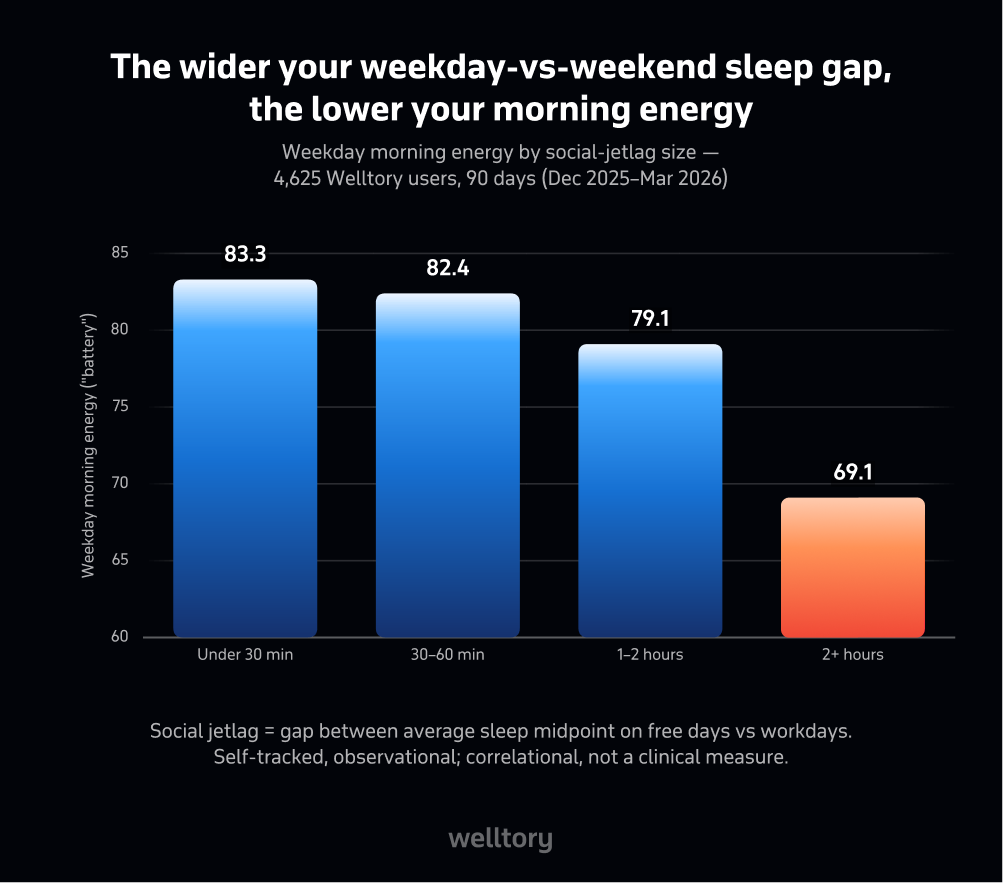
Across 4,625 Welltory users with quality wearable data over a 90-day window (December 15, 2025 – March 14, 2026), we measured each person's "social jetlag" — the gap between their average sleep midpoint on free days (Saturday and Sunday) and on workdays. For most people the gap was small — a median of 27 minutes — but 17.7% carried a gap of an hour or more.
The wider that weekday-to-weekend gap, the lower a person's weekday morning energy — the "battery" readiness score Welltory calculates each morning — in a clean, stepwise gradient:
| Weekday ↔ weekend sleep gap | Users | Weekday morning energy | Weekday stress load | Resting HR |
|---|---|---|---|---|
| Under 30 min | 2,474 | 83.3 | 281 min | 62.6 bpm |
| 30–60 min | 1,332 | 82.4 | 294 min | 63.4 bpm |
| 1–2 hours | 726 | 79.1 | 292 min | 63.5 bpm |
| 2+ hours | 93 | 69.1 | 328 min | 66.0 bpm |
People with a gap of an hour or more ran about 6% lower morning energy and 5% more weekday stress load than the steady-schedule group. At the extreme — a 2+ hour gap — the cost was steeper: morning energy roughly 17% lower, weekday stress about 15% higher, and resting heart rate around 3 bpm higher. The clearest relationship was with morning energy (correlation r ≈ −0.19).
One honest caveat: the morning HRV score barely moved across these groups. The cost of an irregular schedule showed up in readiness, energy, and stress load — not in that particular HRV number. So the takeaway here is "misaligned timing quietly drains your energy," not "it tanks your HRV."
Cohort Finding — Block 3: Methodology Box
This analysis included 4,625 self-tracked Welltory users with quality-controlled wearable data (Apple Watch / iPhone Health + Welltory), drawn from a cohort of 5,061 users and 448,496 user-days over a 90-day window (December 15, 2025 – March 14, 2026). For each night we computed the sleep midpoint — the halfway point between sleep onset and wake. Social jetlag was defined as the absolute difference between a user's average sleep midpoint on free days (Saturday/Sunday wake) and on workdays. Midpoints were computed in UTC; the within-person weekday-versus-weekend difference is unaffected by time zone. Quality gates required reliable sleep-border detection, sleep duration over one hour, and at least 10 workday and 4 free-day nights per user. Outcomes are each user's weekday averages of morning energy ("battery"), stress minutes, resting heart rate, sleep score, and morning HRV score. This is an observational, self-selected app population, and the analysis is correlational — it cannot prove that irregular timing caused the lower energy. Every metric is a physiological signal, not a clinical diagnosis.
Cohort Finding — Block 4: Story Block
One anonymized pattern from the 2+ hour group looked familiar: a late-chronotype desk worker whose sleep midpoint drifted almost two hours later on weekends than on workdays. Monday through Friday they forced an early alarm, and their morning energy sat well below the cohort's steady-schedule average — flat mornings, a slow start, coffee doing the heavy lifting. Nothing dramatic changed overnight. What helped was shrinking the gap: keeping weekend wake-ups within about an hour of the weekday time and getting outside for light soon after actually getting up. Over several weeks their weekday mornings stopped starting from empty. The number that moved first wasn't weight or even sleep length — it was morning energy.
What your body clock actually is — and why 8 hours at the wrong time isn't the same as 8 hours
Your body runs on an internal 24-hour clock, set by a master pacemaker in the brain — the suprachiasmatic nucleus — that keeps your sleep, alertness, hormones, body temperature, and metabolism roughly in sync with the day. (nigms.nih.gov) That clock cares not just about how long you sleep, but when. Eight hours of sleep that lands at the wrong biological time is not the same as eight hours in your natural window — the timing itself carries physiological weight.
This is why "just sleep more" can miss the point. If your clock is shifted late and drifting, catching extra hours at odd times doesn't reset it; it can keep you groggy and low even after a long night. The lever that actually matters is realigning when sleep happens — and the two strongest tools for that are light and melatonin, both of which work by timing, not by force.
Light is your strongest lever — but only if the timing is right
Here's the counterintuitive part almost no one explains: light doesn't simply "wake you up." It shifts your clock in opposite directions depending on when it hits. In controlled human studies, bright light after your core body-temperature minimum pushes your clock earlier (a phase advance — what a late sleeper wants), while light before that minimum pushes it later (a phase delay). The temperature minimum falls, on average, about 2.3 hours before your habitual wake time. (pmc.ncbi.nlm.nih.gov)
Now the trap becomes clear. If you sleep late and suddenly force a 7 a.m. wake-up, that early light can land before your temperature minimum — dragging your clock even later. You white-knuckle the early alarm and quietly drift the wrong way. The way out is to anchor light to your actual current wake time and move the wake-up earlier gradually, so the light always arrives on the "advance" side of the curve.
The good news: the most powerful version of this tool is free. Outdoor light is far brighter than indoor light, even under clouds — an overcast day outside still delivers several thousand lux, while typical indoor lighting sits in the low hundreds. (pmc.ncbi.nlm.nih.gov) Getting outside for 20–30 minutes shortly after you wake, without sunglasses, usually beats any lamp.
Melatonin: timing beats dose
Most people swallow melatonin like a sleeping pill — a few milligrams at lights-out — and that's exactly why it underwhelms. Melatonin's main power isn't sedation; it's a timing signal that tells your clock when biological night begins, and it works on a phase-response curve that is roughly the mirror image of light's. Taken in the evening, before your body's own melatonin rises, it shifts your clock earlier; taken in the morning, it shifts it later.
Dose is not the main lever. In a landmark study comparing 0.5 mg with 3.0 mg, the low dose produced a similar phase shift to the high dose — with the largest advance coming from taking it several hours before your natural melatonin onset, not at bedtime. (pubmed.ncbi.nlm.nih.gov) A practical translation used in circadian clinics: a small dose (around 0.5 mg) a few hours before your target bedtime, well before lights-out. In a randomized trial, 0.5 mg of melatonin combined with behavioural sleep scheduling advanced sleep in people with delayed sleep-wake phase disorder. (journals.plos.org)
Bigger isn't better. Higher doses don't shift the clock more, but they do raise the odds of next-day grogginess, because leftover melatonin lingers in your system for hours. (sleepfoundation.org) A large dose right before bed mostly acts as a weak sedative and barely moves your clock at all. And melatonin works best with light, not instead of it: evening melatonin plus morning outdoor light push in the same direction. (jcsm.aasm.org)
One important caution: melatonin is a hormone, not a harmless supplement, and it isn't the right tool for everyone — it's best used under medical guidance. Over-the-counter products also vary in actual content, so timing and dose are worth discussing with a clinician.
Why cortisol, insulin, and weight are part of the same story
Timing doesn't only shape how rested you feel — it reaches into your hormones and metabolism. In the morning, bright light doesn't just cue alertness; it sharpens the cortisol awakening response, the natural cortisol surge that helps you get going. Moving from dim to bright light in the early morning produces a rapid rise in cortisol, and morning light of a few thousand lux has been shown to boost the awakening cortisol response — while the same light in the afternoon or evening does not. (academic.oup.com) That's another reason "light right after you wake" earns its place at the top of the list — and why scrolling in a dim room instead can leave your mornings flat.
The metabolic link is where this gets serious. Social jetlag — the same weekday-versus-weekend timing gap we measured in our own users — has been associated with disturbed glucose metabolism, reduced insulin sensitivity, and higher risk of metabolic syndrome and type 2 diabetes. Critically, these associations hold even after accounting for sleep duration and quality, which points to circadian timing itself as a factor in metabolic health; the effect is largest in evening types forced onto early schedules. (frontiersin.org) Weight, meanwhile, tends to be the last thing to respond — which is exactly why it's a poor scoreboard for whether you're on the right track. Expect mood and morning energy to shift first (a pattern our own data hints at), with metabolic markers moving over weeks to months, not days.
An 8-week plan that moves your clock without breaking you
The mechanics above become simple in practice. Move your wake-up earlier by about an hour per week, no faster, and let light travel with it — outside for 20–30 minutes soon after each new, earlier wake time. If a week doesn't stick, don't try to "catch up"; just repeat it. Slow beats heroic.
Five tools carry most of the weight:
Morning light — outdoors, within about 30 minutes of waking, for 20–30 minutes, no sunglasses. The single most powerful lever, and free.
Melatonin by timing — a small dose (~0.5 mg) a few hours before your target bedtime, not at lights-out. (Worth discussing with a clinician.)
A dimmer evening — for the few hours before bed, lower overall brightness rather than just adding a "blue filter": turn off overhead lights.
Meal timing — eat breakfast within an hour of waking, in the light, and keep your last meal at least a few hours before sleep.
Caffeine cutoff — stop about 8 hours before your target bedtime; caffeine doesn't just keep you alert, it can nudge your clock later — an evening dose has been shown to delay the body's melatonin rhythm. (pubmed.ncbi.nlm.nih.gov)
Three things will quietly undo the work. Sleeping in on weekends past your weekday time reopens the gap — this is the social jetlag our data tied to lower weekday energy, so keep weekend and weekday wake-ups within roughly an hour of each other. A partner on a very different schedule makes a shared bedroom a shared project; if you can't align, an honest, more modest common goal beats a plan that can't hold. And during any shift, if you're not asleep within about 20 minutes, get up, keep the lights low, do something boring, and return when sleepy — so you fix the timing without training in insomnia.
How to read your own weekday-vs-weekend pattern
You can see this in your own data without any special test. Compare the shape of your workdays with your weekends — not one perfect Saturday, but the rhythm. Look at how far your wake time or sleep midpoint drifts between weekdays and free days, how steady your bedtime is, and what happens to your morning energy and stress load.
Our cohort's lesson is encouraging precisely because it's a gradient, not a cliff: the wider your weekday-to-weekend gap, the lower your weekday morning energy tends to run — which means even shrinking a two-hour gap toward one hour is progress you can feel. Three patterns are worth noticing: a steady schedule (small gap, better morning energy), a drifting schedule (a growing weekday-weekend gap quietly costing you mornings), and an inverted weekend (much later timing on days off). None of these is a verdict — they're prompts. Your wearable can't tell you the whole story, but it can show you where your clock is slipping, and that's usually where to start.


Discounts for blog readers: up to 36% off
See what affects your energy, stress, sleep, and daily state with Welltory
This article is for educational purposes only and is not medical advice. It describes circadian-rhythm mechanisms and general timing strategies studied in the research literature; it is not a treatment protocol. Melatonin is a hormone — its timing and dose should be discussed with a qualified clinician. If sleep is affecting your health, mood, or metabolism, talk to a healthcare provider.
Was this helpful?
Ask AI for a summary of page


Written by Jane Smorodnikova

The founder and CEO of Welltory. A recognized tech leader with two Master's degrees and experience at MIT, she has scaled Welltory to over 17 million users.
Written by Tatsiana Yashyna

Deputy COO at Welltory. With a background in medicine and years of working with health data, she translates research and real physiological signals — sleep, stress, heart rate, and hormones — into clear, evidence-based explanations that help people understand what their bodies are telling them.
Reviewed by Anna Elitzur
-2.jpg)
With her medical degree, Anna reviews Welltory's health content for medical accuracy and alignment with current clinical guidelines and research.
References
- Khalsa SBS, Jewett ME, Cajochen C, Czeisler CA, and related human phase-response work — light phase-response curve and core body-temperature minimum (~2.3 h before habitual wake). https://pmc.ncbi.nlm.nih.gov/articles/PMC3406389/
- Burgess HJ, Revell VL, Molina TA, Eastman CI. Human phase response curves to three days of daily melatonin: 0.5 mg versus 3.0 mg. J Clin Endocrinol Metab. 2010. PMID 20410229. https://pubmed.ncbi.nlm.nih.gov/20410229/
- Sletten TL et al. Efficacy of melatonin with behavioural sleep-wake scheduling for delayed sleep-wake phase disorder: a double-blind, randomised clinical trial. PLOS Medicine. 2018. https://journals.plos.org/plosmedicine/article?id=10.1371/journal.pmed.1002587
- Low-dose exogenous melatonin plus evening dim light advances circadian phase. J Clin Sleep Med. https://jcsm.aasm.org/doi/10.5664/jcsm.11076
- Scheer FAJL, Buijs RM. Light affects morning salivary cortisol / transition from dim to bright light induces cortisol elevation. J Clin Endocrinol Metab. 2001. https://academic.oup.com/jcem/article/86/1/151/2841140
- Social jetlag, evening chronotype, and metabolic parameters — meta-analysis. Front Endocrinol. 2022. https://www.frontiersin.org/journals/endocrinology/articles/10.3389/fendo.2022.1008820/full
- Ambient light levels indoors vs. outdoors (measured). PMC. https://www.ncbi.nlm.nih.gov/pmc/articles/PMC8263252/
- Melatonin side effects and next-day grogginess. Sleep Foundation. https://www.sleepfoundation.org/melatonin/melatonin-side-effects
- Circadian rhythms — the suprachiasmatic-nucleus master clock, light and food as timing cues, and the health risks of long-term misalignment. NIH / National Institute of General Medical Sciences. https://www.nigms.nih.gov/education/fact-sheets/Pages/circadian-rhythms
- Burke TM et al. Effects of caffeine on the human circadian clock in vivo and in vitro. Science Translational Medicine. 2015. PMID 26378246. https://pubmed.ncbi.nlm.nih.gov/26378246/