

Short answer
Bedtime procrastination is going to bed later than you meant to when nothing is stopping you. The "revenge" version adds a motive: staying up to reclaim time the day did not give you. The research behind the original term points somewhere slightly different — to depleted self-control, not a deliberate act of reclaiming.
If you have stayed up past midnight knowing exactly what it would cost tomorrow, and done it again the next night, that is not your fault and not a character problem. The mechanism the evidence supports is a resource that runs out, not a flaw you have.
Note: this article explains a behavioural pattern and is not medical advice. Persistent trouble sleeping, or exhaustion despite adequate hours, needs a clinician rather than a better evening routine.
Where does the term 'revenge bedtime procrastination' come from?
Two different things got glued together, and separating them explains most of the confusion.
The research came first. Floor Kroese and colleagues at Utrecht University introduced bedtime procrastination in Frontiers in Psychology in 2014, defining it as "failing to go to bed at the intended time, while no external circumstances prevent a person from doing so." That last clause is doing the work: not a crying baby, not a night shift, not a deadline. Nothing was stopping you.
The "revenge" came later, and from somewhere else. It comes from a Chinese phrase about long-hours work culture — staying up as a form of retaliation against a day that belonged to someone else — and reached English through social media around 2020.
That is why the term feels so recognisable: the revenge framing is a folk explanation layered on top of a research finding, and it is a flattering one. It casts a costly habit as a small act of autonomy. Which is appealing, and is not quite what the data says.
What does the research actually say?
Kroese's original survey covered 177 adults and found a set of correlations worth knowing, because they point at the mechanism.
self-regulation — −0.52
trait procrastination — +0.60
insufficient sleep — +0.61
Read those together and the picture is fairly clear. People who delay bedtime are not a distinct group of tired rebels — they are people who procrastinate generally and who struggle with self-regulation generally. Bedtime is simply where it shows up most reliably, because it is the one decision nobody else enforces.
The explanation the researchers reached for is Baumeister's model of self-control as a limited resource that depletes through use. You spend the day resisting things — staying on task, being civil, not saying what you thought. By eleven at night there is very little left, and the thing you are now being asked to resist is the most appealing option available.
Which reframes the whole problem. It is not that you want the evening badly enough to sacrifice sleep. It is that by evening, the part of you that would have said no has run out. Same behaviour, very different implications for what to do about it.
Two honest caveats. This is correlational survey work, not a mechanism proven in a lab. And the depletion model itself has been argued over in psychology for the past decade. The construct is useful; it is not settled physics.
How common is bedtime procrastination?
Common enough to be the norm rather than the exception. Kroese's follow-up study surveyed a representative sample of 2,431 Dutch adults and found that a large share of the general population regularly goes to bed later than they intended — and that bedtime procrastination sat squarely between weaker self-regulation and insufficient sleep. People with lower self-control put off bedtime more, and that delay is what explained their shorter nights.
A 2023 daily-diary study makes the cost concrete. 280 university students logged their evenings and nights for 14 days. On nights when they procrastinated more, they fell asleep later, slept for less time, slept less efficiently and woke feeling less restored. Those links held both between people and within the same person from one night to the next, and they survived after accounting for chronotype. (doi.org)
The within-person part is the important one: the late night costs you the next morning, not just some other group of people who "tend to stay up".
Is it "revenge" or is it depletion?
Probably both, in different people, and it matters because they call for different fixes.
The depletion reading. You are not choosing the evening; you are failing to end it. The fix is structural — remove the decision rather than try to win it.
The revenge reading. You genuinely are reclaiming something, because the day contained no time that was yours. The fix here is not better sleep hygiene at all. It is having some of that time earlier, when you are not trading it against sleep.
How to tell which is yours. A rough test: when you finally go to bed, how do you feel about the evening you just had? If the honest answer is "I don't really know where those two hours went," that is depletion — the time was not enjoyed, it was drifted through. If the answer is "that was the only good part of my day," that is the revenge version, and the problem is the day.
Most people are some of both, and the two feed each other: a day with no autonomy is also a day that depletes self-control faster.
One more distinction worth making. If the evening genuinely is valuable to you — you read, you see someone, you do something you care about — then the honest conversation is about when, not whether. Nobody should be told to give up the only part of the day they enjoy. The question is whether some of it can happen at eight rather than at midnight, because the same hour costs very different amounts depending on where it sits.
Why doesn't willpower fix it?
If the resource is depleted precisely when you need it, then a plan that requires it at eleven at night is a plan that fails on the nights you most need it.
What works instead is moving the decision earlier or removing it entirely.
Decide at six, not at eleven. Setting an alarm for bedtime while you are still rested is a different act from deciding in the moment. The evening version of you is not the one to consult.
Make stopping the default. A charger in another room, a device that switches off, a light on a timer. You are not trying to want it less — you are making continuing require an action.
Give the evening an ending. This is the specific thing feeds removed. Something that finishes on its own: an episode rather than a feed, a chapter rather than a scroll. Doomscrolling before bed covers why the endless version is harder to leave than the finite one.
Shrink the gap rather than closing it. Going to bed thirty minutes earlier is achievable and compounds. Going to bed two hours earlier is a plan you will abandon within a week, and the abandonment costs more than the thirty minutes would have gained.
And put some autonomy into the day. If the revenge reading fits you, this is the actual intervention. Twenty protected minutes at lunch is not the same as two hours at midnight — but it is time that does not cost you the next day, and it takes some of the pressure off the evening.
Who does it happen to most?
Not a random slice of people, and the pattern tells you something about the mechanism.
People with long or rigid working days. The revenge framing came out of overwork culture for a reason. A day that is fully spoken for by someone else leaves the evening carrying all of the autonomy, and that is a lot of weight for two hours after ten.
Parents of young children. The most reliably affected group anyone in this field describes. The evening is genuinely the first unsupervised time of the day, and it arrives when the person is most depleted. Advice about earlier bedtimes lands particularly badly here, because the alternative on offer is no time at all.
Shift workers. Where the pattern overlaps with a genuinely disrupted clock and the two become very hard to separate.
Students and younger adults, in whom later natural sleep timing combines with the least externally imposed structure.
People who procrastinate generally. The original research found this directly: bedtime procrastination correlated with trait procrastination at +0.60. If you put off other things, this is the same tendency showing up at the one deadline nobody else enforces.
And it is worse in people who spent the day exercising self-control — resisting food, staying polite through something difficult, concentrating hard. That is the depletion model's clearest prediction and the reason a demanding day so often ends late.
What it costs, and why the loop closes
The cost is straightforward: less sleep, and the consequences of less sleep.
What makes it self-sustaining is more interesting. The sleep you traded away is what made the next day feel like it needed reclaiming. Short sleep makes the following day harder to control, less enjoyable and more depleting — which leaves you with even less self-regulation by the evening, and an even stronger sense that you are owed something. The loop is not a metaphor; each turn makes the next one more likely.
It also concentrates on particular days. Sunday night is the classic one, and so is any evening after a day with no unscheduled time in it. If your late nights cluster, the clustering is information about which days are the problem.
And it does not feel like a sleep problem while it is happening. People with bedtime procrastination usually sleep fine once they get there. That is why it rarely gets raised with a doctor, why it almost never appears in a sleep clinic, and why it responds to entirely different things than insomnia does — the failure is in the hour before bed, not in the bed.
Going to bed late: what our data shows
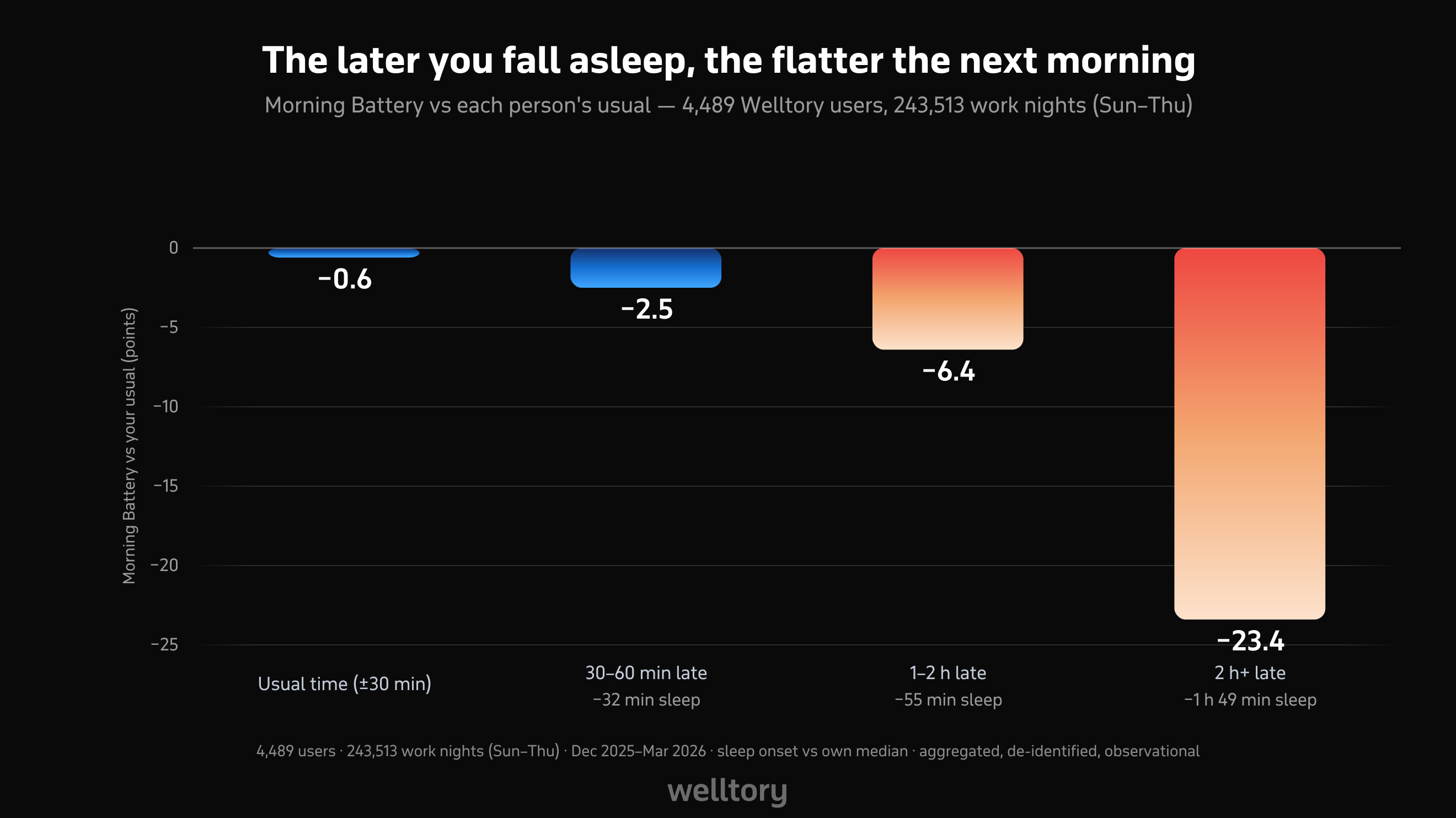
We looked at what happens to the next morning when people fall asleep later than their own usual time. Across 4,489 Welltory users and 332,049 nights (December 2025 to March 2026), each night was compared with that person's own typical sleep onset — so a night owl and an early sleeper are each measured against themselves, not against a rule.
Late nights are routine. 17% of all nights started at least an hour later than the person's usual time, and 61.5% of people averaged at least one such night a week.
The cost scales with the delay. On work nights (Sunday to Thursday evenings), falling asleep 30–60 minutes later than usual came with about 32 minutes less sleep; 1–2 hours later, about 55 minutes less; 2 hours or more later, 1 hour 49 minutes less. The morning Battery score followed the same staircase: about 2 points below the person's usual after a 30–60 minute delay, about 6 points below after 1–2 hours, and about 23 points below after 2 hours or more.
What barely moved was morning resting heart rate — up by less than half a beat per minute even after the latest nights. The price of a late night shows up in sleep length and next-morning energy, not in your pulse, which is one reason it is so easy to underestimate.
Two caveats. This is observational: we can see when people fell asleep, not why, so these late nights include work, parties and night feeds as well as procrastination. And it measures sleep onset, not the time you meant to go to bed — the gap you would record yourself in the two-week plan below.
A two-week version that usually works
Not a lifestyle overhaul. Four things, in this order, because the order is what makes it survivable.
Week one, change nothing — just record two times. When you intended to go to bed, and when you actually did. Nothing else. The gap is the entire measurement, and most people are surprised by it, because in the moment each individual night feels like an exception.
Then set the alarm for the start, not the end. One alarm, in the early evening, that means begin stopping — not be asleep. The thing people get wrong is aiming the reminder at bedtime itself, by which point the decision has already been lost. Aim it thirty to forty minutes earlier, at the transition.
Move one object. The charger, to another room. This is the single highest-yield change in the whole article, and it works because it converts continuing from a default into an action. If you use the phone as an alarm, that is what a three-pound clock is for.
Give the last half hour an ending. Something finite. An episode, a chapter, a shower, a real conversation. The criterion is only that it stops by itself.
Aim for thirty minutes, not two hours. Half an hour earlier, five nights a week, is around two and a half hours of sleep recovered weekly and it is a target you will still be hitting in March. Two hours earlier is a plan that lasts nine days and then teaches you that you cannot do this.
And expect to miss nights. The measure of whether this worked is the gap in week two against week one, not whether you were perfect. A habit that survives a bad week is the only kind worth building.
When it is not procrastination
Worth separating, because the wrong label leads to years of trying to fix the wrong thing.
If you go to bed on time and cannot sleep, that is not this. That is insomnia, and the first-line treatment is cognitive behavioural therapy for insomnia rather than an earlier bedtime.
If you are not sleepy until two in the morning and would sleep well until ten, that may be a delayed body clock rather than a choice — a circadian pattern, not a self-control problem. It responds to light timing, and forcing an earlier bedtime without addressing the clock mostly produces lying in the dark.
If your evenings feel like the only time you are yourself, and that has been true for months, the thing to look at is the shape of your days rather than your bedtime.
If you are staying up because you dread the next day, that is worth taking seriously on its own terms. Sleep and low mood feed each other, and treating one while ignoring the other tends not to work.
And if you are exhausted despite enough hours in bed, the problem is not when you go to sleep. That combination points at sleep quality or something medical, and it deserves an appointment.
What doesn't help — and why is it still recommended?
Worth naming, because most people have already tried these and concluded the problem is them.
"Just go to bed earlier." This is a restatement of the problem, not a solution. If the difficulty were knowing what to do, nobody would have this.
Sleep hygiene leaflets. Dark room, cool room, no caffeine after two. All sensible, all aimed at falling asleep — which is not the failure here. You sleep fine once you get there.
Guilt. The most commonly applied intervention and among the least effective. Feeling bad about last night depletes the same resource you will need tonight, which makes it actively counterproductive rather than merely useless.
Tracking alone. Seeing the data helps you notice the pattern. It does not close the gap, and for some people a nightly score becomes one more thing to feel bad about at midnight. Measurement is a first step, not the intervention.
Elaborate routines. A nine-step wind-down requires more self-regulation than the thing it is replacing. Complexity is the enemy here — the interventions that work are the ones that need no decision at all.
And "you just need more discipline." If the mechanism is a resource that runs out, then asking for more of it at the moment it is lowest is asking for the impossible. Everything that works in this article works by requiring less, not more.
How to bring this up with your doctor
Most bedtime procrastination never needs a clinician. Some of what hides behind it does.
Say it plainly: "I go to bed one to two hours later than I intend to, most nights, and nothing is stopping me." That sentence distinguishes this from insomnia immediately and saves a consultation's worth of confusion.
Bring two weeks of times. When you intended to go to bed, when you actually did, and how you felt the next day. The gap is the whole diagnosis.
Ask about CBT-I anyway if it has become chronic. It addresses the behavioural side of sleep far better than the sleep hygiene leaflet most people are handed.
Raise these specifically, because they change the answer: low mood or loss of interest alongside the late nights; not feeling sleepy until very late and sleeping well if allowed to wake late; exhaustion despite adequate hours; loud snoring with pauses; or stimulant medication, which shifts when you feel able to sleep.
And mention caffeine and alcohol timing. Both affect this more than most people assume, and both are easier to change than a habit.
How Welltory helps — and what it cannot do
The limit first. Welltory does not track what you do in the evening, cannot see your screen, and does not diagnose anything. It is a general wellness product with no regulatory clearance.
What it can do is make the cost visible, which is the part memory handles badly. The gap between the nights you went to bed when you meant to and the nights you did not shows up in things a tracker records well: when you actually fell asleep, how long you slept, your resting heart rate the next morning, and your heart rate variability against your own baseline. (Short nights also add up over a week — see whether you can catch up on sleep debt.)
That comparison is more persuasive than any advice, because it is about you. Most people know abstractly that late nights cost them something. Seeing a fortnight where the late nights and the flat mornings line up is a different kind of knowing.
Two honest caveats. These signals are non-specific — alcohol, a warm room, illness and stress move them the same way a short night does, so read the pattern across a week rather than a single morning. And if checking the data has itself become another thing to feel bad about at midnight, check less. A record is meant to inform a decision, not to grade you.
How we made it
Made with AI tools, then edited and fact-checked by the Welltory team. See our Editorial & AI policy.
Data analysis by Jane Smorodnikova, co-founder of Welltory and the person who built the methodology behind how we read physiological data.
Written by Tatsiana Yashyna.


Discounts for blog readers: up to 36% off
See what affects your energy, stress, sleep, and daily state with Welltory
This article is for educational purposes only and is not medical advice. Bedtime procrastination is a behavioural pattern, not a diagnosis, and appears in no classification of disorders. Persistent difficulty falling or staying asleep, exhaustion despite adequate hours in bed, loud snoring with pauses, or low mood alongside disturbed sleep need clinical assessment rather than a change of routine. Welltory holds no regulatory clearance, is a general wellness product, and does not diagnose. Sources were retrieved on 24 September 2026.
Was this helpful?
Ask AI for a summary of page


Written by Jane Smorodnikova

The founder and CEO of Welltory. A recognized tech leader with two Master's degrees and experience at MIT, she has scaled Welltory to over 17 million users.
Written by Tatsiana Yashyna

Deputy COO at Welltory. With a background in medicine and years of working with health data, she translates research and real physiological signals — sleep, stress, heart rate, and hormones — into clear, evidence-based explanations that help people understand what their bodies are telling them.
References
- Kroese FM, De Ridder DTD, Evers C, Adriaanse MA. Bedtime procrastination: introducing a new area of procrastination. Frontiers in Psychology 2014;5:611. https://www.frontiersin.org/journals/psychology/articles/10.3389/fpsyg.2014.00611/pdf
- Kroese FM, Evers C, Adriaanse MA, De Ridder DTD. Bedtime procrastination: a self-regulation perspective on sleep insufficiency in the general population. Journal of Health Psychology 2016;21(5):853–862. https://doi.org/10.1177/1359105314540014
- Scientific American. It goes by the name "bedtime procrastination." https://www.scientificamerican.com/article/it-goes-by-the-name-bedtime-procrastination-and-you-can-probably-guess-what-it-is/
- Stanford Student Affairs. Sleep and revenge bedtime procrastination. https://studentaffairs.stanford.edu/sleep-revenge-bedtime-procrastination
- Melanopic irradiance defines the impact of evening display light on sleep latency, melatonin and alertness. PMC9974389. https://www.ncbi.nlm.nih.gov/pmc/articles/PMC9974389/
- Carlson SE, Baron KG, Johnson KT, Williams PG. The thief of (bed)time: examination of the daily associations between bedtime procrastination and multidimensional sleep health. Sleep Health 2023;9(6). https://doi.org/10.1016/j.sleh.2023.08.002


