

Short Answer
A heart rate "zone" is just a target intensity band — but the number that defines it is personal, not universal. Almost every chart, watch, and gym machine builds those zones on a single shortcut: 220 − age to estimate your maximum heart rate. It is the most common approach in the world, and also one of the least validated. The equation was never derived from a rigorous study — it traces back to 1970s reviews rather than a formal experiment — and individual maximum heart rate scatters around it by roughly 10 beats per minute, with the error for some people running past 20 (Tanaka et al., *Journal of the American College of Cardiology*, 2001). So treat the formula as a rough placeholder, not a fact about your body.
What actually makes a zone yours is four things this article walks through one by one: your diagnoses, your medications, your blood work, and your sociodemographic reality. Each one can move the real numbers enough that the textbook zone becomes wrong — sometimes in ways that matter for safety.
In Welltory's own data, this shows up plainly: among users of the same age, the heart rate people actually reach during their more active everyday movement varies by more than 20 beats per minute from person to person, and age accounts for only about a tenth of that difference. One age-based number simply can't describe where any individual's effort really lands.
First, why 220 − age is a shaky foundation
The formula everyone knows — subtract your age from 220 to get your "maximum" heart rate, then take percentages of it for your zones — is convenient, universal, and wrong more often than people realize. It began as a line drawn through old, mixed exercise data rather than a validated equation, and the spread around it is large: two 40-year-olds with a true max of 165 and 195 would both be told 180. A widely cited revision, HRmax ≈ 208 − 0.7 × age, tracks the average a little better, especially in older adults, but it does not remove the individual error (Tanaka et al., 2001).
That imprecision is tolerable for a healthy person with a wide margin for error. It stops being tolerable the moment a diagnosis, a medication, or an unusual physiology enters the picture — which is exactly what the next four sections are about. A better mental model: your zone is defined by your own physiology — your resting heart rate, your heart rate reserve, your ventilatory thresholds — and cross-checked by how effort actually feels, through the talk test and perceived exertion, not by your birthday. Training studies define easy aerobic work this way, for example as work where "intensity was exclusively below the first lactate/ventilatory threshold (VT1), or ≤ 60% heart rate reserve" (*Scandinavian Journal of Medicine & Science in Sports*, 2025).
And to be clear about the stakes: correctly dosed movement is powerful medicine. In people with coronary artery disease, a 2026 meta-analysis found that "exercise training reduces the risk of cardiovascular mortality, overall hospitalization and cardiovascular hospitalization" (*European Journal of Cardiovascular Nursing*, 2026). Getting the intensity right is how you capture that benefit without the harm.
What our data shows: one number can't fit people the same age
Across 4,142 Welltory users with at least a month of quality wearable data, we looked at the heart rate each person actually reached during their more active everyday movement — a robust, wearable-derived summary of where their effort typically sits, not a lab maximum. Between people of the same age, that everyday elevated heart rate spanned a range of about 23 beats per minute (10th to 90th percentile), and age explained only about 11% of the person-to-person difference. Among users around 45, for example, it ran from roughly 87 to 109 beats per minute — yet 220 − age hands every 45-year-old the same 175 "maximum" and the same zones.
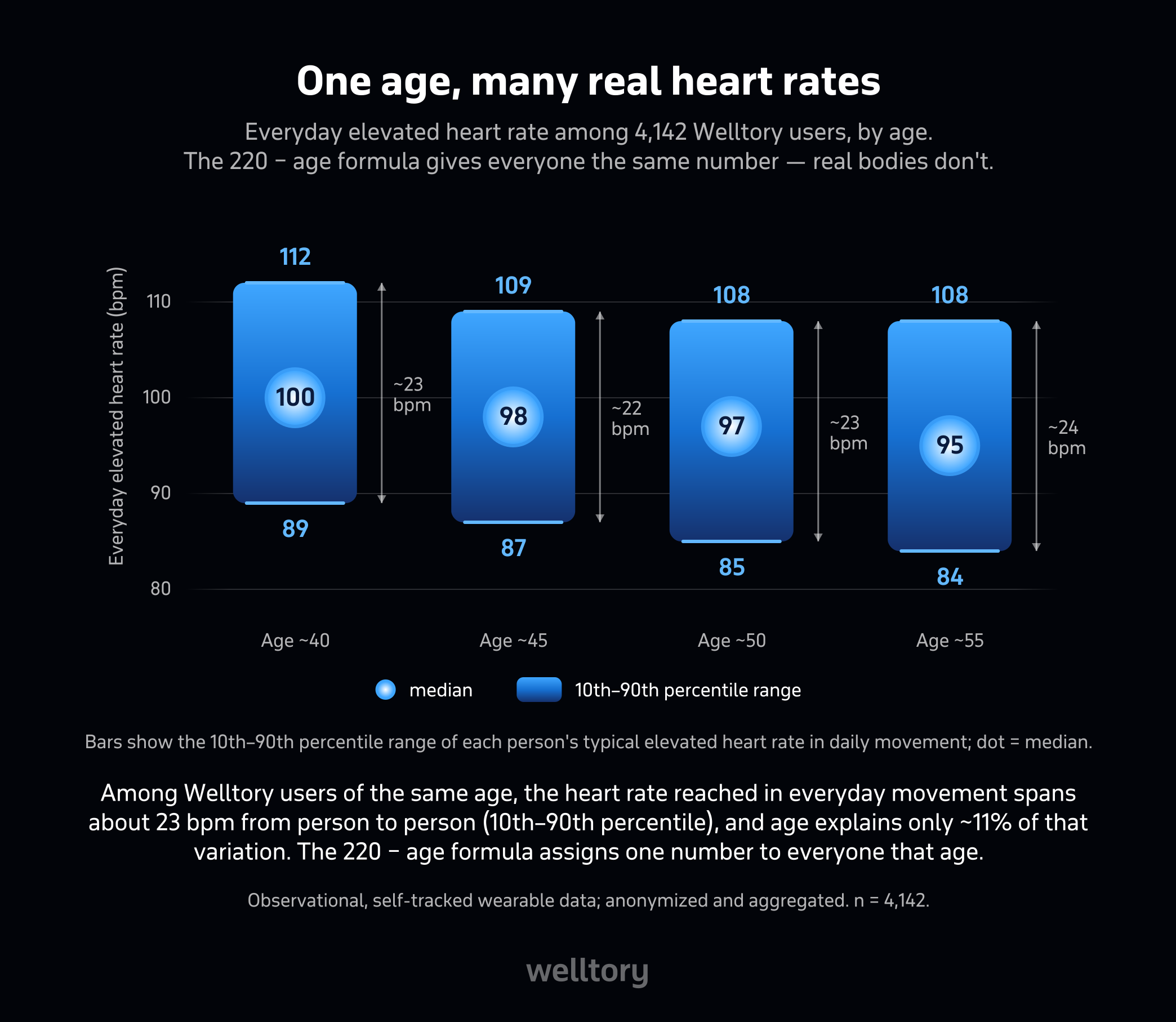
The gap held up when we controlled for the obvious confounders: the spread between same-age people stayed near 9–10 beats per minute whether someone reported no health conditions or several, across men and women, and across every age band. In other words, the reason your zone doesn't match your neighbor's isn't mostly your age, your sex, or your diagnoses — it's you.
How we know this
This is observational, first-party data: 4,142 Welltory users who wore a compatible device and logged at least ~30 days of quality data during the measurement window. The metric is each person's typical elevated heart rate in daily movement (the median of their day-to-day 80th-percentile heart rate) — a proxy for real-world effort, not a maximal or clinical test. Because these are people engaged enough to track consistently (they exercise somewhat more than users who don't), the true population spread is likely at least as wide as what we see. All figures are reported as anonymized, aggregated data; no individual user is identifiable.
Heart rate zones and your diagnoses
A diagnosis can break the normal link between heart rate and effort — the assumption every zone chart quietly relies on.
POTS and dysautonomia. In postural orthostatic tachycardia syndrome, heart rate can leap toward "maximum" at trivial workloads. The condition is defined by a sustained heart-rate rise of "≥30 bpm when moving from a recumbent to a standing position … (or ≥40 bpm in individuals 12 to 19 years of age)" without a drop in blood pressure (2015 Heart Rhythm Society Expert Consensus, Sheldon et al.). When the heart rate reacts that strongly to standing and light activity, an age-based zone badly overstates how hard the body is really working, and heart rate alone misreads intensity.
Chronotropic incompetence and autonomic neuropathy. The opposite failure: the heart rate barely rises with effort. Chronotropic incompetence is "the inability of the heart to increase its rate commensurate with increased activity or demand," commonly flagged when heart rate fails to reach roughly 80% of the expected reserve or age-predicted maximum (Brubaker & Kitzman, *Circulation*, 2011). Here a target zone becomes physically unreachable and useless as a guide.
ME/CFS and Long COVID. The aerobic threshold can sit at a very low workload and drop further after exertion. On a repeat exercise test performed a day after the first, people with ME/CFS show declines in oxygen use and workload — including at the ventilatory threshold — that healthy people don't (Keller et al., *Journal of Translational Medicine*, 2014; Snell et al., *Physical Therapy*, 2013). In conditions with post-exertional malaise, pushing into higher heart-rate zones can trigger prolonged deterioration. The approach is pacing under a personal heart-rate ceiling — not graded escalation toward a target. Current UK guidance is explicit that people should be advised to manage activity and "not 'push through' their symptoms," and it recommends against programmes built on fixed incremental increases in exercise (NICE guideline NG206, 2021). Standard "progress the intensity" advice does not apply here.
Heart failure and cardiac rehab. Zones are set by supervised testing and clinical protocols, not an age formula — and the payoff for getting it right is large, as the mortality and hospitalization findings above show.
The through-line: with these diagnoses, the honest guide is measured thresholds plus how you feel and recover, and 220 − age is at best a loose starting estimate.
Heart rate zones and your medications
Some medications move your entire heart-rate curve, which quietly invalidates any zone built on 220 − age.
Beta-blockers and other rate-controlling drugs. These lower both resting and maximum heart rate. As one 2025 review of the problem puts it, "these medications complicate exercise prescription by lowering heart rate across the entire intensity spectrum," so "maximal heart rate can no longer be accurately estimated, and heart rate zones … may no longer correspond to actual physiological effort" (*European Journal of Applied Physiology*, 2025). An age-based target can become unreachable — or push someone to overexert while chasing a number their medication will never allow. On these drugs, the practical guidance is to set intensity by perceived exertion and the talk test rather than a percentage of an age-predicted max, and to confirm the plan with a clinician.
Stimulants, thyroid replacement, and some decongestants. These can raise heart rate at rest and during light activity, so the same heart rate reflects less real effort than the chart assumes. Pseudoephedrine, a common decongestant, raises heart rate modestly in pooled trials (Salerno et al., *Archives of Internal Medicine*, 2005), and over-replacement with thyroid hormone "may cause an increase in heart rate … palpitations, tachycardia, arrhythmias, increased pulse" (FDA levothyroxine label, DailyMed).
Drugs that blunt the recovery signal. When a medication flattens the heart-rate response, day-to-day heart rate stops being a reliable readiness signal, and perceived effort carries more weight.
Practical rule: if a medication changes your heart rate, your zones must be rebuilt around perceived effort and a clinician's input — the age formula is doubly wrong here.
Heart rate zones and your blood work
Lab results don't just name a disease; they describe the body the exercise is landing on and help set a safe starting dose — a layer no age formula can see.
Glucose and HbA1c. Activity is one of the most reliable levers on blood sugar: a large meta-analysis found that "frequent PA bouts reduced blood glucose [SMD −0.22 (95% CI −0.27 to −0.16)]" (*European Journal of Preventive Cardiology*, 2026). Glucose status also shapes the timing and safety of a session. American Diabetes Association guidance notes that exercise-related hypoglycemia is common in people using insulin or insulin secretagogues and that "hypoglycemic events occur typically within 6–15 h postexercise," and it advises caution with vigorous, jarring activity in proliferative retinopathy and daily foot checks with neuropathy (Colberg et al., *Diabetes Care*, 2016).
Lipids and blood pressure. Exercise lowers blood pressure in a dose-dependent way, with evidence of "a dose–response relationship between total intervention exposure and blood pressure reduction, underscoring the importance of intervention intensity and duration" (*Clinical Cardiology*, 2025). A lipid and blood-pressure profile also sets cardiovascular risk before intensity is pushed.
Inflammatory markers and organ function. Elevated inflammatory markers or impaired kidney, liver, or thyroid function change both exercise tolerance and the sensible starting intensity — they help read the therapeutic window, not just the label.
Anemia, ferritin, and electrolytes. Low oxygen-carrying capacity makes the body compensate by raising heart rate to keep oxygen delivery up (StatPearls, NCBI Bookshelf). When iron or hemoglobin is low, a given heart rate reflects more cardiovascular strain — so the number on the watch can overstate fitness and understate effort.
The point: blood work personalizes the zone from the inside, where 220 − age is blind.
Heart rate zones and your sociodemographic reality
A physiologically perfect zone still fails if it ignores the person's life. Age, sex, income, education, occupation, and access to a safe place to move decide which plan is realistic, sustainable, and fair — this is part of the dose, not a footnote.
Age and sex shift resting and maximum heart rate and recovery, and interact with hormonal stage — another reason a flat formula misfits.
Occupation and time. Shift work and caregiving determine whether a plan of long, structured sessions is even possible; often incidental movement and short home sessions deliver more real benefit because they actually happen.
Income and access. Equipment, gyms, safe streets, and walkable neighborhoods shape adherence and equity. The built environment measurably affects how active people are: the Community Preventive Services Task Force "recommends built environment strategies … to increase physical activity" and notes that "activity-friendly built environment features were associated with levels of physical activity" (The Community Guide). The "best" plan someone can't follow is worse than a modest plan they can.
Personalized zones, in practice, means meeting the body and the life it lives in.
How to build your own personal zones
Measure your resting heart rate over several mornings, before getting up.
Don't trust 220 − age for your ceiling — sanity-check it against real hard efforts or a supervised/field test.
Build zones from your reserve. The Karvonen method uses heart rate reserve: target HR = resting HR + intensity% × (max HR − resting HR), rather than a flat percentage of an estimated max (Karvonen, Kentala & Mustala, 1957). For example, with a resting rate of 60 and a max near 175, 60% of reserve lands around 129 beats per minute.
Cross-check with the talk test or perceived exertion every session. As a field cue, at moderate intensity "a person … can talk, but not sing" (CDC); if the number and the feeling disagree, trust the feeling.
Adjust for your four factors: diagnosis, medication, blood work, and life context each move the target.
Re-check periodically — fitness, medication, illness, and life all shift the zones.
This is a framework for setting intensity, not medical clearance. If you have a heart, metabolic, or autonomic condition, confirm your plan with a clinician.
When to stop and seek help
Seek immediate medical care for chest pain or pressure, fainting or near-fainting, severe or unusual breathlessness, or palpitations that don't settle. Get medical advice, too, for symptoms that get dramatically worse in the day or two after exercise, which can be a red flag for post-exertional malaise. These are reasons to seek care, not to "push through."
How we made it
Made with AI tools, then edited, fact-checked, and medically reviewed by the Welltory team. All cohort figures are reported as anonymized, aggregated data; no individual user is identifiable.


Discounts for blog readers: up to 36% off
See what affects your energy, stress, sleep, and daily state with Welltory
This article is educational and does not replace personalized medical advice. Exercise intensity that is safe for one person can be too much for another, especially with a heart, metabolic, or autonomic condition, or on heart-rate-changing medication. Talk to a clinician before starting or intensifying exercise if you have a diagnosed condition, symptoms on exertion, or take medications that affect your heart rate.
Was this helpful?
Ask AI for a summary of page


Written by Jane Smorodnikova

The founder and CEO of Welltory. A recognized tech leader with two Master's degrees and experience at MIT, she has scaled Welltory to over 17 million users.
Written by Kseniia Iaroslavtseva

She reviews scientific research and turns it into structured, readable insights.
Written by Zoia Andreeva

CBDO at Welltory, an AI-powered digital health app. With 20+ years of C-level experience in IT, she specializes in building and scaling business models at the intersection of digital health, data, retail media, and sustainability. She leads Welltory’s global B2B partnerships and is a member of the New York Fashion Tech Lab and Springboard Enterprises communities.
Reviewed by Anna Elitzur
-2.jpg)
With her medical degree, Anna reviews Welltory's health content for medical accuracy and alignment with current clinical guidelines and research.
References
- Tanaka H, Monahan KD, Seals DR. Age-predicted maximal heart rate revisited. Journal of the American College of Cardiology, 2001. https://pubmed.ncbi.nlm.nih.gov/11153730/
- Effect of exercise intensity and volume on mortality and hospitalization in coronary artery disease. European Journal of Cardiovascular Nursing, 2026. https://doi.org/10.1093/eurjcn/zvaf233
- Low-intensity training below the first ventilatory threshold (≤60% heart rate reserve). Scandinavian Journal of Medicine & Science in Sports, 2025. https://doi.org/10.1111/sms.70208
- Optimizing physical activity bouts to interrupt sedentary behaviour for cardiometabolic health. European Journal of Preventive Cardiology, 2026. https://doi.org/10.1093/eurjpc/zwag079
- Dose-response of exercise and blood pressure reduction. Clinical Cardiology, 2025. https://doi.org/10.1002/clc.70322
- Sheldon RS, et al. 2015 Heart Rhythm Society Expert Consensus Statement on POTS. Heart Rhythm, 2015. https://pubmed.ncbi.nlm.nih.gov/25980576/
- Brubaker PH, Kitzman DW. Chronotropic incompetence. Circulation, 2011. https://www.ahajournals.org/doi/10.1161/CIRCULATIONAHA.110.940577
- Keller BA, et al. Inability of ME/CFS patients to reproduce CPET results. Journal of Translational Medicine, 2014. https://translational-medicine.biomedcentral.com/articles/10.1186/1479-5876-12-104
- Snell CR, et al. Discriminative validity of metabolic and workload measurements in ME/CFS. Physical Therapy, 2013. https://pubmed.ncbi.nlm.nih.gov/23813081/
- NICE guideline NG206: ME/CFS diagnosis and management, 2021. https://www.nice.org.uk/guidance/ng206/chapter/recommendations
- Exercise prescription with beta-blockade and the role of RPE. European Journal of Applied Physiology, 2025. https://link.springer.com/article/10.1007/s00421-025-05818-x
- Salerno SM, et al. Effect of pseudoephedrine on blood pressure and heart rate: a meta-analysis. Archives of Internal Medicine, 2005. https://jamanetwork.com/journals/jamainternalmedicine/fullarticle/765664
- Levothyroxine Sodium — FDA prescribing information (DailyMed). https://dailymed.nlm.nih.gov/dailymed/lookup.cfm?setid=a6233381-3043-4e9a-aaa6-a6b105e5142b
- Chronic Anemia — StatPearls, NCBI Bookshelf. https://www.ncbi.nlm.nih.gov/books/NBK534803/
- Colberg SR, et al. Physical Activity/Exercise and Diabetes: an ADA position statement. Diabetes Care, 2016. https://diabetesjournals.org/care/article/39/11/2065/37249
- Community Preventive Services Task Force. Physical activity: built environment approaches. The Community Guide. https://www.thecommunityguide.org/findings/physical-activity-built-environment-approaches.html
- Karvonen MJ, Kentala E, Mustala O. The effects of training on heart rate. Annales Medicinae Experimentalis et Biologiae Fenniae, 1957. https://pubmed.ncbi.nlm.nih.gov/13470504/
- American Heart Association. Target Heart Rates Chart. https://www.heart.org/en/healthy-living/exercise-and-physical-activity/fitness-basics/target-heart-rates
- CDC. Measuring Physical Activity Intensity. https://www.cdc.gov/physical-activity-basics/measuring/index.html

