
Lupus flare symptoms: the early warning signs, the real triggers, and what to do when one starts
Most lupus flares have a run-up of several days rather than starting suddenly. The triggers with real evidence behind them are UV light, infection, missed medication and stress — and the prodrome is a window worth learning to recognise.

Short answer
A lupus flare is a period when disease activity rises and symptoms worsen — fatigue, joint pain, rash, fever, mouth ulcers. Most flares have a run-up of a few days rather than starting suddenly, and the best-evidenced triggers are UV exposure, infection, missed medication and stress.
If people around you treat a flare as something you brought on yourself by not managing stress well enough, that is not how this works and it is not your fault. Lupus is driven by immune activity. Triggers influence it; they do not constitute it.
Note: this article describes a pattern and is not medical advice. Lupus is managed by a rheumatologist and flares can involve organs — kidneys, heart, lungs, brain — where delay is costly. New or severe symptoms need medical assessment, not a self-management plan.
How common is lupus, and who gets it?
Systemic lupus erythematosus (SLE), the most common form, affects an estimated 204,000 people in the United States — about 184,000 women and 20,000 men, according to the CDC's national lupus registries. Nine in ten people with lupus are women, and the risk is highest during the childbearing years, 15 to 44. Black and American Indian/Alaska Native women are two to three times more likely than White women to develop lupus and tend to have more severe disease. (cdc.gov; doi.org)
Those numbers explain why flares are so often misread. Lupus mostly arrives in young women at the busiest stage of life, where fatigue, joint pain and a rash are easy to put down to work, children or stress — by the person and, sometimes, by the people treating them.
What does a lupus flare feel like?
The frustrating truth is that it differs between people and stays fairly consistent within one person. Your flare tends to look like your flare.
The common features:
Overwhelming fatigue, qualitatively different from being tired, and usually the first thing to arrive
Joint pain and swelling, often symmetrical, often worse in the morning
Rash, classically across the cheeks and nose, or anywhere sun-exposed
Fever without an obvious infection
Mouth or nose ulcers, frequently painless, which is why they get missed
Hair shedding
Chest pain on breathing in, from inflammation of the lining around the lungs or heart
Swelling in legs, feet or around the eyes — this one matters more than it looks, because it can signal kidney involvement
Headache, cognitive fog, mood changes
Raynaud's: fingers going white or blue in the cold
What raises the urgency. Severe chest pain or breathlessness, significant new swelling or frothy urine, seizures, confusion, severe persistent headache, visual changes, or a high fever. These are not "wait and see" symptoms — lupus flares can involve organs, and the difference between a joint flare and a kidney flare is the difference between adjusting your week and needing treatment now.
The early warning signs, and why they matter
Most flares announce themselves. Research on lupus consistently finds that people can identify a prodrome — a period of days, sometimes 1–2 weeks, when things shift before the flare proper begins.
The signals people report most often:
Fatigue increasing before anything else changes
Joints feeling stiff rather than painful
Sleep getting worse
Appetite dropping
Feeling "off" in a way that is hard to name — often the first thing, and the easiest to dismiss
Low-grade temperature
Ulcers appearing
Hair coming out more in the shower
The reason this matters practically: a prodrome is a window. It is time to rest deliberately, be scrupulous about medication, avoid sun, and — this is the part people leave too late — contact your rheumatology team rather than waiting to see how bad it gets. Many teams would rather hear from you early, and some flares can be blunted with a short course of treatment if caught at the beginning.
Most people only learn their own prodrome by recording it, because in the moment it is indistinguishable from an ordinary bad week. It only becomes a pattern when you can look back at several episodes side by side.
What actually triggers a lupus flare?
Four have real evidence behind them. It is worth separating those from the long lists that circulate.
Ultraviolet light. The best-established, and the most underestimated. Between 40% and 70% of people with lupus are photosensitive, and UV can trigger not just a rash but a systemic flare — fatigue, joint pain, the whole picture. This includes indirect exposure: through window glass, on overcast days, and from some fluorescent and halogen lighting. Broad-spectrum SPF 50+ daily, covering clothing and shade are the standard advice, and it is more important than it sounds.
Infection. A straightforward immune provocation, and a common precipitant. It also cuts both ways: some lupus treatments raise infection risk, which is part of why a fever during a flare needs proper assessment rather than assumption.
Missed or stopped medication. One of the most common causes, and the most preventable. Hydroxychloroquine is the clearest case. In the randomised Canadian withdrawal trial, 47 people with stable lupus were switched either to placebo or kept on hydroxychloroquine for 24 weeks: 16 of 22 on placebo flared, against 9 of 25 who continued — a 2.5-fold higher risk of a clinical flare after stopping. (doi.org) Stopping it — often because it does not feel like it is doing anything — is a recognised route into one. It works slowly and in the background, which is precisely why it is easy to abandon.
Stress. Reported consistently by people with lupus as a precipitant. The honest framing matters here: this is not a claim that lupus is caused by stress or that better coping would prevent flares. It is one input among several into an immune system that is already dysregulated.
Others that come up, with weaker or more variable evidence: hormonal changes including pregnancy and the postpartum period, certain medications, surgery, exhaustion and disrupted sleep. Diet is frequently discussed and the evidence for specific foods triggering flares is thin — which does not mean nutrition is irrelevant, only that the confident food lists online are not built on much.
Not all flares are the same kind of flare
This is the distinction that changes urgency most, and it is rarely explained plainly.
A mild flare is mostly joints, skin, fatigue and mouth ulcers. Unpleasant, disruptive, and usually managed with adjustments to existing treatment — an anti-inflammatory, a short steroid course, more rest. It is the kind most people picture.
A severe flare involves an organ. Lupus nephritis affects the kidneys and is the one that matters most statistically; flares can also involve the lining around the heart and lungs, the blood, and the nervous system. These need prompt treatment, sometimes urgently, and the consequences of waiting are not symmetrical with the consequences of calling too early.
The uncomfortable part: the two do not always feel proportionally different at the start. Kidney involvement in particular can be quiet — no pain, nothing dramatic — and show up only as swelling in the ankles or around the eyes, frothy urine, or a rise in blood pressure. This is precisely why routine urine testing is part of lupus care even when you feel fine, and why "I didn't want to bother anyone" is the sentence rheumatology teams hear most often and like least.
So the practical rule is not to grade your own flare by how bad it feels. It is to know the specific signs that move something from a bad week into an urgent one, and to treat those as non-negotiable regardless of how mild everything else seems.
Living between flares
Most of lupus is not the flare. It is the rest of the time, and that part gets much less attention than it deserves.
Fatigue often persists between flares, and for many people it is the most limiting symptom overall — more than joint pain, and far more than anything visible. It is not a sign that a flare is coming and it does not necessarily mean disease activity is high. It is its own problem, and it is worth naming as one rather than treating it as background noise.
Pacing helps here, even though it is not the answer to the flares themselves. Budgeting energy across a week, spreading demanding things out, resting before you need to rather than after — the same energy envelope approach used in ME/CFS applies to lupus fatigue reasonably well, with the important caveat that it is managing a symptom, not the disease. (And if the bigger worry is the long-term outlook, can lupus kill you? covers how serious lupus gets and how it is managed today.)
Sun protection is a permanent habit, not a flare response. Daily broad-spectrum SPF 50+, covering clothing, and awareness that glass, cloud and some indoor lighting do not protect you. This is the single most actionable thing on the list and the one most often applied only after a flare has already started.
Medication adherence is the quiet lever. Hydroxychloroquine in particular works in the background over months, which makes it feel skippable. It is not, and the flare risk of stopping is one of the better-evidenced things in this whole article.
Sleep, infection avoidance and vaccination all matter for the same reason: they reduce the number of provocations reaching an immune system that does not need more of them.
And one thing that is not a lever: blaming yourself for flares. The evidence that stress contributes does not mean flares are caused by coping badly, and the version of this advice that turns into self-recrimination makes the fatigue worse without touching the disease.
How is a lupus flare different from a PEM crash?
Worth separating, because the management is different and the two get conflated in chronic-illness spaces.
A crash in ME/CFS or long COVID is post-exertional malaise — exertion itself provokes a worsening, arriving 12 to 48 hours later. The relationship to activity is fairly direct, and the management is pacing: staying inside an energy envelope. (For how this kind of fatigue differs from ordinary tiredness, see fatigue and exhaustion explained.)
A lupus flare is disease activity rising. Overexertion and poor sleep can contribute, but a flare is not simply payback for doing too much — UV, infection and medication gaps all feed in, and the immune process has its own momentum. That difference has a concrete consequence: a pattern of lupus flares may need a treatment change, not a better schedule. No amount of pacing substitutes for a rheumatology review when flares are becoming more frequent.
Two practical notes on the overlap. Fatigue in lupus is real and often persists between flares, and pacing genuinely helps with that — it is a useful tool for the fatigue even though it is not the answer to the flares. And some people have both lupus and a PEM-type picture, in which case both approaches apply and it is worth being explicit with your clinicians about which symptom you are describing.
What to do when a flare starts
Contact your rheumatology team. Earlier than feels justified. This is the most useful single action and the one most often postponed, usually out of not wanting to make a fuss. Many teams have a helpline precisely for this.
Do not adjust your own medication. Particularly steroids — neither starting nor stopping on your own. If you have an agreed flare plan, follow it; if you do not, ask for one at your next appointment, because having it in writing removes the guesswork at the worst possible moment.
Rest properly and early. Not pushing to the end of the week and collapsing.
Stay out of the sun, strictly, while a flare is active.
Treat infection seriously. A fever during a flare is not something to ride out.
Write it down as it happens. What symptoms, what order, what preceded them. In the middle of a flare this feels like the last thing you want to do, and it is what makes the next one recognisable in advance.
And know your red flags cold: chest pain, breathlessness, new swelling or frothy urine, confusion, seizures, severe headache, visual change. Those go to urgent care, not to a diary.
Can tracking help prevent flares?
Partly — and it is worth being precise about which part, because this is where a lot of overclaiming happens.
What tracking cannot do. No app or wearable detects lupus disease activity. Disease activity is assessed clinically and with blood tests — complement levels, anti-dsDNA antibodies, inflammatory markers, urine protein. Nothing on your wrist sees any of that, and any product implying it can is misleading you about a condition where organ involvement is a real risk.
What tracking can do. Two things, both about the prodrome.
The first is making your own early-warning pattern visible. A prodrome is only recognisable across episodes, and recognising it in real time is exactly what a fatigued brain does badly. A dated record — symptoms, sleep, how you felt, what you did — turns "I think I was more tired before the last one too" into something you can check.
The second is exposure and adherence. Sun, missed doses and infection are the triggers with the best evidence, and all three are far easier to reconstruct from a log than from memory.
Bad mornings come in runs: what our data shows
Welltory cannot see lupus, and this is not lupus data. But the idea behind a prodrome — that a bad stretch builds over days rather than landing out of nowhere — is something we can look at in everyday physiology.
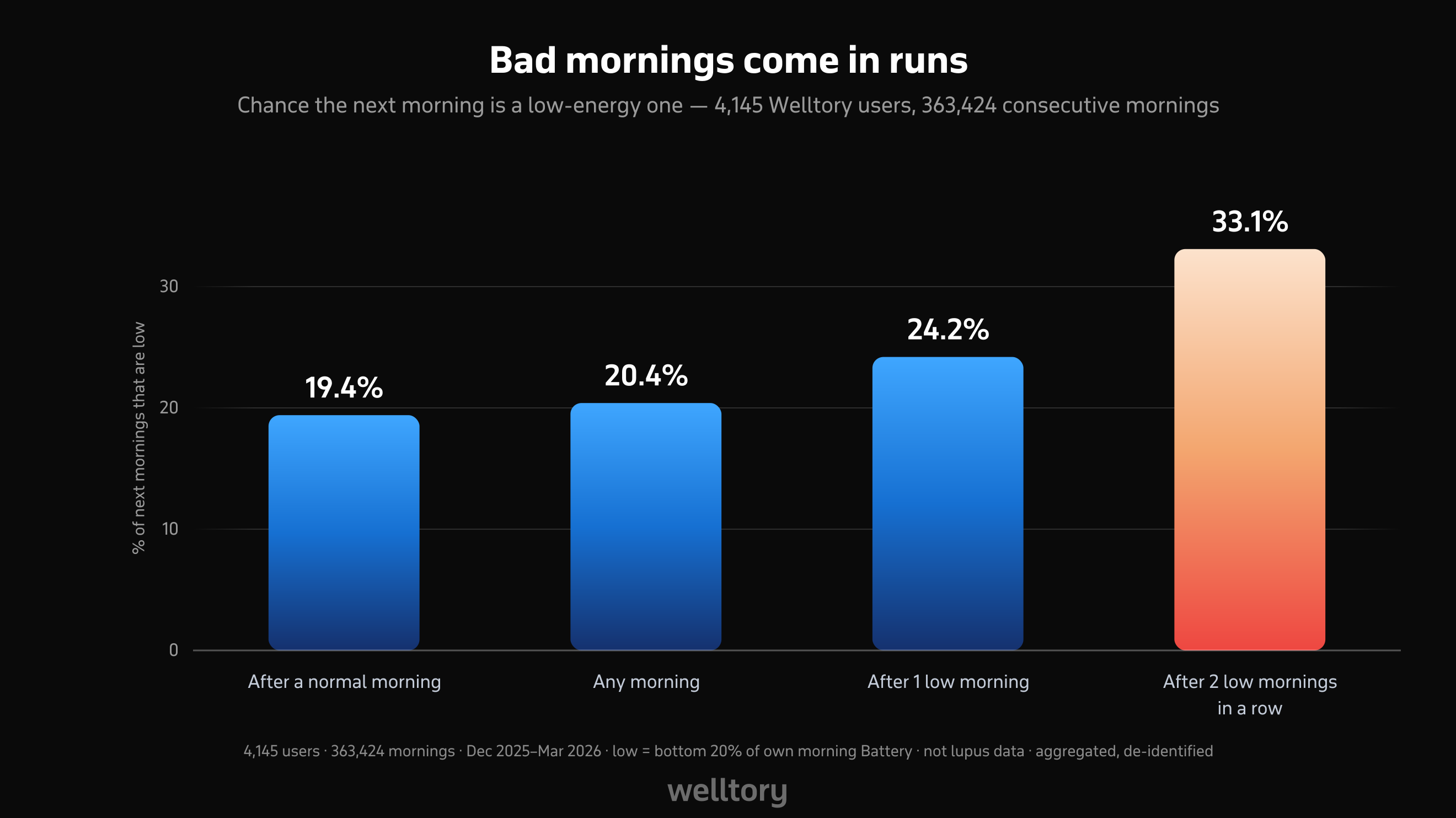
We took 4,145 Welltory users and 363,424 consecutive mornings (December 2025 to March 2026) and marked each person's lowest-energy mornings: the bottom fifth of their own morning Battery scores. Then we asked how often a low morning follows other mornings.
After a normal morning, the next one was low 19.4% of the time.
After one low morning, 24.2%.
After two low mornings in a row, 33.1% — about 1.7 times the rate after a normal day.
The pattern was the same in people who reported no health conditions (33.0%) and in those who reported three or more (34.0%). Bad days cluster for almost everyone.
For someone living with lupus, the practical reading is modest but useful: one bad morning is noise; two or three in a row is the moment to open your flare diary and check for the other signs above — the ulcers, the stiffness, the low-grade temperature. It is not a prediction of a flare. It is a nudge to look before the week gets away from you.
What a flare diary should actually contain
Most flare diaries fail for the same reason: they record too much, become a chore, and get abandoned two weeks in — usually right before the episode that would have made them useful.
The version that survives is short and has four columns.
The date, and a number for fatigue. One to ten, your own scale, entered daily including the days nothing happens. Those uneventful days are the baseline; without them there is nothing for a rise to stand out against.
Symptoms present, in one line. Joints, rash, ulcers, fever, chest pain, swelling. Names, not paragraphs.
Exposure. Sun, missed doses, infection, a stressful event, poor sleep, travel. These are the four evidenced triggers plus the two that plausibly shrink your margin, and they are the hardest things to reconstruct later.
One line on what you did. Not a full account. Enough to recognise the week.
That is it. 30 seconds a day. The work is not the recording, it is the reading back — once a month, look at the week before each flare and ask what those weeks had in common. Your prodrome lives in that comparison and nowhere else, because in real time it is indistinguishable from an ordinary bad patch.
Two things to add once you have a few episodes: the order your symptoms arrive in, which tends to be consistent for a given person and is the most useful predictive detail you will find; and how long each flare ran, which is what makes your own flare plan realistic rather than hopeful.
How to bring this up with your doctor
Bring a record of your last few flares, with dates, what the first sign was, and what was happening in the days before. This is the raw material for a flare plan and most people arrive without it.
Ask for a written flare plan. What to do at the first signs, who to contact, under what circumstances medication changes, and what counts as urgent. Having this settled in advance is worth more than any tracking.
Ask how your disease activity is being monitored and how often bloods and urine are being checked. Kidney involvement can be silent, and urine testing is the cheap thing that catches it.
Raise hydroxychloroquine honestly if you have been skipping it or have stopped. It is common, clinicians know it is common, and it is a fixable cause of flares.
Ask about sun protection specifically, including whether your indoor lighting or medications add photosensitivity.
If flares are getting more frequent, say that plainly and ask whether the treatment plan should change. Escalating frequency is information, not something to absorb.
How Welltory helps — and what it cannot do
The limit first, and it is a hard one. Welltory does not detect lupus flares, does not measure disease activity, and does not diagnose anything. It is a general wellness product with no regulatory clearance. Lupus is monitored with clinical assessment and blood tests, and nothing here substitutes for that.
What it can hold is the context around the prodrome. Fatigue and disturbed sleep are among the earliest signals people report, and both are hard to judge from inside — "more tired than usual" needs a usual to compare against. A record of sleep, resting heart rate and heart rate variability across months gives you that baseline, which is what turns a vague sense of being off into something you can point at.
Two honest caveats. These signals are entirely non-specific: they shift with infection, poor sleep, heat, stress and alcohol just as readily as with rising disease activity, so a change tells you something is different, never what. And a tracker is not a monitoring system for an organ-threatening condition — if something feels wrong, the answer is your rheumatology team, not a longer look at a chart.
Used as a record you bring to an appointment, it does useful work. That is the claim, and it stops there.
How we made it
Made with AI tools, then edited and fact-checked by the Welltory team. See our Editorial & AI policy.
Data analysis by Jane Smorodnikova, co-founder of Welltory and the person who built the methodology behind how we read physiological data.
Written by Tatsiana Yashyna.


Discounts for blog readers: up to 36% off
See what affects your energy, stress, sleep, and daily state with Welltory
This article is for educational purposes only and is not medical advice. Lupus is managed by a rheumatologist and flares can involve the kidneys, heart, lungs and brain, where delay is costly. Do not start, stop or adjust any medication — steroids especially — without your clinical team. No app or wearable measures lupus disease activity. Welltory holds no regulatory clearance, is a general wellness product, and does not diagnose. Chest pain, breathlessness, new swelling, frothy urine, confusion, seizures, severe headache or visual changes need urgent assessment. Sources were retrieved on 23 September 2026.
Was this helpful?
Ask AI for a summary of page


Written by Jane Smorodnikova

The founder and CEO of Welltory. A recognized tech leader with two Master's degrees and experience at MIT, she has scaled Welltory to over 17 million users.
Written by Tatsiana Yashyna

Deputy COO at Welltory. With a background in medicine and years of working with health data, she translates research and real physiological signals — sleep, stress, heart rate, and hormones — into clear, evidence-based explanations that help people understand what their bodies are telling them.
References
- Lupus Foundation of America. UV exposure: what you need to know. https://www.lupus.org/resources/uv-exposure-what-you-need-to-know
- Kaleidoscope Fighting Lupus. Lupus flares: recognizing one, triggers, and prevention. https://kaleidoscopefightinglupus.org/lupus-flares-recognizing-one-triggers-prevention/
- Human and murine evidence for mechanisms driving autoimmune photosensitivity. PMC6205973. https://www.ncbi.nlm.nih.gov/pmc/articles/PMC6205973/
- Neutrophil extracellular traps drive acute lupus flares with skin and kidney inflammation triggered by ultraviolet irradiation. bioRxiv. https://www.biorxiv.org/content/10.1101/2023.12.23.572573.full.pdf
- NICE. Myalgic encephalomyelitis/chronic fatigue syndrome: diagnosis and management (for the PEM contrast). NG206, 2021. https://www.nice.org.uk/guidance/ng206/chapter/recommendations
- Centers for Disease Control and Prevention. People with lupus. https://www.cdc.gov/lupus/data-research/index.html
- Izmirly PM, et al. Prevalence of systemic lupus erythematosus in the United States: estimates from a meta-analysis of the CDC National Lupus Registries. Arthritis & Rheumatology 2021;73(6). https://doi.org/10.1002/art.41632
- The Canadian Hydroxychloroquine Study Group. A randomized study of the effect of withdrawing hydroxychloroquine sulfate in systemic lupus erythematosus. New England Journal of Medicine 1991;324(3):150–154. https://doi.org/10.1056/NEJM199101173240303

