

Short answer
Most health apps let you export, and in Europe you have a legal right to it: GDPR Article 20 entitles you to your data "in a structured, commonly used and machine-readable format." How fast varies enormously — Oura's full export can take up to 10 days; a Welltory chart exports to CSV immediately, including raw beat-to-beat intervals. The harder question is what the file is good for.
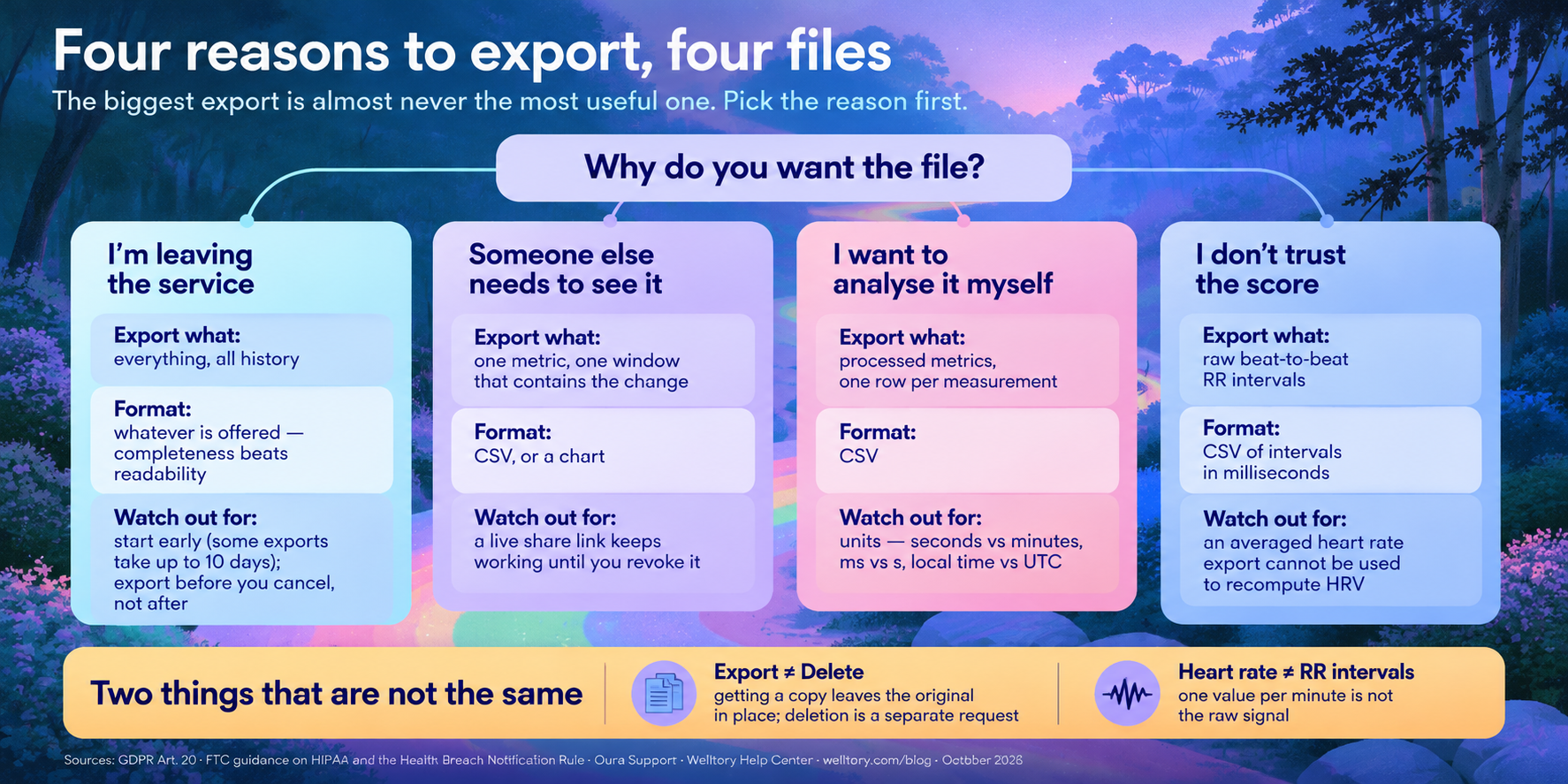
Why would you want your health data out of the app?
Four reasons come up repeatedly, and they call for different exports.
You are leaving. You are switching rings, or cancelling a subscription, and you do not want two years of nights to disappear with the account. What you need here is completeness — everything, in whatever format.
Someone else needs to see it. A doctor, a physiotherapist, a coach. What you need here is readability, and usually a much narrower slice: six weeks, one metric, not everything you have ever recorded.
You want to do your own analysis. A spreadsheet, a notebook, a comparison between two periods of your life. What you need here is a clean table with one row per measurement.
You do not trust the app's interpretation. This is the most interesting case and the one people are shyest about. You want the underlying numbers so you can check whether the score sitting on top of them is doing anything sensible. That is a legitimate thing to want, and it is the use that requires the rawest data of all.
Knowing which of these you are doing saves a lot of time, because the biggest export is rarely the most useful one.
What you are legally entitled to
In the EU and UK, GDPR Article 20 gives you the right to receive personal data you provided to a company "in a structured, commonly used and machine-readable format," and to transmit it to another company "without hindrance" — where the processing rests on your consent or on a contract and is carried out by automated means, which covers most consumer apps. Where technically feasible, you can ask for it to be sent directly from one service to another. The article also makes clear that exercising this right is separate from your right to erasure — getting a copy does not delete the original, and you may want to do both.
Two practical consequences. First, a company that only offers you a PDF summary is arguably not meeting the machine-readable test. Second, "data you provided" is a narrower category than "data about you" — it covers what you gave and what your device recorded, not necessarily the company's own derived scores and models.
In the United States there is no equivalent general right, and the gap people most often get wrong is HIPAA. The FTC's own guidance is explicit that the HIPAA Rules apply to covered entities — health plans, providers conducting standard electronic transactions, clearinghouses — and their business associates. A consumer fitness app that is none of those is outside HIPAA, however medical its data feels. What does apply is the FTC Act's prohibition on unfair or deceptive practices, which the FTC says reaches "companies that collect, use, or share health information that aren't required to comply with HIPAA," and the Health Breach Notification Rule, which covers vendors of personal health records not covered by HIPAA and requires them to notify you and the FTC after a breach.
So: in Europe you can demand a copy. In the US you generally get what the company chooses to offer — which is still, in practice, most of it.
What the file actually contains — CSV, XML, FIT and why the difference matters
Exports arrive in a handful of formats and they are not equivalent.
CSV is a plain table: one row per record, one column per field, opens in any spreadsheet. This is the format you want for analysis, and the one a clinician can actually glance at.
XML is what a full Apple Health export produces. It is complete and machine-readable in the legal sense, and genuinely awkward in the practical sense — a long-standing iPhone can produce a file of hundreds of megabytes that a spreadsheet will refuse to open. It is a format for a script, not for a person.
FIT is the activity-file standard used by sports devices. Excellent for a workout, meaningless for a sleep trend.
PDF is a picture of a table. Easy to email, impossible to analyse. Oura's Shareable Reports, for example, produce a PDF summary of sleep and daily movement for a health provider, and its support pages note you cannot adjust the timeframes or the type of data included. That is a sharing tool rather than Oura's data export — its Membership Hub export, covered below, is the machine-readable route.
One more thing worth checking before you trust your own analysis: units. Oura's export documents that durations are given in total seconds rather than hours and minutes — 24,030 seconds is about 6 hours 40 minutes. Milliseconds versus seconds, local time versus UTC, and inclusive versus exclusive date ranges are where most homemade health spreadsheets quietly go wrong.
How long does an export take?
Anywhere from instant to a week and a half, and the difference tells you something about how the company stores your data.
Services that generate the file on demand from a live database give it to you immediately. Services that queue a job, assemble an archive and email you a link take days — Oura's support page says a Membership Hub export "may take up to 10 days from the time of request before your data is available for download."
If you are leaving a service or need data for an appointment, start the request before you need it, not the night before. And if you are cancelling a subscription, export first: some services, ours included, will not let you delete an account while a subscription is active, and the sequence of cancel-then-delete can leave less time than you expect.
What Welltory actually measures here — and exactly what comes out in the file
Welltory's export includes one thing many exports leave out: the raw signal, not only the processed numbers. Here is what is in it.
Where to get it. Open the Welltory web app, go to the Dashboard, click the chart with the data you want, set the period using Latest, Days, Weeks or Months and the date range in the top right of the chart, then click Export. The file downloads as CSV. Next to it, RR-intervals downloads your raw measurement data, also as CSV.
What the processed export gives you. The standard HRV metrics from Measurement details, one row per measurement:
Heart rate and Mean RR — average beats per minute, and the average gap between beats in milliseconds.
SDNN — standard deviation of normal intervals between beats; the broad indicator of whether your variability sits in the usual range.
RMSSD — root mean square of successive differences; the one most closely tied to parasympathetic activity, the recovery side.
pNN50 — the proportion of adjacent intervals differing by more than 50 ms; high when relaxed, low when tired or over-stressed.
AMo50 — mode amplitude, reflecting sympathetic (mobilising) activity.
MxDMn — the spread between your longest and shortest interval in that reading.
Frequency-domain values — Total Power, VLF, LF, HF and the LF/HF ratio, if you took the reading in 300-beat mode (Menu → Settings).
What the RR-interval export gives you. The list of intervals between individual heartbeats, in milliseconds, exactly as recorded. This is the raw material from which every metric above is computed, and it is what a researcher or a cardiologist-minded reader would actually want, because it lets them recompute anything themselves — including metrics we do not show — using the definitions in the 1996 Task Force guidelines that the whole field still works from.
How we interpret it, and why you might disagree. Our reference range for RMSSD is 20–89 ms. That is narrower than the literature, where pooling published studies gives something like 13–107 ms, which is too wide to tell anyone anything. We narrowed it with an internal analysis of artefact-free RR intervals from over 600 Welltory users who had measured for at least 90 days. That analysis is ours and has not been externally peer-reviewed. You are entitled to think that range is wrong for you — and with the RR intervals in hand, you can check against your own history instead of taking our word for it. That is the point of giving them out.
One honest limit: the export covers your measurements and the data from connected apps and devices. It is not a dump of every internal field we hold.
What is usually missing from an export, even a complete one
Exports are written by engineers to satisfy a request, and what comes out tends to be the data the system stores rather than the data you were looking at. Three gaps come up repeatedly, and knowing about them in advance saves a lot of confusion.
The derived scores are often absent. Readiness, recovery, stress, energy, sleep scores — the numbers you actually read day to day — are frequently a company's own model output rather than stored measurements, and many exports contain the inputs instead. Legally this is defensible: GDPR Article 20 covers data you provided, which is a narrower category than everything a company holds about you. Practically it means your file can look nothing like your app.
The context is gone. Tags, notes, what you wrote about a bad week, the annotation that made a chart meaningful — these are often in a different part of the system and may not come out with the measurements, or may come out in a separate file you have to join yourself.
Gaps are invisible. An export shows the nights you recorded. It does not mark the nights your ring was charging, and an empty row and a missing row look identical once the file is in a spreadsheet. Before concluding that something changed in your body in March, check whether the device was on your body in March.
None of this makes exports useless. It makes the first ten minutes with the file about orientation rather than analysis: open it, count the rows, find the date range, look for the gaps, and check one value against what the app showed you that day. If that one value matches, you can trust the rest; if it does not, you have learned something more important than whatever you came to find out.
How do you share data with a doctor or coach without sending a file?
There is a second route that people miss, and it is usually the better one for an ongoing relationship.
In the Welltory web app, the Dashboard has a Share button. It copies a link that gives whoever you send it to access to your measurements and to data from the apps and gadgets you have synced — a live view rather than a snapshot that is stale the moment you send it. You can cut access off at any time: in your profile, on the Invite your friends page, find Get shareable link and click Generate new link. The old link stops working.
Two cautions. A link is a link: anyone who has it can open it, so treat it the way you would treat a shared document. And a live dashboard is more than most clinicians want in a ten-minute appointment — if you are going to a single consultation, a six-week CSV of one metric is kinder than a login.
What can a clinician actually do with a CSV of your heart rate?
Less than you hope, and more than nothing. Being realistic about this is the difference between a useful conversation and an awkward one.
What it is not. It is not a diagnostic test. An HRV measurement is not an ECG, it cannot detect or exclude any heart condition, and no consumer app's export has the standing of a clinical investigation. A doctor who declines to interpret it is not being dismissive — they are being accurate about what the instrument is.
What it is good for. Trends over time, in your own body, around a specific event. "My resting heart rate has been six beats higher every morning for three weeks since starting this medication" is a usable observation. "Here are 4,000 rows" is not. The useful export is small, dated, and attached to a question.
How to make it usable. Pick one metric. Pick a window that contains the change you want to discuss. Write the question in one sentence at the top. Bring the chart, not the raw file. If your clinician wants the underlying data, they will ask, and then you have the RR intervals.
Before you decide your data isn't worth anything
A lot of people export their data once, open the file, see 4,000 rows of numbers, and quietly conclude that they were kidding themselves — that this was never real information, just an app giving them something to look at.
That reaction is about the format, not the content. A spreadsheet of RR intervals is genuinely unreadable; so is a blood test before someone draws the reference line next to it. What makes the same numbers legible is one comparison: this period against that period, in your own body. Three bad nights in a row show up. A fortnight of a new medication shows up. The week you were sure you were fine and your evenings said otherwise shows up.
Before you decide you are imagining the pattern, pick one metric, one six-week window, and look at what your body already recorded.


Start understanding your body
Learn what affects your energy, stress, sleep, and daily state. Get the app.
How Welltory helps — and what it cannot do
What it does. Exports measurement results to CSV from any chart in the web app, for whatever period you choose, immediately. Exports the raw RR intervals alongside them, so you can recompute anything yourself. Provides a revocable share link for a doctor or coach. Shows the standard HRV metrics rather than only a proprietary score, so the export is interpretable by someone who has never used the app.
What it cannot do. It cannot make the file meaningful on its own — that takes a question and a comparison window. It cannot export data a connected device never sent us. It is not a medical record, and nothing in the export is a diagnosis or a clinical test result: Welltory is not a medical device and does not diagnose, treat or monitor any condition. It holds health data, but no clinical record — no diagnosis, no condition, no treatment history, because we never ask for any. And if you want everything deleted rather than copied, that is a separate action — deleting your account removes your data within one month, with backups erased within up to 90 days and only records we are legally required to keep, such as payment records, retained. You cannot delete while a subscription is still active.
If something about your health worries you, that belongs with a clinician, not with a bigger spreadsheet.


Discounts for blog readers: up to 36% off
See what affects your energy, stress, sleep, and daily state with Welltory
This article is for educational purposes only and is not a substitute for medical advice, diagnosis, or treatment from a qualified clinician. Welltory is not a medical device.
Was this helpful?
Ask AI for a summary of page


Written by Jane Smorodnikova

The founder and CEO of Welltory. A recognized tech leader with two Master's degrees and experience at MIT, she has scaled Welltory to over 17 million users.
Written by Tatsiana Yashyna

Deputy COO at Welltory. With a background in medicine and years of working with health data, she translates research and real physiological signals — sleep, stress, heart rate, and hormones — into clear, evidence-based explanations that help people understand what their bodies are telling them.
Written by Veranika Zdanovich

Veranika leads Welltory’s commercial strategy, growth initiatives, and global partnerships. Working at the intersection of health technology, consumer behavior, and product-led growth, she helps build personalized wellness experiences used by millions worldwide.
References
- Regulation (EU) 2016/679 (General Data Protection Regulation), Article 20 — Right to data portability. https://gdpr-info.eu/art-20-gdpr/
- Federal Trade Commission. Collecting, using, or sharing consumer health information? Look to HIPAA, the FTC Act, and the Health Breach Notification Rule. https://www.ftc.gov/business-guidance/resources/collecting-using-or-sharing-consumer-health-information-look-hipaa-ftc-act-health-breach
- Federal Trade Commission. Health Breach Notification Rule, 16 CFR Part 318. https://www.ftc.gov/legal-library/browse/rules/health-breach-notification-rule
- Oura Support. Export and share your Oura data — Membership Hub export timing, Shareable Reports, and unit conventions. https://support.ouraring.com/hc/en-us/articles/360025441594-Export-Share-Your-Oura-Data
- Task Force of the European Society of Cardiology and the North American Society of Pacing and Electrophysiology. Heart rate variability: standards of measurement, physiological interpretation, and clinical use — Circulation, 1996;93(5):1043–1065. PMID 8598068. https://pubmed.ncbi.nlm.nih.gov/8598068/
- How can I export my Measurement details data? — Welltory Help Center. https://help.welltory.com/en/articles/3357916-how-can-i-export-my-measurement-details-data
- Processing of personal data — Welltory Help Center. https://help.welltory.com/en/articles/4954550-processing-of-personal-data
- How do I share my data with a coach or doctor? — Welltory Help Center. https://help.welltory.com/en/articles/3357929-how-do-i-share-my-data-with-a-coach-or-doctor
- What normal ranges and measurement standards we use to interpret your heart rate variability — Welltory Help Center. https://help.welltory.com/en/articles/4413231-what-normal-ranges-and-measurement-standards-we-use-to-interpret-your-heart-rate-variability