

Short answer
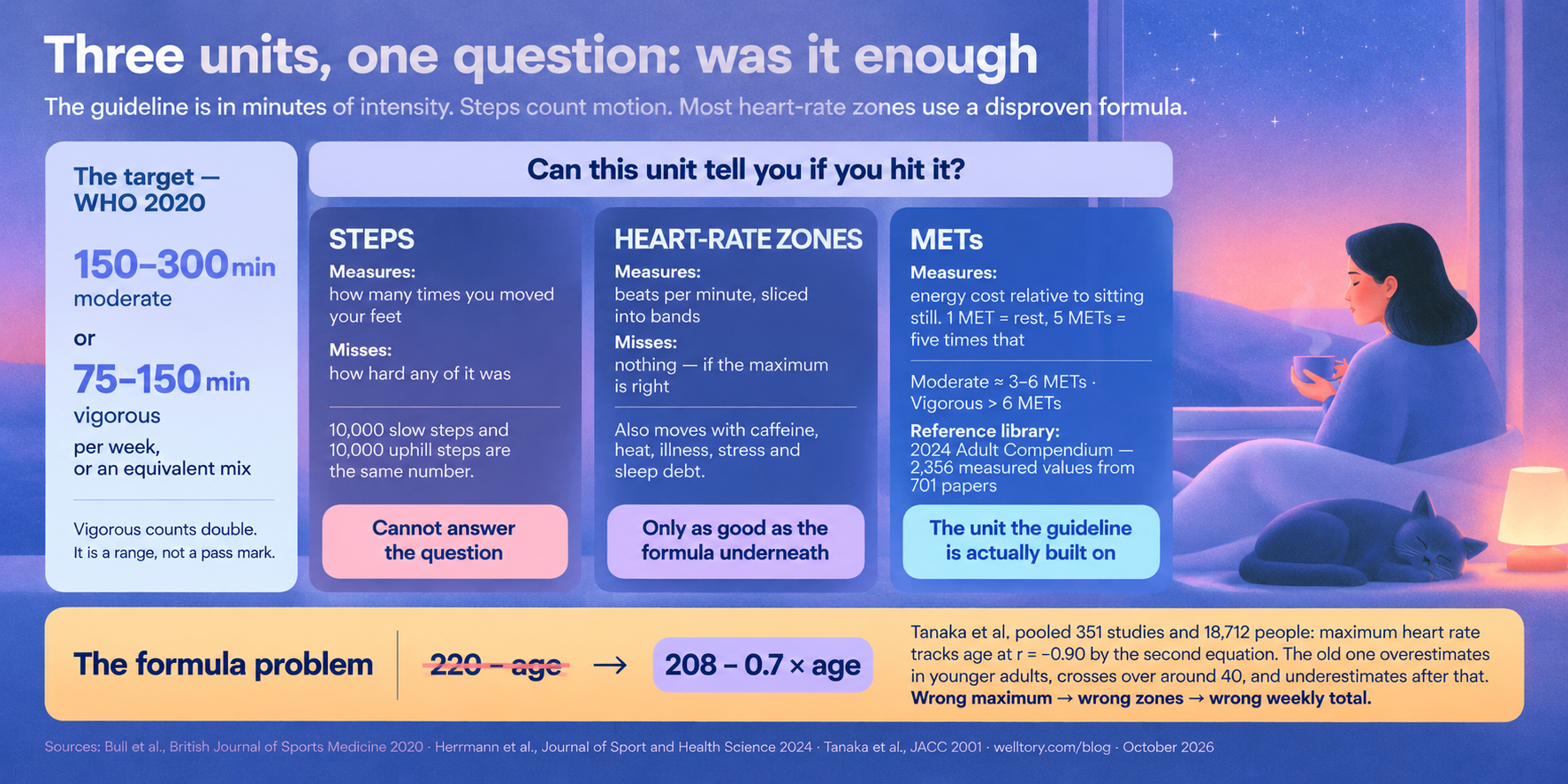
The WHO's 2020 guidelines say adults should get 150–300 minutes of moderate-intensity activity a week, or 75–150 minutes of vigorous, or an equivalent mix. The difficulty is not the target but the counting: steps measure quantity and not intensity, and the heart-rate zones most apps show are built on "220 minus your age," an equation a meta-analysis of 351 studies found does not hold.
Where does 150 minutes come from?
It is a real number from a real process, which is worth knowing because it gets quoted as folklore.
The WHO's 2020 guidelines on physical activity and sedentary behaviour, published in the British Journal of Sports Medicine, state that all adults should undertake 150–300 minutes of moderate-intensity, or 75–150 minutes of vigorous-intensity aerobic activity per week, or an equivalent combination of the two. They add regular muscle-strengthening activity for all age groups, and recommend reducing sedentary time — while noting honestly that the evidence was not sufficient to put a number on how much sitting is too much.
Three things in that sentence usually get lost.
It is a range, not a threshold. 150 is the lower end of the band where benefit is well established, and 300 is where more of it accrues. Treating 150 as a pass mark and 149 as a failure is not what the guideline says.
Vigorous counts double. 75 minutes of vigorous activity is treated as equivalent to 150 minutes of moderate. This is the single most useful thing in the guideline for anyone short on time, and the thing apps are worst at helping you track.
"Moderate" and "vigorous" are defined by effort relative to you, not by the activity. A brisk walk is moderate for most people and vigorous for someone deconditioned or recovering. Which is exactly where the counting problem begins.
Why is it so hard to tell whether you hit it?
Because almost nothing you are shown is in the right unit.
Steps are a count, not a dose. Ten thousand slow steps around a supermarket and ten thousand steps up a hill are the same number and physiologically not remotely the same event. A step counter cannot distinguish them, because it is counting a motion, not an effort. This is not a flaw in step counting — it is just the wrong instrument for the question "was that moderate intensity?"
Calories are an output, not an intensity. Burning 300 calories over four hours of pottering and 300 calories in 25 minutes of cycling are different stimuli to your heart and lungs. The daily calorie total hides exactly the thing the guideline cares about.
And the heart-rate zones you are shown may be built on a formula that does not work. Where a device defaults to 220 minus your age and slices that range into zones — a common default, though some let you enter your own maximum or use heart-rate reserve instead — the underlying equation is one the evidence does not support. In 2001, Tanaka, Monahan and Seals pooled 351 studies covering 18,712 people and found maximum heart rate was strongly related to age (r = −0.90) by the equation 208 − 0.7 × age — and confirmed it in a separate laboratory study of 514 people. The practical consequence: "220 − age" overestimates maximum heart rate in younger adults, crosses over around age 40, and increasingly underestimates it after that. If your zones are wrong, your minutes-in-zone are wrong, and so is your weekly total.
There is a second problem with heart-rate zones even when the maximum is right. Heart rate reflects effort and caffeine, heat, dehydration, illness, stress and sleep debt. A reading of 140 bpm can mean a hard effort on Tuesday and a mediocre one on a hot Friday after a bad night.
What a MET is, and why it is the unit the guideline actually rests on
MET stands for metabolic equivalent of task. One MET is the energy your body uses at rest. An activity at 5 METs costs five times that; at 10 METs, ten times.
This is the unit underneath the words "moderate" and "vigorous." Moderate intensity is conventionally about 3–6 METs; vigorous is above 6. The reference library is the Compendium of Physical Activities, updated in 2024 for adults aged 19–59: the authors screened 32,173 abstracts and 1,507 full papers, extracted 2,356 energy-expenditure values from 701 papers, and added 303 new activities measured by indirect calorimetry.
Why METs are the better unit for this particular question:
They measure the effort, not the motion. Carrying shopping upstairs registers; shuffling on flat ground does not get inflated into exercise.
They make the exchange rate explicit. The guideline's "vigorous counts double" falls straight out of MET arithmetic, instead of being a rule you have to remember.
They do not drift with your coffee. A MET estimate built from movement and energy expenditure is less hostage to the things that move heart rate around on a given day.
METs are not perfect — the Compendium gives population averages for activities, and your personal cost for the same activity depends on fitness, weight and efficiency. But as the unit for "did I get enough this week," it is closer to the question than steps, calories or a zone built on a disproven formula.
What Welltory actually measures here
This is where the Activity report in Welltory differs from a step counter, so it is worth being specific about what is computed and from what.
Intensity zones are calculated from METs, not heart rate. The zones run EASY, LIGHT, MODERATE, VIGOROUS, HARD, VERY HARD and MAX. Because they are built on effort rather than beats per minute, two people in the same colour band can have very different pulses — the band describes the load relative to your own capacity, not a number on a dial.
The figures under the chart, and what each one means:
Active time — all the time you were moving: walking, housework, light training, the ordinary business of a day.
Sedentary time — periods without movement, with sleep excluded.
Active calories — calories spent on movement, counted continuously rather than only inside a logged workout.
Total calories — everything burned while awake, movement-related or not.
Active METs — the sum of METs across your active periods.
Intense time — minutes in every zone from moderate upward; this is the number that maps onto the WHO guideline.
Intense METs — METs accumulated during activity intense enough to train the heart, vessels and lungs.
Steps — counted from one sleep to the next, not midnight to midnight, which is why the figure can differ from your phone's daily counter.
Stand hours — hours in which you got up and changed position.
Three charts that turn those numbers into a judgement:
Today's Longevity Goal — a daily MET target that is recalculated rather than fixed, alternating a recovery phase at roughly 20% below your usual load with a progress phase slightly above it. The point is periodisation: a target that adapts to what you have already done this week.
Longevity Progress — where your load sits in four bands: Regress (not enough to hold your current level), Recovery (below your usual, deliberately), Progress (roughly 100–130% of your usual, where adaptation happens) and Overtrain (more than you are recovering from). Occasional excursions are normal; living in the extremes is what costs you.
7-Day Intensity Minimum — the WHO's 150 minutes translated into METs, so you can see where you stand against it. This one is a public-health benchmark rather than a personal target, and we label it that way.
Two things to say about these straight away. The "Longevity" naming refers to the body of population research linking regular activity with long-term health; it is a general-wellness framing, not a prediction about your lifespan, and hitting a daily target is not itself a health outcome. And if you live with ME/CFS, long COVID, POTS or another energy-limiting condition, do not read "Regress" as an instruction to do more: in those conditions exertion can carry a delayed cost, and the pacing approach you have worked out with a clinician takes precedence over any band in any app.
Where workouts differ. Inside a workout, Welltory does use heart-rate zones — but with the Karvonen formula, which incorporates your resting heart rate, and with maximum heart rate estimated by the 208 − 0.7 × age regression rather than 220 − age. Two people the same age with resting heart rates of 48 and 72 do not have the same training zones, and a formula that ignores resting heart rate cannot know that.
And the interpretation that matters most is against yourself. The population benchmark tells you whether you are in the range public-health evidence supports. Your own trend over several weeks tells you whether this week was light or heavy for you, which is the question that actually changes what you do tomorrow.
What about strength? The half of the guideline everyone drops
The WHO recommendation has two limbs, and the aerobic one gets all the attention. The guidelines also recommend regular muscle-strengthening activity for all adults, at moderate or greater intensity, involving the major muscle groups — and for adults over 65 they add balance and strength training on three or more days a week to help prevent falls.
This half is routinely missed for a measurable reason: almost nothing tracks it well, Welltory included. MET-based intensity is built for aerobic load, and a heavy set of five reps barely registers as "activity" on any wrist or phone sensor — brief, low in total energy cost, and physiologically significant in a way the measurement does not capture. A tracker that shows a flat line through a strength session is not telling you the session did nothing; it is telling you it is the wrong instrument for that question.
Two practical consequences. If you train with weights, expect your activity numbers to understate your week, and do not chase aerobic minutes to compensate for what looks like a gap. And if your week is all cardio and your numbers look excellent, that is not evidence you have covered the guideline — the strength limb is simply invisible to the measurement, not absent from the recommendation.
The honest version of what a tracker can do here is log that a session happened and show you what your body did afterwards — resting heart rate overnight, HRV the next morning, how long the recovery took. That is a different and still useful question from "how intense was it."
What "enough" looks like on a week that is not perfect
Guidelines are written for populations and read by individuals, which is how a reasonable recommendation turns into a sense of failure. A few things worth holding onto.
The weekly total is what counts, not the daily distribution. Three deliberate sessions and four ordinary days meets the guideline as well as a little every day. The research base is built on weekly volume.
Everyday movement is real movement. The walk with a pushchair, the stairs, cleaning the flat, dancing in the kitchen. Measured in METs, these register — and for most people they are the larger share of weekly intense time, not the gym.
Consistency beats intensity over any horizon longer than a month. A hard week followed by three nothing weeks does less for you than four moderate ones, and costs more in recovery.
And a low week after a hard one is the system working. That is what the recovery band is for.
And the part of the guideline with no number attached
The WHO guidelines recommend reducing sedentary behaviour for every age group — and then say openly that the evidence was not sufficient to quantify a threshold. There is no equivalent of "150 minutes" for sitting, because nobody has established one.
That honesty is worth holding onto, because the gap gets filled with invented numbers: sit for no more than 30 minutes at a stretch, stand for 15 minutes an hour, 10,000 steps. These are reasonable rules of thumb and none of them is a guideline finding. What the evidence supports is directional — less sitting is better, and the clearest benefit is in replacing sedentary time with movement of any intensity rather than in hitting a particular interruption schedule.
Which is why sedentary time is worth watching as a trend rather than a target. A week where your sedentary hours climbed and your active time did not is a real change, and it usually has an explanation you can name — a deadline, travel, weather, a stretch of bad nights. That explanation is more useful than any number, because it is the thing you can actually do something about.
Before you decide you are lazy
The most common thing people conclude from an activity tracker is something about their character. The step count is low, the rings are unclosed, and the explanation that arrives is I have no discipline.
Look at what else was happening first. Activity drops after short nights, during illness you have not noticed yet, in the week before a period, under acute stress, and in heat — all of them for physiological reasons, not moral ones. If your movement fell off a cliff on Wednesday, the useful question is what Tuesday night looked like, not what is wrong with you.
That is also the practical reason to look at activity next to sleep and recovery rather than on its own: a low-activity week that follows three short nights is a body economising, and the lever is the sleep, not more willpower on Thursday.
Before you blame yourself, check what your body already recorded.


Start understanding your body
Learn what affects your energy, stress, sleep, and daily state. Get the app.
How Welltory helps — and what it cannot do
What it does. Computes activity intensity in METs rather than from a heart-rate formula, so the zones reflect effort relative to your own capacity. Separates intense time — the number that maps onto the WHO guideline — from total movement. Gives a daily target that adapts to your recent load instead of a fixed goal, and shows whether your week sits in recovery, progress or overload. Uses the Karvonen formula with a regression-based maximum heart rate for workout zones. Puts activity next to sleep, stress and recovery, which is where the explanations usually are.
What it cannot do. It cannot tell you the right amount of activity for your body if you have a heart condition, are recovering from injury or illness, or live with an energy-limiting condition where exertion carries a delayed cost — those need a clinician, and in some conditions the usual "more is better" logic does not apply. It cannot measure strength training well, since MET-based intensity is built for aerobic load. Its MET estimates are derived from movement and energy data, not from a metabolic cart, so they are good estimates and not laboratory measurements. And it is not a medical device: it does not diagnose, treat or monitor any condition.


Discounts for blog readers: up to 36% off
See what affects your energy, stress, sleep, and daily state with Welltory
This article is for educational purposes only and is not a substitute for medical advice, diagnosis, or treatment from a qualified clinician. Welltory is not a medical device.
Was this helpful?
Ask AI for a summary of page


Written by Jane Smorodnikova

The founder and CEO of Welltory. A recognized tech leader with two Master's degrees and experience at MIT, she has scaled Welltory to over 17 million users.
Written by Tatsiana Yashyna

Deputy COO at Welltory. With a background in medicine and years of working with health data, she translates research and real physiological signals — sleep, stress, heart rate, and hormones — into clear, evidence-based explanations that help people understand what their bodies are telling them.
Written by Veranika Zdanovich

Veranika leads Welltory’s commercial strategy, growth initiatives, and global partnerships. Working at the intersection of health technology, consumer behavior, and product-led growth, she helps build personalized wellness experiences used by millions worldwide.
References
- Bull FC, Al-Ansari SS, Biddle S, Borodulin K, Buman MP, Cardon G, et al. World Health Organization 2020 guidelines on physical activity and sedentary behaviour — British Journal of Sports Medicine, 2020;54(24):1451–1462. https://doi.org/10.1136/bjsports-2020-102955
- World Health Organization. Physical activity — fact sheet. https://www.who.int/news-room/fact-sheets/detail/physical-activity
- Herrmann SD, Willis EA, Ainsworth BE, Barreira TV, Hastert M, Kracht CL, et al. 2024 Adult Compendium of Physical Activities: a third update of the energy costs of human activities — Journal of Sport and Health Science, 2024;13(1):6–12. https://doi.org/10.1016/j.jshs.2023.10.010
- Tanaka H, Monahan KD, Seals DR. Age-predicted maximal heart rate revisited — Journal of the American College of Cardiology, 2001;37(1):153–156. https://doi.org/10.1016/S0735-1097(00)01054-8
- Welltory heart rate zones explained — Welltory Help Center. https://help.welltory.com/en/articles/4252821-welltory-heart-rate-zones-explained
- Data sources and how to connect them — Welltory Help Center. https://help.welltory.com/en/articles/11130907-data-sources-and-how-to-connect-them
- Is my device compatible with Welltory for HRV measurements and activity tracking? — Welltory Help Center. https://help.welltory.com/en/articles/4998580-is-my-device-compatible-with-welltory-for-hrv-measurements-and-activity-tracking
- About your heart rate variability metrics — Welltory Help Center. https://help.welltory.com/en/articles/3878830-about-your-heart-rate-variability-metrics