

Short Answer
A slow, calm breathing session lowers your stress in the moment — that part is real and immediate. But the bigger payoff isn't from doing it once; it's from doing it again and again. In Welltory data from about 5,000 users, a single calm breathing measurement eased stress on the spot, yet the people who practiced repeatedly over three months were the ones whose overall stress load actually drifted down — while those who tried it once or twice barely moved, or crept up. And the benefit was largest for the people carrying the most stress to begin with. Breathing is a skill, not a one-off trick. Repetition is the active ingredient.
Cohort Finding — Block 2: What Welltory's data shows
In the moment. A single calm rest/breathing measurement lowered a user's stress reading by about 3.6 points on average, with a measurable drop on 61% of the days it was done. Breathing works immediately — but the effect is modest.
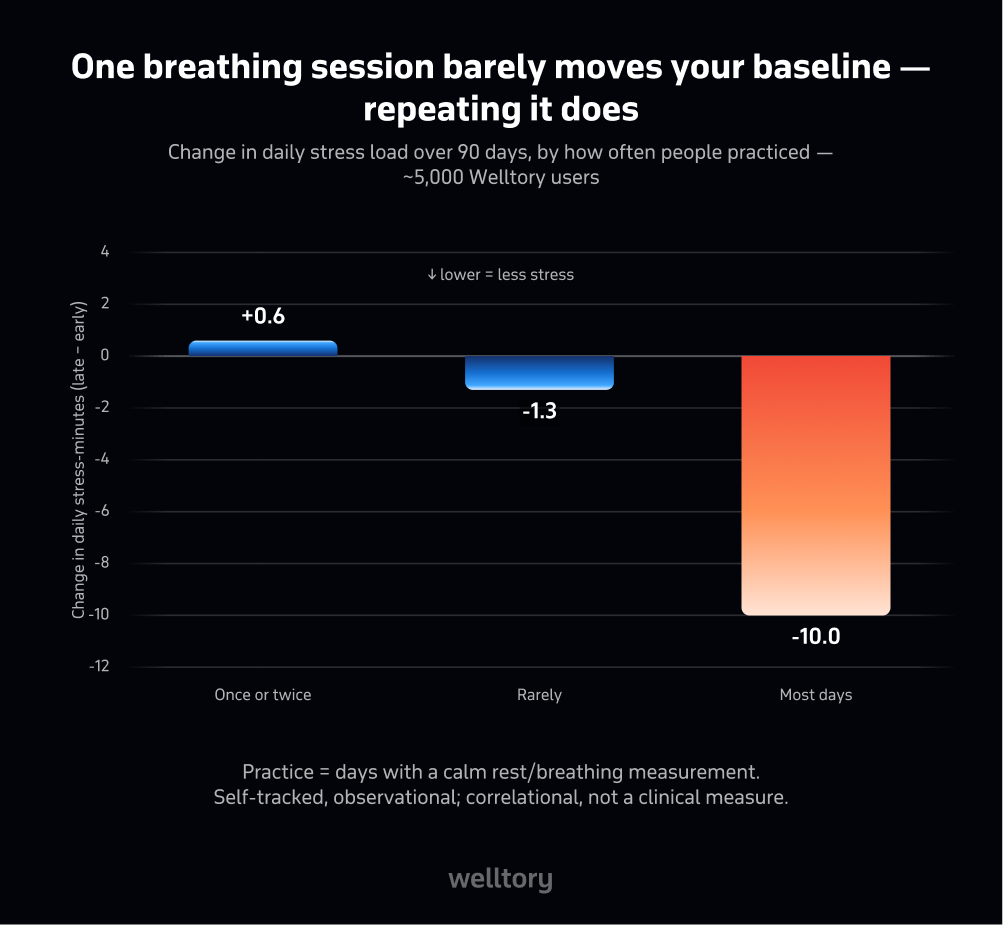
Over 90 days. Across roughly 5,000 Welltory users (December 15, 2025 – March 14, 2026), we grouped people by how often they practiced. Those who practiced frequently — on 73 or more of 90 days — saw their daily stress load fall by about 10 minutes from their first three weeks to their last three. Those who practiced rarely (56 days or fewer) barely changed (−1 minute). And those who did it essentially once or twice (3 days or fewer) actually drifted up (+0.6). By the end of the window, frequent practitioners averaged 221 stress-minutes a day versus 272 for the rare group.
It isn't just "calmer people practice more." When we held each person's starting stress level constant, frequent practitioners still came out ahead in every band — and most where it mattered most. Among the highest-stress group, frequent practitioners improved by 29 more stress-minutes than rare ones; in the middle band, by about 6; even in the lowest-stress band, they drifted up 15 minutes less. The benefit scaled with need.
One honest caveat. The morning HRV score barely moved across these groups — the payoff showed up in stress load, not in that particular HRV number. And this is an observational pattern, not a controlled trial: it shows repetition tracking with lower stress, not proof that breathing alone caused it.
Cohort Finding — Block 3: Methodology Box
This analysis is based on roughly 5,000 self-tracked Welltory users (Apple Watch / iPhone Health + Welltory) over a 90-day window (December 15, 2025 – March 14, 2026), from a cohort of 5,061 users and 448,496 user-days. In Welltory, a measurement is a short calm/stillness (breathing) exercise. The in-the-moment effect is the same-day stress reduction recorded during a rest/breathing measurement. Practice frequency is the number of days (of 90) with at least one rest/breathing measurement; we split users into frequent (top third, 73+ days), rare (bottom third, ≤56 days), and near-one-time (≤3 days). Change over time is each user's average daily stress-minutes in the last three weeks minus the first three weeks. To rule out reverse causation — the idea that calmer people simply practice more — we repeated the comparison within tertiles of baseline (early-window) stress. This is an observational, self-selected, engaged app population; the analysis is correlational, some regression to the mean is present (which is exactly why we compare within baseline groups), and every metric is a physiological signal, not a clinical diagnosis.
Cohort Finding — Block 4: Story Block
One anonymized trajectory from the highest-stress group looked like a quiet turnaround. In the first weeks, this user's stress load ran high, and they started doing a short calm measurement most days — some mornings, some evenings after work. Nothing dramatic happened on day one; the in-the-moment drop was small. But the daily readings kept accumulating, and by the last three weeks of the window their average stress load had fallen sharply from where it started. The contrast in the data was with users who opened the app, did a measurement once or twice, felt little, and stopped — their stress didn't move. The difference wasn't the technique. It was the repetition.
What a slow breathing session actually does to your nervous system
Slow breathing isn't just "calming yourself down" — it has a specific physiological handle. Breathing at around six breaths per minute is the rate at which your heart rate and breath fall into sync with the baroreflex, producing the largest heart-rate oscillations and the highest heart rate variability (HRV). At that pace, slow breathing increases activation of the vagus nerve — the main nerve of the parasympathetic, "rest-and-digest" branch — and shifts your autonomic balance away from fight-or-flight. In controlled studies, slow-paced breathing at six breaths per minute reliably raises markers of cardiac vagal activity such as RMSSD. (onlinelibrary.wiley.com) That's the "signal" behind the calm — and it's why breathing is the rare stress tool you can steer on purpose.
The in-the-moment effect is real — but modest
Here's where our own data meets the science. In Welltory users, a single calm breathing measurement lowered the stress reading by about 3.6 points, on 61% of the days it was done — a real, immediate dip, but a small one. That matches what trials find: a single session of slow breathing can blunt physiological arousal and is especially helpful for people with high anxiety, but the size of any one session is limited. (nature.com) In other words, one calm minute genuinely helps you right now — it just doesn't rewrite your baseline by itself. Which is exactly why the next section matters.
Why one session isn't enough: breathing is a skill you train
The real change comes from repetition. A meta-analysis of randomized controlled trials found that breathwork significantly lowers self-reported stress, anxiety, and depressive symptoms — and these are programs, practiced over time, not single breaths. (nature.com) The mechanism is training, not magic: repeatedly nudging your system toward parasympathetic activity appears to build more flexible autonomic regulation, the way repeated workouts build fitness. Structured HRV-biofeedback and slow-breathing practice have been shown to reduce perceived stress when done regularly over weeks. (pubmed.ncbi.nlm.nih.gov)
Our data tells the same story from the other direction. The people whose baseline stress load actually fell over three months were the ones who practiced most days — not the ones who tried it once. A single session is a state change; a repeated practice is a trait change. Think of breathing less like a painkiller and more like a muscle.
Who benefits most — and why that's encouraging
The most reassuring part of our finding is who gained the most. When we compared frequent and rare practitioners within the same starting-stress level, the people carrying the heaviest stress load saw the biggest advantage from practicing regularly — about 29 more stress-minutes of improvement than their rarely-practicing peers, versus a smaller edge in the calmer groups. In plain terms: if your stress runs high right now, a repeated breathing practice is where you may have the most to gain, not the least. This is an association in self-tracked data, not a promise or a treatment — but it points the same way as the trial evidence, and it's an encouraging place to start.
How to build a breathing practice that actually sticks
The takeaway isn't a fancier technique — it's consistency. A few principles that fit what both the research and our data show:
Short and frequent beats long and rare. A couple of minutes most days does more than a long session once a month. Repetition is the ingredient.
Anchor it to something you already do — after waking, before bed, or after meetings — so it doesn't depend on remembering.
Keep the technique simple. Slow breathing at roughly five to six breaths per minute for two to five minutes is the core. Some people extend the exhale; that's fine, but studies suggest how slow and how regular you breathe matters more than the exact inhale-to-exhale ratio. (sciencedirect.com)
Measure it, so you can see the response. Watching your own stress dip can make the habit easier to repeat.
Aim for regular, not perfect. A missed day isn't failure; the trend over weeks is what moves.
Three traps undo the benefit: expecting a single session to fix everything, quitting after a couple of tries because it felt small, and only breathing during acute stress rather than building the habit on ordinary days.
How to read your own stress-and-practice pattern
You can watch this in your own data, no special test required. Notice three things: whether you do a calm measurement regularly, whether your stress dips in the moment when you do, and — most importantly — whether your baseline stress load drifts down over the weeks as the practice becomes a habit. One reading is a snapshot; the trend across weeks is the real signal. Your wearable can't tell you the whole story, but it can show you whether repetition is paying off — and, as our data suggests, that's where the payoff lives.


Discounts for blog readers: up to 36% off
See what affects your energy, stress, sleep, and daily state with Welltory
Two adjacent pieces: breathlessness on exertion and what it means, and the window of tolerance, which is what breathing practice is really widening.
This article is for educational purposes only and is not medical advice. It describes how slow breathing affects stress physiology in the research literature and in aggregated Welltory data. If stress or anxiety is affecting your health, mood, or daily life, talk to a qualified clinician.
Was this helpful?
Ask AI for a summary of page


Written by Jane Smorodnikova

The founder and CEO of Welltory. A recognized tech leader with two Master's degrees and experience at MIT, she has scaled Welltory to over 17 million users.
Written by Tatsiana Yashyna

Deputy COO at Welltory. With a background in medicine and years of working with health data, she translates research and real physiological signals — sleep, stress, heart rate, and hormones — into clear, evidence-based explanations that help people understand what their bodies are telling them.
Reviewed by Anna Elitzur
-2.jpg)
With her medical degree, Anna reviews Welltory's health content for medical accuracy and alignment with current clinical guidelines and research.
References
- Laborde S et al. Psychophysiological effects of slow-paced breathing at six cycles per minute with or without HRV biofeedback. Psychophysiology. 2022. https://onlinelibrary.wiley.com/doi/10.1111/psyp.13952
- Single slow-paced breathing session at six cycles per minute: dose-response on cardiac vagal activity. PMC. https://www.ncbi.nlm.nih.gov/pmc/articles/PMC8656666/
- Effect of breathwork on stress and mental health: a meta-analysis of randomised-controlled trials. Scientific Reports. 2023. https://www.nature.com/articles/s41598-022-27247-y
- The effect of slow breathing in regulating anxiety (single-session and high-anxiety findings). Scientific Reports. 2025. https://www.nature.com/articles/s41598-025-92017-5
- Enhancing wellness: a systematic review of biofeedback interventions (perceived stress, autonomic measures). Frontiers in Psychiatry. 2026. PMID 41918582. https://pubmed.ncbi.nlm.nih.gov/41918582/
- Slow breathing for reducing stress: the effect of extending exhale. ScienceDirect. https://www.sciencedirect.com/science/article/pii/S0965229923000249