
Are vacations overrated?
We compared five vacation types to see whether people came back recharged. Their body data showed no clear improvement in the first week after returning. People often slept worse and had lower energy scores on vacation. After coming home, their scores were generally close to where they started.

-2.jpg)

Which vacation helps you recharge most?
We wanted to find out which type of vacation helped the body recover best. But the results surprised us: none showed a clear improvement in the measured recovery indicators during the first week after returning.
The study included 325 US Welltory users with Apple Watches, covering beach, mountain, city, mixed, and other vacations. We compared energy, body resilience, sleep quality, sleep duration, and stress before vacation, during the trip, and in the first seven days after returning.
We also examined averages across the first 14 days after returning to see whether a longer follow-up showed a different pattern.
Away from home, sleep and energy scores fell
Average sleep quality, energy, and body resilience scores declined during vacation.
Sleep quality fell from 80.89 to 75.88, energy from 38.39 to 36.64, and body resilience from 92.22 to 90.87. Average stress increased from 26.43 to 29.62, while sleep duration fell from 6.80 to 6.64 hours per night.
Average sleep quality declined in every vacation category. Taking a break from everyday life did not automatically translate into better scores during the trip.
Back home, back near baseline
In the first week after returning, sleep scores moved back toward their pre-vacation levels. Energy and resilience remained slightly below them, while average stress was almost unchanged.
Some averages improved, but none of the five measures showed a statistically significant post-return improvement, either overall or within any vacation category, after accounting for multiple comparisons.
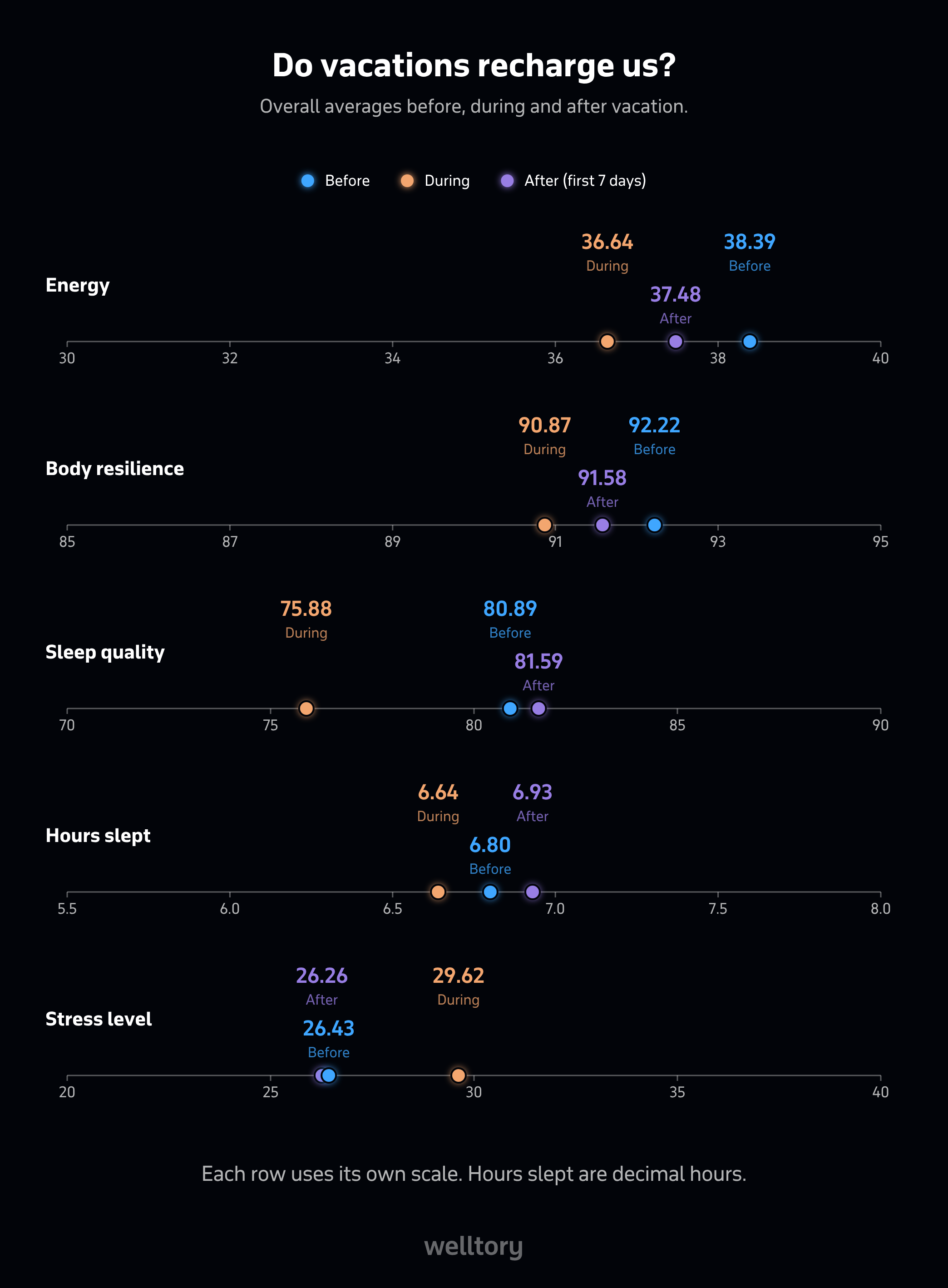
The two-week follow-up showed a similar overall picture. Energy and resilience averages were slightly below baseline, while sleep scores and sleep duration were slightly above it. None of the overall changes was statistically significant after adjustment. These averages cover the full first fortnight, rather than the second week alone.
No clear winner among vacation types
No vacation category showed a statistically significant improvement in the five measures during the first week after returning, after adjustment.
City travellers recorded slightly higher average sleep scores after returning, while mountain travellers recorded slightly higher energy scores. However, the results do not provide enough evidence to identify a vacation type that reliably improved these measures.
Individual experiences can differ. These findings describe group averages, not how every person responded to their trip.
Recovery takes more than a vacation
These findings are not a reason to cancel your next trip. Enjoyment, time with loved ones, and fresh inspiration can make a vacation worthwhile. Those experiences are separate from the physiological indicators measured here.
The data tells a narrower story: we did not detect a clear post-vacation improvement in the measures studied. That does not establish that vacations have no benefits.
It raises a useful question: are we expecting occasional breaks to carry too much of the responsibility for our wellbeing? Two or three vacations a year should not be treated as a replacement for looking after ourselves throughout the year.
Commenting on the findings, Dr. Anna Elitzur, Mental Health Expert at Welltory said:
We cannot expect two or three vacations a year to take care of our overall wellbeing. The body regulates sleep, alertness, and stress responses every day, through circadian rhythms and the nervous system. Supporting those processes takes consistent sleep, physical activity, and stress management. Vacations can complement those habits, but they cannot replace them.
Methodology
We calculated each participant’s average within each comparison period, then averaged those results. The baseline covered days 21–8 before departure, with follow-ups covering days 1–7 and days 1–14 after return. Missing data was excluded, and analytical sample sizes vary by measure. Statistical tests compared each person’s post-return values with their own baseline and included adjustments for multiple comparisons. This observational study measured physiological indicators, not happiness or enjoyment, and cannot establish that vacations caused the changes.
Find the full table with data here


Discounts for blog readers: up to 36% off
See what affects your energy, stress, sleep, and daily state with Welltory
Was this helpful?
Ask AI for a summary of page


Written by Mariia Ermatova
Project manager and brand advocate at Welltory. She helps turn complex health data into engaging stories and meaningful user experiences.
Written by Anna Elitzur
Medical doctor and mental health expert at Welltory. With expertise in behavioral health, AI in healthcare, and psychological systems design, she explores innovative ways to improve well-being through science, data, and technology.