

Short Answer
Waking up already anxious — heart going, stomach tight, dread arriving before you've even remembered your to-do list — is a real and common experience with a physiological basis. Every morning your body produces a cortisol awakening response (CAR): a sharp, normal surge of the alertness hormone cortisol in the first 30–45 minutes after you wake, meant to get you up and going. In a calm, well-rested person that surge feels like waking energy. But under chronic stress or anxiety, the same surge can land as panic instead of pep — and a bad night makes it worse. In Welltory data, the morning stress reading after a poor night's sleep is more than double that after a good night (about 17.4 vs 7.2), with far lower morning energy. So "why am I so anxious the moment I wake up?" often has two answers stacked together: a normal cortisol spike, amplified by poor sleep and a keyed-up nervous system. The reassuring part is that the morning is also very responsive to a few simple changes. This article explains the mechanism and what genuinely calms it.
Cohort Context: a bad night sets up an anxious morning
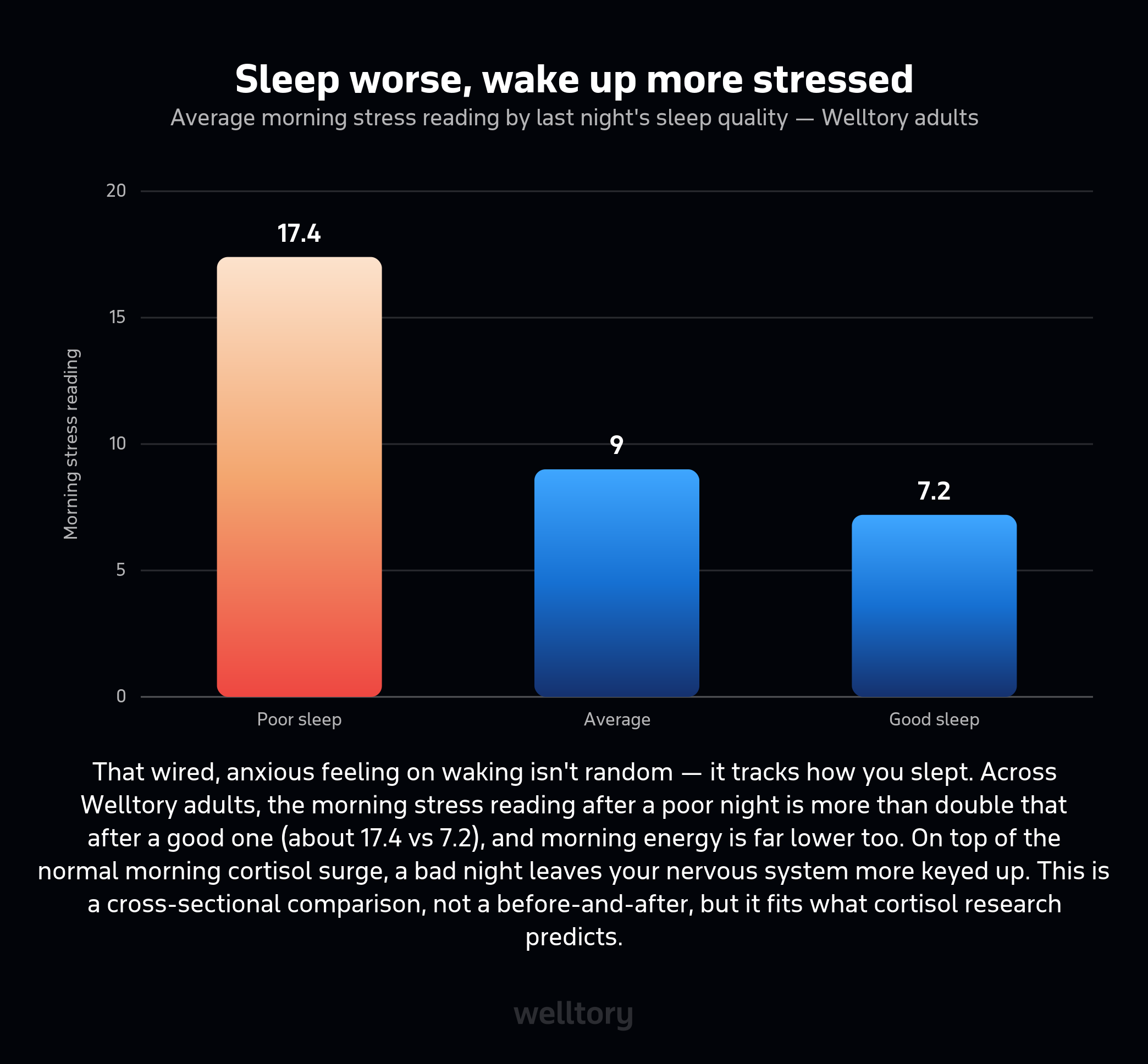
Grouping nights by sleep quality shows how strongly the previous night shapes the morning. After a poor night, the body wakes far more stressed and depleted:
Poor sleep: morning stress reading about 17.4, morning energy ~69.
Average sleep: morning stress about 9.0, morning energy ~85.
Good sleep: morning stress about 7.2, morning energy ~88.
That's a morning stress level more than twice as high after a bad night as after a good one, with a big energy gap to match — a cross-sectional snapshot, not a before-and-after, but a strong, consistent pattern.
The morning cortisol surge is normal — until it isn't
Cortisol isn't the villain here; it's supposed to spike in the morning. The cortisol awakening response is a well-documented feature of your daily rhythm: cortisol rises sharply — on the order of 60–150% — within about 30 minutes of waking, an indicator of your HPA (stress) axis switching on for the day, and it's closely tied to your general life stress. (sciencedirect.com) In a rested, calm body, you barely notice it. The trouble starts when that surge is dysregulated. In people carrying chronic stress or anxiety, the awakening cortisol response can be exaggerated and steeper — one study found anxious patients showed a significantly steeper 30-minute cortisol increase — so the normal "wake up" chemical arrives as a jolt of alarm rather than gentle alertness. (sciencedirect.com) (Honestly, the research is mixed — some anxious people show a flatter response instead — but the throughline is a stress axis that isn't regulating the morning smoothly.)
Why poor sleep makes the morning worse
Layer poor sleep on top and the morning gets harder still. Chronic insomnia and stress are states of hyperarousal, with elevated cortisol across the day and night, consistent with an overactive nervous system rather than simple tiredness. (pubmed.ncbi.nlm.nih.gov) A bad night leaves you under-recovered and more physiologically stressed — which is exactly what our data shows: the morning stress reading after a poor night is more than double that after a good one. So morning anxiety often isn't a mystery mood; it's a measurable state produced by a rough night meeting a normal cortisol surge in an already keyed-up system. That reframing matters, because it points straight at the levers that help.
What calms the morning
The good news is that mornings respond well to small, concrete changes — most of which either lower the cortisol surge or stop you from feeding it:
Don't reach for your phone. Checking email, news, or social feeds in the first minutes hands your already-spiking cortisol a fresh stressor. Delay it until after your morning routine.
Get light and move. Morning daylight anchors your body clock, and gentle movement — a short walk or stretch — helps metabolize excess cortisol and shifts you toward calm.
Eat something, with protein. A protein-containing breakfast steadies blood sugar, which otherwise dips and adds another cortisol nudge.
Breathe and slow down. A few minutes of slow, long-exhale breathing directly calms the nervous system driving the anxiety; waking 15–30 minutes earlier removes the rush that amplifies it.
Protect your sleep. Since a poor night sets up an anxious morning, the highest-leverage fix is upstream: consistent sleep and wake times, a cool dark room, and limiting late alcohol and caffeine.
Treat the underlying anxiety. If mornings are regularly overwhelming, CBT and professional support are effective — this is a common, treatable pattern, not a character flaw.
How to bring this up with your doctor — and what to ask for
Describe the sequence, because the order matters. Say: the anxiety is there before I have a thought to attach it to, it is worst in the first hour, and it eases as the morning goes on. That sequence — physical sensation first, explanation second — is clinically informative, and it separates a cortisol-driven pattern from a worry-driven one.
Ask for the physical causes to be ruled out. Thyroid function, and a blood count, are reasonable first requests: an overactive thyroid produces exactly this picture — early waking, a racing heart, and a sense of dread with no content. If mornings come after broken nights, ask whether sleep apnea should be considered too.
Ask about treatment by name. CBT has the strongest evidence for anxiety, and asking for a referral directly is far more effective than waiting for it to be offered. If alcohol is part of the evenings, say so — rebound anxiety the next morning is a specific, reversible mechanism and worth naming.
Bring the shape of your mornings. A two-week note of wake time, how long the dread lasted, sleep hours, and alcohol. If you track, add morning heart rate and HRV — a body that is already activated at 6 a.m. is objective support for what you are describing.
How Welltory helps you see (and shift) it
Because morning anxiety is a physiological state, your data can make it legible and give you a feedback loop. Watch your morning stress and energy, your HRV, and your sleep quality over time, and the link usually jumps out: poor-sleep nights are followed by higher morning stress and lower energy, exactly as in the cohort pattern above. That lets you test what actually helps you — whether protecting sleep, a phone-free first hour, morning light and movement, or breathing practice measurably softens your mornings and lifts your morning numbers over a couple of weeks. Two honest caveats: these readings are estimates and noisy day to day, so read the trend rather than one morning, and a tracker can't diagnose an anxiety disorder — if mornings are severe or tied to low mood, that deserves a professional. But for turning "I always wake up anxious" into a pattern you can understand and act on, an honest mirror is exactly the point.


Discounts for blog readers: up to 36% off
See what affects your energy, stress, sleep, and daily state with Welltory
This article is for educational purposes only and is not medical advice. If morning anxiety is severe, persistent, or tied to low mood, please talk to a doctor or mental-health professional. Welltory measures physiological signals like heart rate, HRV, sleep, activity, and stress; it does not diagnose anything.
Was this helpful?
Ask AI for a summary of page


Written by Jane Smorodnikova

The founder and CEO of Welltory. A recognized tech leader with two Master's degrees and experience at MIT, she has scaled Welltory to over 17 million users.
Written by Tatsiana Yashyna

Deputy COO at Welltory. With a background in medicine and years of working with health data, she translates research and real physiological signals — sleep, stress, heart rate, and hormones — into clear, evidence-based explanations that help people understand what their bodies are telling them.
Reviewed by Anna Elitzur
-2.jpg)
With her medical degree, Anna reviews Welltory's health content for medical accuracy and alignment with current clinical guidelines and research.
References
- The cortisol awakening response (CAR) — a 60–150% morning cortisol rise within ~30 minutes, HPA-axis activation linked to life stress. ScienceDirect (overview). https://www.sciencedirect.com/topics/neuroscience/cortisol-awakening-response
- Abnormal cortisol awakening responses (steeper 30-minute increase) in anxious patients. ScienceDirect (Journal of Psychosomatic Research). https://www.sciencedirect.com/science/article/abs/pii/S0022395620308566
- Vgontzas AN et al. Chronic insomnia and stress are associated with HPA-axis activation (elevated cortisol, hyperarousal). Journal of Clinical Endocrinology & Metabolism. 2001. https://pubmed.ncbi.nlm.nih.gov/11502812/
- Welltory adult cohort context (morning stress reading and morning energy by last night's sleep quality). Reproducible script: `persona_lab/scripts/morning_anxiety_sleep.py`.


