
Social battery: why socializing is exhausting, and how to recharge
The social battery is a metaphor, but the cost behind it is measurable: self-monitoring, hiding reactions and feeling judged all take effort, and the tiredness often arrives hours later. It shares one pool of energy with your sleep and your week.

Short answer
A social battery is a popular metaphor, not a scientific measure, for how much energy being around people costs you. The drain is real: in one 12-day study, sociable behaviour lifted mood at the time but predicted more fatigue about 3 hours later, in introverts and extraverts alike. If a quiet day recharges you, that is normal; if you dread everyone for two weeks or more, look deeper.
Before you blame yourself, check what your body already recorded. Needing time alone after a dinner, a party or a family visit is not a character flaw and not a sign that you are bad with people. The cost usually comes from effort you do not notice — watching yourself, reading others, holding back — and from what the rest of your week has already taken.
Note: this article explains a popular idea and the research around it. It is not medical or psychological advice. If avoiding people has come with low mood, panic or thoughts of self-harm, the sections on when it is something else and on talking to your doctor say where to start.
What is a social battery?
"Social battery" is an everyday metaphor that took off on social media: you start with a certain charge, each interaction uses some of it, and time alone refills it. When it is low, you want to cancel plans, stop answering messages and sit in a quiet room.
It is not a clinical term, and researchers do not measure anything called a social battery. But the metaphor points at things that are studied: how much effort social situations demand and how that effort shows up as fatigue.
Two things the metaphor gets right:
Social contact has a cost as well as a benefit. Even pleasant interactions use attention, memory and self-control.
The cost can arrive late. Many people feel fine during a party and tired the next morning. That delay is part of what the research shows.
Two things it gets wrong:
It suggests a fixed capacity. In reality, your "charge" depends on sleep, stress, health and who you are with.
It suggests all people drain the same. They do not. A close friend on a walk and a tense work dinner are not the same draw, even if they last the same time.
A more accurate version of the metaphor: you have one battery, not a separate social one, and socializing is one of several things that draw on it.
Why is socializing so exhausting, even with people you like?
Because a lot of the work is invisible. Here is what research has found about the effort behind an ordinary conversation.
Being sociable feels good now and tiring later. Sointu Leikas and Ville-Juhani Ilmarinen followed 48 adults for 12 days, asking about their behaviour, mood, stress and fatigue five times a day — 2,328 reports in total. When people had just been acting extraverted — talkative, outgoing, energetic — they reported better mood and less fatigue at that moment. But about 3 hours later, the same behaviour predicted more fatigue. Two details matter. The link was not moderated by personality traits, so it held for introverts as well as extraverts. And it ran partly through the number of people the person had met (doi.org). The social hangover is not an introvert quirk. It looks like a normal delayed cost of being "on".
Acting outgoing is not harmful for introverts. It helps to know what the research does not show. In experiments by John Zelenski and colleagues, people randomly assigned to act extraverted during group tasks in the lab reported more positive feelings, whether they were natural introverts or not, and without a rise in negative feelings. The only cognitive cost the researchers found — worse performance on a concentration task — appeared in natural extraverts told to act introverted (doi.org). So "I'm an introvert, social time is bad for me" is not what the evidence says. Social time can feel good and still leave a bill.
Holding back your reactions uses up mental resources. Jane Richards and James Gross asked people to watch emotional films or slides while hiding what they felt. Suppressing their expressions led to poorer memory for the details; reframing the situation in their heads did not. People who habitually suppress their feelings also showed poorer memory (doi.org). These are lab findings, but they suggest that an evening spent keeping your face neutral draws on the same mental resources you need for listening.
Hiding feelings also raises blood pressure — on both sides. Emma Butler and colleagues paired women who had not met and asked them to discuss an upsetting topic. When one was told to suppress her emotional expression, conversation suffered, rapport dropped, and blood pressure rose in her partner; in a second study it rose in both women (doi.org). Masking is not a private act. It changes the whole exchange.
Feeling judged is one of the strongest stressors there is. A meta-analysis by Sally Dickerson and Margaret Kemeny pooled 208 laboratory studies of stress hormones. The largest cortisol responses, and the slowest recoveries, came from tasks that combined social-evaluative threat — the sense that others could judge you — with a lack of control (doi.org). A job interview is the obvious example. A dinner with in-laws, a networking event or a first meeting with a partner's friends can carry the same ingredients.
Your senses are working too. Noise, crowds, music over conversation and bright light add load of their own. Two hours in a loud bar and two hours in a quiet kitchen are different events, even with the same friends.
Put together: it is rarely the number of people that drains you. It is how much self-monitoring the situation asks for. That is why an evening with one old friend can refill you while a small, formal dinner empties you.
Why do some people recharge you and others empty you?
Think about the people after whom you feel lighter. With them, you probably do less of the work described above: you do not choose every word, you do not hide your mood, you do not wonder how you are coming across.
Now think about the people after whom you need a quiet room. Often, something in the situation keeps you on guard. You might be unsure how they will react, or feel evaluated, or be managing their mood as well as your own.
Research on relationships and the body supports this distinction. Julianne Holt-Lunstad and colleagues had 102 healthy adults wear blood pressure monitors for 3 days, with a reading taken 5 minutes into each social interaction. On average, interactions with family members and spouses came with lower blood pressure. Interactions with people the participants felt ambivalent about — both positive and negative feelings towards the same person — came with the highest systolic readings (doi.org).
So "people drain me" is often too broad. A more useful version is: "certain contexts drain me — the ones where I can't be myself." That is something you can work with. You can choose settings, formats and company that ask for less performance, without cutting down on connection itself.
The opposite problem is real too: loneliness has its own physical cost, and withdrawing from everyone to protect your battery can backfire. Our article on loneliness and the nervous system looks at that side of the same scale.
Why family visits can drain you more than a party
A party with thirty people can leave you tired but fine, while an afternoon with your parents leaves you wrung out. Fewer people, people you love — so why the bigger cost?
The blood pressure study above found that family time is, on average, not a strain. So the issue is not family as such. It is what particular family situations tend to bring with them.
Old roles come back automatically. Around parents and siblings, many adults slip into a version of themselves from years ago: the responsible one, the peacemaker, the one who is always criticised. Playing a role you have outgrown takes effort.
The topics are loaded. Your job, your partner, your weight, your plans. With family, the same questions come back, and you prepare for them before you arrive.
You care what they think. Evaluation stings more from people whose opinion matters to you. That is the social-evaluative threat from the stress research, delivered by the people closest to you.
It is hard to leave. A party has an exit. A family visit may last a weekend, in someone else's house, with little private space. Low control is the other half of the recipe for the strongest stress response.
Caregiving can be part of it. If a parent is ill or ageing, a visit may also mean practical help, worry and decisions. That is a different kind of load from socializing, and it adds up.
None of this means something is wrong with your family, or with you. It means family visits often combine the most demanding ingredients at once. What tends to help: shorter visits, a place to stay nearby rather than in the house, an activity or walk to break up long conversations, one topic you decide in advance not to discuss, and a quiet evening planned for afterwards.
What is a social hangover?
A social hangover is the tired, flat, sometimes irritable feeling that arrives after a lot of socializing — often not right away but hours later or the next morning. People describe it as feeling "peopled out": a headache, low energy, no wish to talk, sometimes a replay of every awkward thing they said.
Research supports the timing. In the 12-day study above, the cost of acting sociable showed up as fatigue about 3 hours later, not in the moment. That fits the common experience of feeling great at a party and crashing on the way home.
Several other things usually pile onto a big social evening:
A later night. Social events push bedtime back, and the shorter night shows up the next day.
Alcohol. Drinking tends to disturb sleep, so the night can give less recovery than its length suggests.
Noise and crowds. Sensory load is tiring on its own.
Rumination. Replaying conversations keeps your mind on alert after you have left.
So a social hangover is often part social effort, part short sleep, part everything else that came with the evening. That is useful to know, because it means you can reduce it without seeing people less. Protecting sleep after a big night or choosing earlier formats may do more than cutting your social life.
Sleep also changes how social you feel in the first place. In a study by Eti Ben Simon and Matthew Walker, 18 young adults were kept awake for 24 hours. Afterwards they kept more distance from people approaching them — about 13% to 18% more than when rested — and 1,033 online viewers rated them as lonelier and less appealing to interact with (doi.org). A low social battery can simply be a short night talking.
Your week has a stress rhythm: what our data shows
A social battery does not recharge in a vacuum. It shares its reserves with everything else in your week. To see what that background looks like, we looked at stress load across the days of the week.
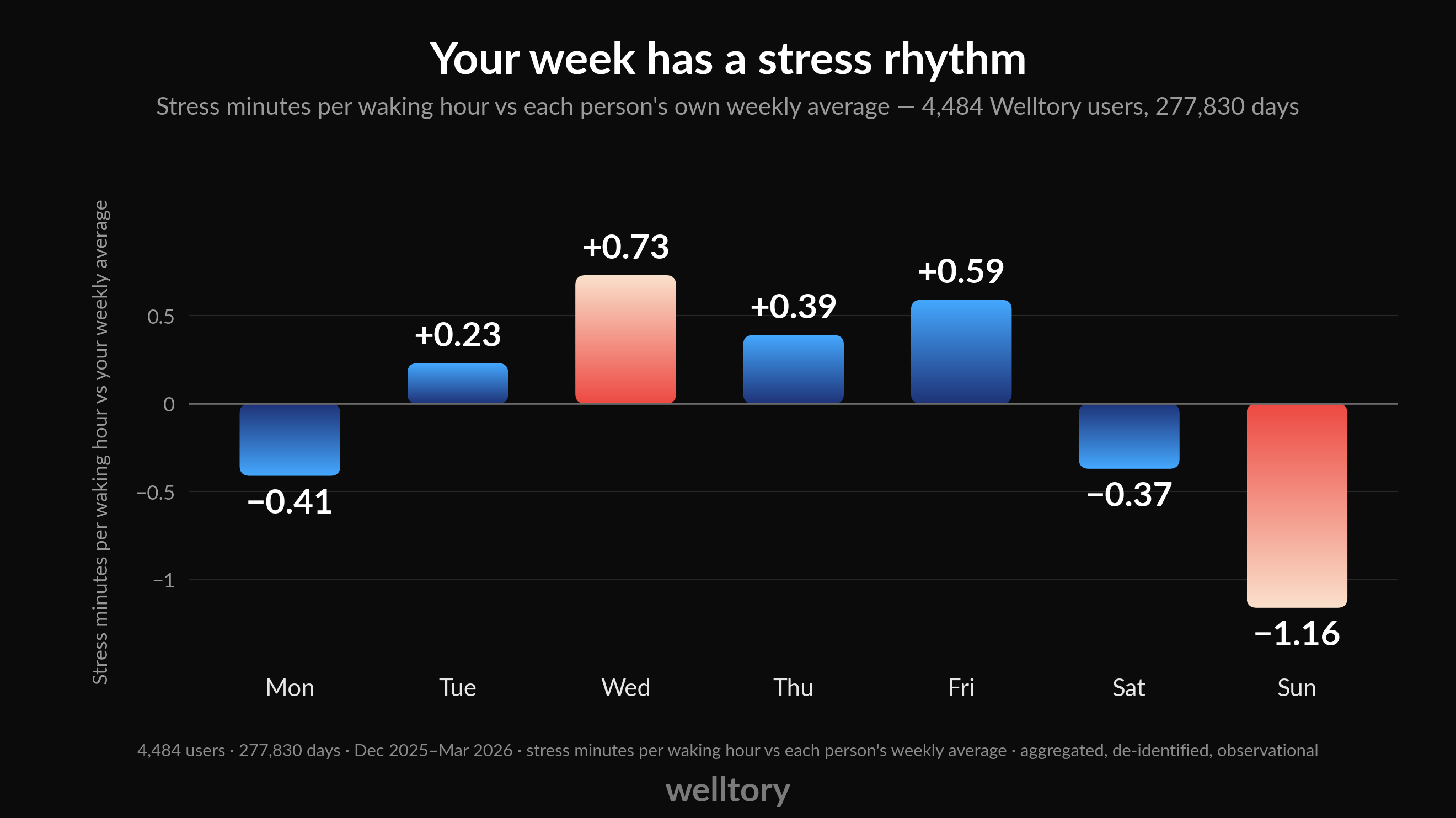
We used stress minutes — time the body spends in a physiological stress state, estimated from heart rate data — and compared each day with each person's own weekly average. The data covers 4,484 Welltory users and 277,830 days, from December 2025 to March 2026.
The week has a clear shape. Monday starts slightly below a person's average (−0.41 stress minutes per waking hour). Load climbs on Tuesday (+0.23) and peaks on Wednesday (+0.73). It stays above average on Thursday (+0.39) and Friday (+0.59). It eases on Saturday (−0.37) and reaches its lowest point on Sunday (−1.16).
In context: a typical load is about 19.0 stress minutes per waking hour. The gap between Wednesday and Sunday is roughly 1.9 minutes per hour — about 10% of a typical hour's stress load. That is not dramatic on any single day. But it describes a steady tilt: the middle and end of the working week carry more physiological load than the weekend.
The practical point: many social plans land on Thursday and Friday evenings, when the body is still carrying more stress than usual. The same dinner might feel easier on a Saturday or Sunday, when your baseline load is lower. And if you notice that a weekly family call or a regular after-work drink feels heavy, check which day it falls on before deciding it is the people. Our article on why weekends help you recover covers the recovery side of this rhythm.
A note on the data. This is observational data, aggregated and de-identified; no individual data is shown or shared. Stress minutes are an estimate of physiological stress load from heart rate data — they do not measure mood, and they do not measure socializing specifically. We cannot see who people were with or what they were doing on any given day. Weekend patterns differ by job, so shift workers and people who work weekends will have a different rhythm. Welltory users are not a random sample of the population. The pattern describes averages across many people and does not prove that any particular day, or any social event, causes a change in stress.
Is it introversion, social anxiety, or something else?
Needing time alone after socializing is common and usually harmless. But several different things can feel like "my social battery is low", and they call for different responses.
Introversion. A personality trait, not a problem. Introverts tend to prefer quieter settings and need more time alone to feel restored. Their energy returns after rest, and they do not fear social situations — they budget for them.
Social anxiety. Here the core is fear, not fatigue: fear of being judged, embarrassed or rejected, often with physical symptoms such as blushing, a racing heart or nausea, and worry for days before an event. Social anxiety disorder is common. The US National Institute of Mental Health estimates that 7.1% of US adults had it in the past year, and 12.1% experience it at some point in their lives (nimh.nih.gov). It responds well to treatment, especially cognitive behavioural therapy. If this sounds like you, our article on high-functioning anxiety may also help.
Depression. Pulling away from people can be a sign of low mood rather than a low battery. The difference: with depression, time alone does not restore you. You lose interest in things you used to enjoy, sleep and appetite change, and the heaviness lasts two weeks or more.
Burnout and chronic stress. When work or caregiving has used up your reserves for months, every interaction feels expensive.
Masking and autistic burnout. Many autistic adults describe "camouflaging" — hiding autistic traits and copying others to fit in. In a study of 92 autistic adults, Laura Hull and colleagues found that exhaustion was one of the main consequences people reported (doi.org). Research led by Dora Raymaker described autistic burnout as long-term exhaustion, loss of skills and reduced tolerance to sensory input, typically lasting 3 months or more, and found that reducing masking was part of recovery (doi.org). If socializing has always required intense effort to seem "normal", this is worth exploring with a clinician.
Sleep debt. As the sleep-deprivation study showed, a short night alone can make people pull back from others. If your social battery seems low only after poor sleep, the battery may be fine and the sleep may be the issue.
A quick way to sort these: does rest restore you? If a quiet day or two brings you back, introversion or ordinary social fatigue is the likely story. If you feel afraid before events, think about social anxiety. If rest does not help, the low mood lasts for weeks, or you are withdrawing from everyone, talk to a doctor. If you are in crisis or thinking about harming yourself, call or text 988 to reach the Suicide & Crisis Lifeline.
How to recharge your social battery: before, during, after
The aim is not to see people less. It is to make social time cost less, and to recover well afterwards.
Before
Check your reserves. A short night or a heavy workday lowers what you bring. If you can, avoid stacking a big social event on your most loaded day of the week.
Choose the format. A walk, a meal with a clear end, or a small group asks for less performance than an open-ended evening in a loud room.
Decide your exit. Knowing when you will leave gives you back a sense of control, which the stress research suggests matters.
During
Take small breaks. Step outside, help in the kitchen, take the longer route to the bathroom. A few minutes without conversation lets your attention reset.
Stay near your people. One person you can be yourself with lowers the monitoring load for the whole evening.
Drop some of the act. You do not need to be "on" all the time. Listening is a valid way to take part.
Watch alcohol and time. Both make the next day heavier.
After
Plan a quiet stretch. A slow morning or a free evening after a big event is recovery, not avoidance.
Protect your sleep. A regular bedtime after a late night helps more than a long lie-in.
Move gently. A walk alone, stretching, or time outdoors helps many people come down.
Let the replay go. Almost everyone replays awkward moments after an evening out.
If you often feel overloaded by social situations, the idea of a window of tolerance can help you notice when you are moving out of the zone where you can think and respond calmly.
How to bring this up with your doctor
Most social fatigue does not need a doctor. Book an appointment if it has changed recently, if rest does not help, or if it comes with fear, low mood or physical symptoms.
What to track for two weeks:
social events and how you felt during, right after and the next day;
your sleep each night, especially after late evenings;
your mood across the whole period, not only after seeing people;
physical signs: headaches, a racing heart, stomach upset, trouble sleeping.
What to say:
"I've always needed time alone after socializing, but lately even short contact exhausts me." This tells your doctor something has changed.
"I feel afraid for days before social events." This points towards anxiety rather than fatigue.
"Rest doesn't restore me anymore." This is an important clue for depression or burnout.
"I spend a lot of energy hiding how I really am around people." This can open a conversation about masking or neurodivergence.
What to ask:
Could this be social anxiety, depression or burnout, and how would we tell?
Is there a physical reason for my tiredness, such as a sleep problem or something in my blood work?
Would therapy help, and which kind — for example, cognitive behavioural therapy?
If I think I might be autistic or have ADHD, how can I get assessed as an adult?
Before you blame yourself, check what your body already recorded
After a night out that left you drained, it is easy to reach for a harsh story. "I'm antisocial." "I'm bad at friendships." "Other people can handle this, so something is wrong with me."
Look at what is visible first. A low social battery usually has a cause your body records: a short night, a week of heavy stress load, a Thursday dinner after a demanding Wednesday, a family visit that kept you on guard for hours. These are loads, not character flaws.
So give yourself permission to need recovery time without making it mean anything about who you are. Then change one lever:
move one regular social plan from a heavy weekday to the weekend;
protect the night after a big event;
swap one long evening for a shorter, calmer format;
or keep one standing plan with the person you feel most yourself with.
Watch the trend for one to two weeks. If the drain eases, you have found part of the answer. If it does not, and especially if rest has stopped helping, that is a reason to talk to someone.
How Welltory helps — and what it cannot do
The limits first. Welltory is a general wellness product with no regulatory clearance, and it does not diagnose anything — not social anxiety, not depression, not introversion. It does not know who you were with or what happened at an event unless you tell it.
What it can show is how your body responded to your days. You can see your sleep, how many minutes you spent in physiological stress, your Battery score for energy, your resting heart rate and your heart rate variability (HRV). The Battery is the closest thing to a real social battery: it reflects your physiological energy from sleep, stress and heart data, and our article on body battery explains how that kind of score works.
You can also note what happened. When Welltory detects a stress or recovery episode, you can tag it — "dinner with friends", "family visit", "work drinks", "quiet evening". Tags come only from episodes your body went through. After about two to three weeks, My Patterns can show which tagged situations tend to come before stressful stretches, and which tend to come before recovery.
That can answer the question behind a low social battery: is it people in general, certain settings, or the short night and busy week that came before? Your body's data is one signal, not a verdict — but it is often more consistent than memory.
How we made it
Made with AI tools, then edited and fact-checked by the Welltory team. See our Editorial & AI policy.
Data analysis by Jane Smorodnikova, co-founder of Welltory and the person who built the methodology behind how we read physiological data.
Written by Tatsiana Yashyna.


Discounts for blog readers: up to 36% off
See what affects your energy, stress, sleep, and daily state with Welltory
This article is for educational purposes only and is not medical or psychological advice. Social battery is an informal metaphor, not a diagnosis. Persistent withdrawal from people, fear of social situations, low mood lasting two weeks or more, or exhaustion that rest no longer relieves need assessment by a clinician; in a mental-health crisis, call or text 988. Welltory holds no regulatory clearance, is a general wellness product, and does not diagnose. Sources were retrieved on 29 September 2026.
Was this helpful?
Ask AI for a summary of page


Written by Jane Smorodnikova

The founder and CEO of Welltory. A recognized tech leader with two Master's degrees and experience at MIT, she has scaled Welltory to over 17 million users.
Written by Tatsiana Yashyna

Deputy COO at Welltory. With a background in medicine and years of working with health data, she translates research and real physiological signals — sleep, stress, heart rate, and hormones — into clear, evidence-based explanations that help people understand what their bodies are telling them.
References
- Leikas S, Ilmarinen VJ. Happy now, tired later? Extraverted and conscientious behavior are related to immediate mood gains, but to later fatigue. Journal of Personality 2017;85(5):603–615 (published online 2016). https://doi.org/10.1111/jopy.12264
- Zelenski JM, Santoro MS, Whelan DC. Would introverts be better off if they acted more like extraverts? Exploring emotional and cognitive consequences of counterdispositional behavior. Emotion 2012;12(2):290–303. https://doi.org/10.1037/a0025169
- Richards JM, Gross JJ. Emotion regulation and memory: the cognitive costs of keeping one's cool. Journal of Personality and Social Psychology 2000;79(3):410–424. https://doi.org/10.1037/0022-3514.79.3.410
- Butler EA, Egloff B, Wilhelm FH, Smith NC, Erickson EA, Gross JJ. The social consequences of expressive suppression. Emotion 2003;3(1):48–67. https://doi.org/10.1037/1528-3542.3.1.48
- Dickerson SS, Kemeny ME. Acute stressors and cortisol responses: a theoretical integration and synthesis of laboratory research. Psychological Bulletin 2004;130(3):355–391. https://doi.org/10.1037/0033-2909.130.3.355
- Holt-Lunstad J, Uchino BN, Smith TW, Olson-Cerny C, Nealey-Moore JB. Social relationships and ambulatory blood pressure: structural and qualitative predictors of cardiovascular function during everyday social interactions. Health Psychology 2003;22(4):388–397. https://doi.org/10.1037/0278-6133.22.4.388
- Ben Simon E, Walker MP. Sleep loss causes social withdrawal and loneliness. Nature Communications 2018;9:3146. https://doi.org/10.1038/s41467-018-05377-0
- Hull L, Petrides KV, Allison C, Smith P, Baron-Cohen S, Lai MC, Mandy W. "Putting on my best normal": social camouflaging in adults with autism spectrum conditions. Journal of Autism and Developmental Disorders 2017;47(8):2519–2534. https://doi.org/10.1007/s10803-017-3166-5
- Raymaker DM, Teo AR, Steckler NA, et al. "Having all of your internal resources exhausted beyond measure and being left with no clean-up crew": defining autistic burnout. Autism in Adulthood 2020;2(2):132–143. https://doi.org/10.1089/aut.2019.0079
- National Institute of Mental Health. Social anxiety disorder: statistics. https://www.nimh.nih.gov/health/statistics/social-anxiety-disorder

