

Short answer
Tdap vaccine pregnancy timing is the part that hasn't changed: one Tdap shot between 27 and 36 weeks in every pregnancy, ideally early in that window, because the antibodies you make cross the placenta and protect your newborn from whooping cough before the baby can be vaccinated (1, 14). For RSV you choose one of two routes for the baby: the RSV vaccine for you at 32 through 36 weeks if those weeks fall in September through January, or an antibody shot for the baby after birth; most babies don't need both (3, 4).
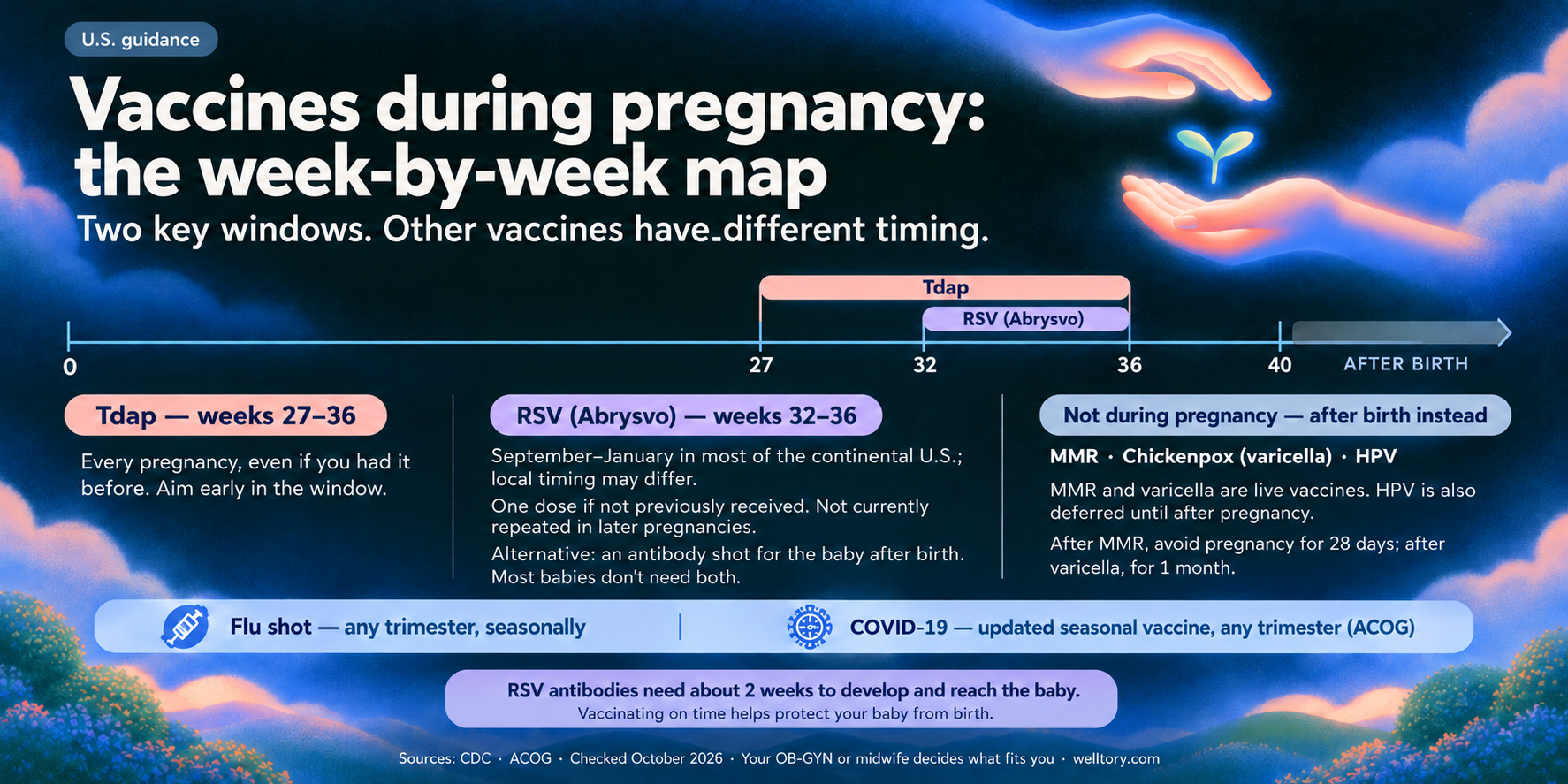
A flu shot fits any trimester, and as of October 2026 both CDC and ACOG list a 2026–27 COVID-19 vaccine for pregnant people (8, 10). Live vaccines such as MMR and chickenpox wait until after birth (2).
If the past year's headlines left you unsure, you're not imagining it: federal advice did shift, and the timing rules are fiddly. Your obstetric clinician (OB-GYN or midwife) decides what fits you.
Note: this article explains what guidelines and research say and is not medical advice; your OB-GYN or midwife decides which vaccines fit you and when. Call 911 for hives, swelling of the face or throat, trouble breathing, a fast heartbeat, dizziness or weakness after a shot. In pregnancy, a fever of 100.4°F or higher, a severe headache, vision changes, chest pain, bleeding or leaking fluid, or your baby moving less needs medical care right away (23, 27).
Vaccines during pregnancy at a glance: the week-by-week timeline
Two windows matter most: 27–36 weeks for Tdap and 32–36 weeks for the RSV vaccine.
| When | Vaccine | What CDC and ACOG say |
|---|---|---|
| Before pregnancy | MMR, chickenpox (varicella), HPV if not done | Check rubella immunity; avoid getting pregnant for one month after MMR (7) |
| Any trimester | Flu shot (not the nasal spray) | During flu season; ideally by the end of October (2, 7) |
| Any trimester | 2026–27 COVID-19 vaccine | Can be given at any point in pregnancy (8, 10) |
| Any trimester, if needed | Hepatitis B (if never vaccinated); Tdap for a wound or an outbreak | Hep B for unvaccinated adults 19–59; a Tdap given early is not repeated later (1, 2) |
| 27–36 weeks, earlier is better | Tdap (whooping cough) | Every pregnancy (1, 14) |
| 32 weeks 0 days – 36 weeks 6 days | RSV vaccine (Abrysvo), one dose | CDC: September–January in most of the US; ACOG: ideally September 1–March 1; first eligible pregnancy only (3, 6) |
| 37 weeks and later | No RSV vaccine | The baby gets an RSV antibody instead (3) |
| Birth to first week | Baby: RSV antibody if you weren't vaccinated (or gave birth within 14 days of it) | October–March, ideally before leaving the hospital (5) |
| After birth | You: MMR or chickenpox if not immune; Tdap only if you've never had it; finish HPV | Safe while breastfeeding (2, 14) |
Pregnancy vaccines by month: what your due date changes
Your due date mainly decides whether the RSV vaccine is an option for you or the baby gets the antibody; Tdap stays at 27–36 weeks whatever the month. RSV usually peaks in December and January (4). Working from CDC's September–January window, roughly:
| Due date (approximate) | Your weeks 32–36 fall in | RSV protection for the baby |
|---|---|---|
| Late October to late February | September–January | Your vaccine at 32–36 weeks, or the baby's antibody in the first week after birth |
| Late September to October, or March | Partly inside September–January | Your vaccine only on days that fall inside the window; otherwise the baby's antibody |
| April | February–March | CDC: the baby's antibody before the season (October–November). ACOG's window runs to March 1, so some offices may offer the vaccine (6) |
| May to mid-September | March–August | The baby's antibody shortly before RSV season, usually October–November (5) |
These are approximations; your clinician works from your exact dates, and Alaska and tropical areas such as southern Florida, Hawaii and Puerto Rico follow local timing (3).
For flu, September or October is preferred; in the third trimester a July or August shot can be considered so the baby is born protected (2).
Tdap vaccine pregnancy guide: timing, safety and the reason it repeats
What is the Tdap vaccine in pregnancy?
Tdap protects against tetanus, diphtheria and pertussis (whooping cough). In pregnancy the target is whooping cough in your newborn. Babies start their own DTaP series at 2 months, and about 7 in 10 whooping cough deaths are in babies younger than 2 months; many don't cough at all but stop breathing and turn blue (7). Both Tdap brands, Boostrix and Adacel, are FDA-approved in pregnancy (1).
Whooping cough hasn't gone away: US cases in 2024 were more than six times 2023's, peaking in November 2024 (25).
When to get Tdap in pregnancy: CDC's 27–36 weeks
CDC calls the optimal timing "between 27 and 36 weeks gestation, preferably during the earlier part of this period" (1). ACOG says the same and suggests linking the Tdap shot in pregnancy to the routine glucose screening for gestational diabetes, so it isn't forgotten (14).
The reasons for that Tdap pregnancy timing:
Antibody transport. Active transfer of maternal antibodies across the placenta "does not substantially take place before 30 weeks," and antibodies given earlier in pregnancy had faded by term in one study (15).
Two weeks to respond. Your body needs about 2 weeks after the shot to make protective antibodies (1).
After birth is too late for the baby. A postpartum Tdap gives the newborn no antibodies (1).
Tdap can be given earlier for a wound or an outbreak; it then isn't repeated at 27–36 weeks, since CDC recommends one dose per pregnancy (1).
Why Tdap during pregnancy, every time?
Because the antibodies fade fast. When CDC's advisers extended the recommendation to every pregnancy in 2012, they wrote that "antibody levels wane substantially during the first year after vaccination," so a dose in one pregnancy would not protect the next baby (15).
Is Tdap safe in pregnancy?
The large studies are reassuring. CDC reports that its national reporting system "has not found any safety signals" among pregnant women or their babies after Tdap (1). In 123,494 California pregnancies, Tdap was not associated with preterm birth, small-for-gestational-age babies or high blood pressure in pregnancy; it was linked to a small rise in diagnoses of chorioamnionitis, an infection of the membranes (6.1% vs 5.5%) (17). A later study of 118,211 pregnancies across eight US health systems found no association with chorioamnionitis, preterm birth or related infant problems, and noted that the diagnosis codes used in such studies are imprecise (18).
Tdap vaccine pregnancy side effects
Most are mild and pass on their own: a sore, red or swollen arm, mild fever, headache, tiredness, and sometimes nausea or an upset stomach (23, 1). Rates, how long reactions last and the rare ones are covered in our guide to vaccine side effects. In pregnancy, a fever of 100.4°F or higher is a reason to contact your OB-GYN or midwife right away rather than wait it out (27).
Tdap vaccine pregnancy pros and cons
Prevented 78% of whooping cough cases in babies under 2 months and 91% of hospitalized cases in a CDC evaluation (1, 16) — Protection isn't total; babies still need their own DTaP series
Protects you, so you're less likely to catch it and pass it on (1) — Needs repeating in every pregnancy (15)
No safety signals in national monitoring; no link to preterm birth in large cohorts (1, 17) — A sore arm or a tired day or two is common (23)
Even when it doesn't prevent infection, babies of vaccinated mothers had less severe illness (14) — One 2014 study linked it to more chorioamnionitis diagnoses; a 2023 study across eight health systems did not (17, 18)
CDC estimates only 59.6% of pregnant women get Tdap (1); if nobody has offered it by 30 weeks, ask.
RSV vaccine pregnancy: who, when, and which shot
The RSV vaccine for pregnant women is Abrysvo, one dose at 32 weeks 0 days through 36 weeks 6 days. It's the only RSV vaccine approved in pregnancy; the other two adult RSV vaccines, Arexvy and mResvia, are not approved in pregnancy, and CDC has had reports of that mix-up (3). At a pharmacy, ask for it by name (6).
RSV is the most common reason babies are hospitalized in the US (6); 2 to 3 of every 100 babies under 3 months are hospitalized with it each year (28).
When to get RSV vaccine in pregnancy
At 32–36 weeks, during the months set for your area. CDC recommends September through January in most of the continental US, and says not to vaccinate after 36 weeks 6 days, because there may not be time for antibodies to form and cross the placenta (3). ACOG's 2026–27 guidance gives a wider window, ideally September 1 through March 1 (6, 10).
It takes about 2 weeks for protection to form and pass to the baby (4). If you give birth less than 14 days after the shot, the baby is recommended to get the antibody too (5).
Does RSV vaccine in pregnancy protect baby?
Yes, for about the first six months. In the main trial of 7,358 pregnant women, the vaccine cut severe, medically attended RSV lung infections in babies by 81.8% in the first 90 days and 69.4% in the first 180 days (19).
Should I get the RSV vaccine while pregnant?
You're choosing between two recommended options, not between protection and none. ACOG calls both "safe and effective" and suggests weighing availability, your preference and your health (6). The question that makes some people prefer the baby's antibody is preterm birth: the trials saw slightly more preterm births with the vaccine, not statistically significant, so FDA limited it to 32 weeks and later; the label says the data can't establish or exclude a causal link (20). A French national study of about 25,000 vaccinated women found no increase in preterm birth or preeclampsia (22), while CDC lists high blood pressure disorders of pregnancy as still under study (4). For the numbers, see RSV vaccine in pregnancy and the preterm-birth question. Your obstetric clinician decides what fits you.
Only once: why RSV doesn't repeat each pregnancy
If you got an RSV vaccine in a previous pregnancy, CDC does not recommend another dose; your next baby gets the antibody instead (3). ACOG agrees, and CDC is still evaluating whether a repeat dose would help (6, 3).
RSV: shot for you or antibody for the baby?
Both routes give the baby ready-made antibodies. With the vaccine, you make them and pass them through the placenta. With nirsevimab (Beyfortus) or clesrovimab (Enflonsia), the baby is injected with lab-made antibodies; these "are not vaccines" and don't activate the baby's immune system (5).
| | RSV vaccine for you (Abrysvo) | RSV antibody for the baby (nirsevimab or clesrovimab) |
|---|---|---|
| When | 32–36 weeks, September–January in most of the US (4) | October–March; within the first week if born then, or shortly before the season if born April–September (5) |
| Protection starts | About 2 weeks after your shot (4) | Right away (4) |
| How long | About 6 months after birth (4) | At least 5 months (4) |
| Trial results | 82% fewer severe infant illnesses at 3 months, 69% at 6 months (3) | Nirsevimab: 80.6% fewer RSV hospitalizations; clesrovimab: 90.9%, over 150 days (5) |
| Common side effects | Arm pain, headache, muscle pain, nausea, in you (6) | Mild pain or swelling at the injection site, in the baby; allergic reactions are uncommon (5) |
| Still under study | High blood pressure disorders of pregnancy (4); the label leaves the preterm-birth question open (20) | No safety concerns in trials; rare serious allergic reactions reported since nirsevimab's 2023 approval (21) |
| Next pregnancy | Not repeated (3) | Each new baby can get it |
These numbers come from different trials with different endpoints, so they aren't a head-to-head contest. Clesrovimab was licensed in June 2025 and added to the federal Vaccines for Children program in April 2026 (12). The AAP's 2026–27 recommendation, as the AMA summarizes it, covers infant RSV immunization "unless it is demonstrated" that the mother was vaccinated, so keep your record and tell the pediatrician (10, 6).
How families tend to decide. Some prefer the vaccine: protection from the first breath, no newborn injection. Others prefer the antibody: it acts at once, sidesteps the preterm-birth question and can be timed to the season. Outside the vaccine window, the antibody is the route. You decide with your OB-GYN or midwife and your baby's pediatrician.
Flu shot during pregnancy
A flu shot is recommended in any trimester; it must be an inactivated or recombinant shot, never the nasal spray (2). A 2026 evidence review found that vaccination in pregnancy cut symptomatic flu in babies' first six months by 44% (10). For timing details, see flu shot while pregnant; babies can start their own flu shots at 6 months, covered in the flu shot for kids.
COVID vaccine pregnancy: where recommendations stand in October 2026
As of October 11, 2026, CDC and ACOG both list a 2026–27 COVID-19 vaccine for pregnant people, after shifting federal advice:
May 27, 2025: the HHS Secretary announced that CDC would no longer recommend COVID-19 vaccines for healthy pregnant women. ACOG's president said the organization was "extremely disappointed" and kept recommending COVID-19 vaccination in pregnancy (11).
March 16, 2026: a federal court stayed the new CDC vaccine advisers' appointments and decisions; CDC restored its July 2, 2025 schedules (12). The government's appeal was pending as of October 7, 2026 (13).
September 23, 2026: CDC said the COVID-19 recommendations of the July 2025 schedule stay in effect for 2026–27: a 2026–27 vaccine "is recommended for all adults ages 18 years and older" (9). CDC's pregnancy page (October 8, 2026) adds that vaccination "offers the greatest benefit" for people at higher risk, "including if you are pregnant," and can be given at any point in pregnancy (8).
September 2026: ACOG, with three other medical societies, recommends COVID-19 vaccination for people who are pregnant, considering pregnancy, or postpartum and breastfeeding (10).
CDC cites studies of more than a million pregnant women that found no increased risk of miscarriage, preterm delivery, stillbirth or birth defects (8). The 2026 evidence review found vaccination in pregnancy cut emergency or urgent-care visits by 58%, and hospital visits in babies' first year by 36% (10). Pharmacy rules vary by state (31), so call ahead. Your OB-GYN or midwife decides what fits you.
Who recommends what in October 2026: CDC and ACOG side by side
Tdap — CDC (as of October 2026): Every pregnancy, 27–36 weeks, early in the window (1); ACOG (current guidance): Same (14)
RSV (Abrysvo) — CDC (as of October 2026): 32–36 weeks, September–January; or infant antibody (3); ACOG (current guidance): 32–36 weeks, ideally September 1–March 1; or infant antibody (6)
Flu — CDC (as of October 2026): Any trimester, shot only (2); ACOG (current guidance): Pregnant or postpartum (10)
COVID-19 — CDC (as of October 2026): All adults 18+, any point in pregnancy (8, 9); ACOG (current guidance): Pregnant, planning, postpartum or breastfeeding (10)
Vaccines not given during pregnancy, and what to do postpartum
Live vaccines wait until after birth because of a theoretical risk to the fetus (2), one ACOG notes has never been documented (14).
MMR (measles, mumps, rubella) — During pregnancy: Not given; What to do: Get it after birth if you're not immune to rubella; avoid pregnancy for 28 days after a dose (2)
Chickenpox (varicella) — During pregnancy: Not given; What to do: After birth; avoid pregnancy for 1 month after each dose (2)
Nasal-spray flu (LAIV) — During pregnancy: Not given; What to do: Get the flu shot instead (2)
HPV — During pregnancy: Deferred; What to do: Finish the series after pregnancy; a dose given before you knew needs no action (2)
Shingles (Shingrix) — During pregnancy: No recommendation; What to do: Consider waiting until after pregnancy (2)
If you got one before you knew you were pregnant: CDC says MMR or chickenpox vaccination during pregnancy "should not be considered a reason to terminate pregnancy"(2). HPV vaccine registries have found no health concerns (2).
After birth, catch up on MMR and chickenpox if you aren't immune, and finish HPV. Breastfeeding is not a barrier: CDC's guidance quotes ACIP that neither inactivated nor live vaccines given to a breastfeeding mother "affect the safety of breastfeeding"; the exceptions are smallpox and, where possible, yellow fever vaccines (2). Tdap after birth is only for women who have never had Tdap; if you had it as a teen, an adult or in an earlier pregnancy, ACOG says not to repeat it postpartum (14).
Hepatitis B and travel, briefly. If you're 19 to 59 and have never had hepatitis B vaccine, CDC recommends it in pregnancy and lists Engerix-B, Heplisav-B, Recombivax HB or Twinrix (2, 26). For international travel, talk to your clinician 4 to 6 weeks ahead (7); yellow fever vaccine is given in pregnancy only if the trip's risk outweighs the vaccine's (2).
Do dads need to get Tdap every pregnancy?
No. The every-pregnancy rule is for the pregnant person, because her antibodies cross the placenta; a partner's shot can't do that. For partners, grandparents and other caregivers, CDC recommends one Tdap for any adult who has never had one, "at any time, regardless of when they last got Td," then a Td or Tdap booster every 10 years (24). Anyone not up to date should get it at least 2 weeks before meeting the baby (1).
Vaccinating everyone around a newborn is called "cocooning." CDC still recommends it but says it alone "may not be sufficient," which is why the pregnancy dose comes first (1). A yearly flu shot for the household helps protect a baby too young for one; see the flu shot for kids. Unsure of their history? Their own doctor or pharmacist decides.
Living with pregnancy vaccines: the questions people ask next
Can I get Tdap, flu, RSV and COVID shots on the same day?
Yes. CDC says the maternal RSV vaccine "can be administered during the same visit" as Tdap, COVID-19 and flu vaccines (3), and ACOG gives the same answer (6). If Tdap hasn't happened by 32 weeks, one visit can cover both; spacing them works too, as long as each lands in its window. Your OB-GYN, midwife or pharmacist can help plan it.
I'm 37 weeks and missed the RSV vaccine window. What now?
Your baby can still be protected. CDC says women past 36 weeks 6 days should not get the RSV vaccine, because there likely isn't time for antibodies to reach the baby; instead the baby gets an RSV antibody shortly before or at the start of the season (3). If the baby is born between October and March, that's ideally within the first week, during the birth hospital stay (5).
I had Tdap in my last pregnancy 18 months ago. Do I really need it again?
Yes. CDC's rule is one dose during each pregnancy "irrespective of the patient's prior history" of Tdap (2), because antibody levels drop substantially within a year and a previous dose won't give the new baby enough protection (15). ACOG says safety data remain reassuring for successive doses in close-together pregnancies (14). Mention any past severe swelling after a tetanus shot (23).
I have a cold. Should I still go to my vaccine appointment?
Usually yes. CDC says people with a minor illness such as a cold can get the RSV vaccine or Tdap, while those with moderate or severe illness, with or without fever, should usually wait until they recover (3, 23). Keep the windows in mind: if waiting would push you past 36 weeks 6 days, ask whether the baby's antibody makes more sense. In pregnancy, a fever of 100.4°F or higher is its own reason to call your OB-GYN or midwife right away (27).
Can I get these at a pharmacy instead of my OB's office?
Often, yes. ACOG says many pharmacies give the RSV vaccine, suggests asking whether you need a prescription stating you're 32–36 weeks, and reminds you to ask for Abrysvo by name (6). ACOG also says most insurance companies are required to cover the RSV vaccine and Medicaid covers it in all states (6). Tdap is available at most major pharmacies (14). Bring the record back so your chart and your baby's pediatrician know.
When to seek care, and how to bring this up with your OB-GYN or midwife
Call 911 after any shot for signs of a severe allergic reaction, even after you've left: hives, swelling of the face and throat, difficulty breathing, a fast heartbeat, dizziness or weakness (23).
In pregnancy and the year after birth, CDC says to seek medical care immediately for any urgent maternal warning sign: a headache that won't go away or gets worse; dizziness or fainting; vision changes; a fever of 100.4°F or higher; extreme swelling of the hands or face; trouble breathing; chest pain or a fast-beating heart; severe nausea and vomiting; severe belly pain; your baby moving less or stopping; vaginal bleeding or fluid leaking, or heavy bleeding after birth; swelling, redness or pain in a leg or arm; overwhelming tiredness; or thoughts of harming yourself or your baby (27). If a sign is severe or sudden, such as trouble breathing, chest pain, fainting or a seizure, call 911; for thoughts of harming yourself, you can also call or text 988.
For your newborn, call the pediatrician right away for a temperature of 100.4°F or higher under 3 months (29). Seek care for difficulty breathing, not drinking enough or worsening symptoms (28). Pauses in breathing or turning blue mean 911; with whooping cough, babies may not cough at all (7).
What to say at your next visit. "I'm [X] weeks, due [date]. Have I had Tdap this pregnancy? Given my due date, is the RSV vaccine an option, or should we plan the baby's antibody? Is my rubella immunity on file?" Mention any past severe allergic reaction to a vaccine, Guillain-Barré syndrome, or severe swelling after a tetanus shot (23).
What to ask. "Can I get these today?" "If we choose the antibody, does the hospital give it before discharge?" "Which vaccines should I plan for after birth?" Your OB-GYN or midwife decides with you; the baby's pediatrician decides for the baby.


Start understanding your body
Learn what affects your energy, stress, sleep, and daily state. Get the app.
How Welltory helps — and what it cannot do
The limits first. Welltory is a general wellness product, not a medical device. It does not diagnose, detect, predict, monitor, prevent, treat or mitigate any condition, including vaccine reactions or pregnancy complications. It does not monitor your baby or your pregnancy, and it can't tell you whether a symptom is expected or a vaccine worked.
What it can do is keep a record of your own days. Pregnancy changes your heart on its own: in a study of 58 women who wore smartwatches through pregnancy and three months after, nighttime heart rate rose in the second trimester and fell in the third, while heart rate variability (HRV) did the opposite (30). So the useful comparison is with your own recent days, not with last year or anyone else.
You note the shot; the app records the rest. Add a tag from the plus sign at the top of the feed ("Tdap 28 weeks", "sore arm"). When the Today screen marks a stress or rest stretch, it asks "What happened?"; tap a suggested tag, type or talk, and correct the tags before saving.
Look at the next nights next to the nights before. Sleep analysis shows how your heart rate changed overnight; resting heart rate, HRV, stress minutes and Battery are recorded the same way every day (Battery and stress minutes need iOS with an Apple Watch or Oura; detailed sleep analysis needs an Apple Watch). Outside pregnancy, a smartwatch study after mRNA COVID-19 vaccines saw resting heart rate rise from each person's own baseline for a few days (32); we found no wearable study of Tdap or RSV vaccination in pregnancy. Your numbers sit next to your own history, not a line marked normal.
Over a few months, My Patterns shows what your tags have in common. My Patterns collects tags from stress and rest stretches (iOS with an Apple Watch or Oura); patterns appear at around seven tagged events in a month, so two shots alone won't make one.
A record you made, for an appointment. The Journal (Premium) keeps your measurements, tags and notes; from the web app you can export a CSV (Dashboard → choose a chart → Export). A dated note such as "Tdap at 28 weeks, tired for a day" is easy to show your OB-GYN or midwife. Any pattern is an association to discuss with them, not a cause.
The same red flags apply here, in the same type size: hives, swelling of the face or throat, trouble breathing or a fast heartbeat after a shot means 911. A fever of 100.4°F or higher, a severe headache, vision changes, chest pain, bleeding or leaking fluid, or your baby moving less needs care right away, whatever your data shows (23, 27).
How we made it
Made with AI tools, then edited and fact-checked by the Welltory team. See our Editorial & AI policy.
Data analysis by Jane Smorodnikova, co-founder of Welltory and the person who built the methodology behind how we read physiological data.
Written by Tatsiana Yashyna.


Discounts for blog readers: up to 36% off
See what affects your energy, stress, sleep, and daily state with Welltory
This article is for educational purposes only and is not medical advice; your OB-GYN or midwife decides which vaccines fit you and when. Call 911 for hives, swelling of the face or throat, trouble breathing, a fast heartbeat, dizziness or a seizure after a shot. In pregnancy, a fever of 100.4°F or higher, a severe headache, vision changes, chest pain, bleeding or leaking fluid, or your baby moving less needs medical care right away. Welltory is a general wellness product and does not diagnose, detect or predict any condition and does not monitor pregnancy.
Was this helpful?
Ask AI for a summary of page


Written by Jane Smorodnikova

The founder and CEO of Welltory. A recognized tech leader with two Master's degrees and experience at MIT, she has scaled Welltory to over 17 million users.
Written by Tatsiana Yashyna

Deputy COO at Welltory. With a background in medicine and years of working with health data, she translates research and real physiological signals — sleep, stress, heart rate, and hormones — into clear, evidence-based explanations that help people understand what their bodies are telling them.
References
- Centers for Disease Control and Prevention. Vaccinating pregnant patients (whooping cough). December 2, 2025. https://www.cdc.gov/pertussis/hcp/vaccine-recommendations/vaccinating-pregnant-patients.html
- Centers for Disease Control and Prevention. Guidelines for vaccinating pregnant women. August 22, 2025. https://www.cdc.gov/vaccines-pregnancy/hcp/vaccination-guidelines/index.html
- Centers for Disease Control and Prevention. RSV vaccine guidance for pregnant women. August 30, 2024. https://www.cdc.gov/rsv/hcp/vaccine-clinical-guidance/pregnant-people.html
- Centers for Disease Control and Prevention. Immunizations to protect infants (RSV). August 18, 2025. https://www.cdc.gov/rsv/vaccines/protect-infants.html
- Centers for Disease Control and Prevention. RSV immunization guidance for infants and young children. August 18, 2025. https://www.cdc.gov/rsv/hcp/vaccine-clinical-guidance/infants-young-children.html
- American College of Obstetricians and Gynecologists. The RSV vaccine and pregnancy (FAQ534). Last updated September 2026. https://www.acog.org/womens-health/faqs/the-rsv-vaccine-and-pregnancy
- Centers for Disease Control and Prevention. Vaccine recommendations before, during, and after pregnancy. October 7, 2026. https://www.cdc.gov/vaccines-pregnancy/recommended-vaccines/index.html
- Centers for Disease Control and Prevention. Women who are pregnant or breastfeeding and COVID-19 vaccines. October 8, 2026. https://www.cdc.gov/covid/vaccines/pregnant-or-breastfeeding.html
- Centers for Disease Control and Prevention. Interim clinical considerations for use of COVID-19 vaccines in the United States. September 23, 2026. https://www.cdc.gov/covid/hcp/vaccine-considerations/index.html
- American Medical Association. Doctors united on respiratory virus vaccine recommendations. September 2, 2026. https://www.ama-assn.org/public-health/prevention-wellness/doctors-united-respiratory-virus-vaccine-recommendations
- Soucheray S. RFK Jr says no COVID vaccines for healthy children, pregnant women. CIDRAP, University of Minnesota. May 27, 2025. https://www.cidrap.umn.edu/covid-19/rfk-jr-says-no-covid-vaccines-healthy-children-pregnant-women
- Immunize.org. CDC restores official U.S. immunization schedules to July 2, 2025, versions to comply with March 16 court order. IZ Express, issue 1871, April 29, 2026. https://www.immunize.org/news/iz-express/issue/1871/
- Georgetown Law Litigation Tracker. American Academy of Pediatrics et al. v. Kennedy et al. Updated October 7, 2026. https://litigationtracker.law.georgetown.edu/litigation/american-academy-of-pediatrics-et-al-v-kennedy-et-al/
- American College of Obstetricians and Gynecologists. Committee Opinion No. 718: Update on immunization and pregnancy: tetanus, diphtheria, and pertussis vaccination. Obstetrics & Gynecology 2017;130(3):e153–e157 (reaffirmed 2022). https://doi.org/10.1097/AOG.0000000000002301
- Centers for Disease Control and Prevention. Updated recommendations for use of tetanus toxoid, reduced diphtheria toxoid, and acellular pertussis vaccine (Tdap) in pregnant women — Advisory Committee on Immunization Practices (ACIP), 2012. MMWR 2013;62(7):131–135. https://www.cdc.gov/mmwr/preview/mmwrhtml/mm6207a4.htm
- Skoff TH, Blain AE, Watt J, Scherzinger K, McMahon M, Zansky SM, et al. Impact of the US maternal tetanus, diphtheria, and acellular pertussis vaccination program on preventing pertussis in infants <2 months of age: a case-control evaluation. Clinical Infectious Diseases 2017;65(12):1977–1983. https://doi.org/10.1093/cid/cix724
- Kharbanda EO, Vazquez-Benitez G, Lipkind HS, Klein NP, Cheetham TC, Naleway A, et al. Evaluation of the association of maternal pertussis vaccination with obstetric events and birth outcomes. JAMA 2014;312(18):1897–1904. https://doi.org/10.1001/jama.2014.14825
- Greenberg V, Vazquez-Benitez G, Kharbanda EO, Daley MF, Fu Tseng H, Klein NP, et al. Tdap vaccination during pregnancy and risk of chorioamnionitis and related infant outcomes. Vaccine 2023;41(22):3429–3435. https://doi.org/10.1016/j.vaccine.2023.04.043
- Kampmann B, Madhi SA, Munjal I, Simões EAF, Pahud BA, Llapur C, et al. Bivalent prefusion F vaccine in pregnancy to prevent RSV illness in infants. New England Journal of Medicine 2023;388(16):1451–1464. https://doi.org/10.1056/NEJMoa2216480
- Pfizer. ABRYSVO (respiratory syncytial virus vaccine): prescribing information. Revised December 2025. https://www.fda.gov/media/168889/download
- Centers for Disease Control and Prevention. Respiratory syncytial virus (RSV) vaccine safety. July 11, 2025. https://www.cdc.gov/vaccine-safety/vaccines/rsv.html
- Gabet A, Bertrand M, Jabagi MJ, Kolla E, Olié V, Zureik M. Maternal and neonatal outcomes after respiratory syncytial virus prefusion F protein vaccination during pregnancy: analysis from the 2024–2025 immunization campaign in France. Obstetrics & Gynecology 2026;147(1):118–126. https://doi.org/10.1097/aog.0000000000006121
- Centers for Disease Control and Prevention. Tdap (tetanus, diphtheria, pertussis) vaccine: what you need to know (VIS). Edition January 31, 2025; page updated February 28, 2025. https://www.cdc.gov/vaccines/hcp/current-vis/tdap.html
- Centers for Disease Control and Prevention. Whooping cough vaccine recommendations. December 2, 2025. https://www.cdc.gov/pertussis/vaccines/recommendations.html
- Centers for Disease Control and Prevention. Pertussis surveillance and trends. July 10, 2026. https://www.cdc.gov/pertussis/php/surveillance/index.html
- Centers for Disease Control and Prevention. Hepatitis B vaccine administration. September 18, 2025. https://www.cdc.gov/hepatitis-b/hcp/vaccine-administration/index.html
- Centers for Disease Control and Prevention. Urgent maternal warning signs and symptoms (Hear Her). May 15, 2024. https://www.cdc.gov/hearher/maternal-warning-signs/index.html
- Centers for Disease Control and Prevention. RSV in infants and young children. February 20, 2026. https://www.cdc.gov/rsv/infants-young-children/index.html
- American Academy of Pediatrics, HealthyChildren.org. Fever: when to call the pediatrician. Updated December 2, 2022. https://www.healthychildren.org/English/health-issues/conditions/fever/Pages/When-to-Call-the-Pediatrician.aspx
- Sarhaddi F, Azimi I, Axelin A, Niela-Vilen H, Liljeberg P, Rahmani AM. Trends in heart rate and heart rate variability during pregnancy and the 3-month postpartum period: continuous monitoring in a free-living context. JMIR mHealth and uHealth 2022;10(6):e33458. https://doi.org/10.2196/33458
- Public Health Communications Collaborative. Communicating about COVID-19 vaccination in 2026–27. Updated September 11, 2026. https://publichealthcollaborative.org/communication-tools/communicating-about-covid-19-vaccination-in-2026-27/
- Quer G, Gadaleta M, Radin JM, Andersen KG, Baca-Motes K, Ramos E, et al. Inter-individual variation in objective measure of reactogenicity following COVID-19 vaccination via smartwatches and fitness bands. npj Digital Medicine 2022;5:49. https://doi.org/10.1038/s41746-022-00591-z