

Short answer
Sleep anxiety is worry or dread about sleep itself: tension that builds as bedtime approaches, the thought "what if I don't sleep again?", and a body that stays alert in bed. If it follows a few bad nights and fades within weeks, it is a common reaction that usually settles; if it happens three or more nights a week for three months, ask a doctor about CBT-I.
Lying awake afraid of the night is not a character flaw, and it is not weakness. It is a loop the brain learns: worry raises arousal, arousal delays sleep, the delay confirms the worry. Before you blame yourself, check what your body already recorded — in our data, most rough nights are followed by an ordinary one.
Note: this article explains a common sleep pattern and is not medical advice. Trouble sleeping on most nights for months, loud snoring with pauses, or low mood alongside poor sleep need a clinician, not a better bedtime routine. If you are having thoughts of harming yourself, call or text 988 in the US.
What is sleep anxiety?
Sleep anxiety is not a formal diagnosis. It is a plain-language name for something sleep researchers have described for decades: being anxious about sleep, rather than simply anxious at night. The two feel alike in the dark, but they respond to different things.
Anxiety at night is the day's worry arriving when nothing is left to distract you — money, work, a conversation that went badly. The content is about your life; bed is just where it becomes audible. If that sounds closer, our piece on feeling anxious at night for no clear reason goes into it.
Anxiety about sleep has sleep as its subject. "I won't be able to fall asleep." "If I don't sleep, tomorrow will fall apart." It often starts after a run of poor nights — a stressful month, a new baby, jet lag, an illness — and then outlives whatever started it.
Allison Harvey's cognitive model of insomnia, published in 2002, put this at the centre of how insomnia is maintained. People with insomnia, she proposed, tend to be overly worried about their sleep and about the daytime consequences of not getting enough, and that worry triggers both physical arousal and emotional distress (doi.org00061-4)). The worry is not just a side effect of poor sleep. It is one of the things keeping sleep poor.
A quick way to tell which kind is driving tonight: if you are rehearsing a meeting, it is the first. If you are calculating how many hours are left before the alarm, it is the second.
What are the symptoms of sleep anxiety?
The symptoms — often searched for as "bedtime anxiety" — cluster at three points in the night.
Before bed. Dread that grows through the evening. Putting off bedtime because bed feels like a test. Working out how much sleep is still "possible". Elaborate preparation, with a sense that one wrong detail will ruin the night.
In bed. Tired on the sofa, wide awake the moment your head touches the pillow. A racing mind that jumps between tomorrow's tasks and predictions of how bad tomorrow will be. A pounding heart, a tight jaw or chest, feeling hot, shallow breathing. Trying harder to sleep, and noticing that trying makes it worse.
In the night and the next day. Waking and checking the clock straight away. Feeling sure you "barely slept". Scanning yourself in the morning for headache, fog or irritability and treating each as proof. Rearranging the day around the expected bad night.
A telling sign is sleeping more easily away from your own bed — dozing on the sofa or in a hotel, then lying awake at home. That points to the bedroom having become a learned cue for alertness, not to a fault in your ability to sleep.
Is sleep anxiety the same as insomnia?
Not quite. Sleep anxiety is a pattern of worry; insomnia is a sleep problem defined by what happens and how often. They overlap heavily, and each can feed the other.
Short bouts of poor sleep are common, and most resolve. A study that followed 1,248 good sleepers aged 35 and over with daily sleep diaries for a year found that 27.0% developed acute insomnia — trouble sleeping three or more nights a week for 2 to 12 weeks. Of those, 72.4% went on to recover good sleep, and only 1.8% of the whole group developed chronic insomnia during the year (doi.org).
Chronic insomnia has a specific threshold. Under the third edition of the International Classification of Sleep Disorders, chronic insomnia disorder means symptoms at least three times per week for at least 3 months, with daytime consequences (doi.org). At that point the recommended treatment is cognitive behavioural therapy for insomnia, covered below.
Where sleep anxiety fits. Worry about sleep is one of the main forces that can stretch a short bout of poor sleep into a long one. It can also linger after sleep improves, so bedtime still feels tense on nights that go perfectly well. The same tools help either way.
Why worrying about sleep makes it worse
Worry about sleep does not just sit alongside poor sleep. It feeds it, through several routes at once.
Worry is arousal. Sleep needs the body to wind down; worry pushes the other way. Harvey's model describes a chain: worry triggers arousal and distress, the anxious state makes you watch for anything that threatens sleep, and the watching raises arousal further (doi.org00061-4)). You cannot relax and scan for danger at the same time.
The bed learns to mean "awake". If the bed is where you have spent many nights frustrated and alert, it gradually becomes a cue for alertness — what the American Academy of Sleep Medicine calls conditioned arousal (aasm.org). This is the reasoning behind stimulus control, a core part of CBT-I: rebuild the link between bed and sleep by not lying there awake for long stretches.
Clock-watching adds fuel. In two experiments published in 2007, people were asked to watch a clock, or not, while trying to fall asleep. In the first, with 30 good and 30 poor sleepers, clock-watchers reported more pre-sleep worry and took longer to fall asleep — in both groups. In the second, 38 people with insomnia watched either a clock or a neutral display; the clock-watchers worried more, reported taking longer to fall asleep than on their baseline night, and overestimated that time more than the comparison group (doi.org). Checking the time does not just reflect sleeplessness; it can help keep it going.
Anxiety distorts the record. Harvey's model also proposes that an anxious, vigilant state leads people to overestimate how badly they slept and how badly they are functioning the next day (doi.org00061-4)). The night can feel like "two hours at most" when a recording shows more. The experience is real; the estimate is skewed by the fear.
Effort backfires. Sleep gets harder the more you try, because trying keeps the mind on the goal and on whether it is being reached. Many people know the odd relief of giving up at 4 a.m. and then drifting off.
Safety behaviours keep the fear alive. Harvey's model names counterproductive safety behaviours, such as trying to suppress thoughts, and mistaken beliefs about sleep as things that make the loop worse (doi.org00061-4)). Everyday compensations work the same way: going to bed early to "bank" sleep means more time awake in bed, and treating every bad night as an emergency teaches the brain that bad nights are one.
The loop is not a sign that something is wrong with you. It is what any brain does once it decides that sleep is a threat.
When your sleep tracker becomes part of the problem
Sleep trackers can help you notice patterns. They can also become a new source of exactly this worry.
In 2017, Kelly Baron and colleagues described patients who came to a sleep clinic with self-diagnosed insomnia or insufficient sleep, based on periods of "light" or "restless" sleep in their tracker data. They named it orthosomnia: a perfectionistic quest for ideal sleep in order to optimise daytime function (doi.org).
Two details stand out. To these patients, tracker data often felt more consistent with their experience than validated clinical measures such as polysomnography or actigraphy. And the authors did not suggest abandoning trackers — they argued that the devices should be built into CBT-I, because their use is expanding so quickly among patients (doi.org).
Signs your tracker is feeding the loop: you check the score before noticing how you feel; a low number changes your mood more than the night did; you try to sleep "better" to raise a score; you feel uneasy without the device. If that sounds familiar, our article on health tracking anxiety covers it in detail. The fix is rarely to stop tracking — it is to change what you look at, and when.
How do I overcome sleep anxiety?
The best-supported approach is cognitive behavioural therapy for insomnia (CBT-I), and the evidence for it is unusually strong.
It is first-line in US guidelines. The American College of Physicians recommends CBT-I as the initial treatment for all adults with chronic insomnia disorder — a strong recommendation based on moderate-quality evidence — with medication considered through shared decision-making if CBT-I alone has not worked (doi.org). The American Academy of Sleep Medicine's 2021 guideline also strongly recommends multicomponent CBT-I, and conditionally supports stimulus control and sleep restriction as single components (doi.org).
It works on what people care about. A meta-analysis of 20 randomised trials with 1,162 adults found that, compared with inactive control conditions, people who had CBT-I fell asleep about 19 minutes faster, spent about 26 minutes less awake during the night, and their sleep efficiency — the share of time in bed spent asleep — rose by about 9.9 percentage points. Total sleep time rose by only about 7.6 minutes at the end of treatment, a difference too small to be statistically clear. Gains seemed to be sustained, and no adverse outcomes were reported (doi.org).
CBT-I mostly works not by adding hours but by cutting the time spent lying awake — less struggle in bed. For sleep anxiety, that is the part that matters. It is usually delivered over several weeks by a trained clinician; these are the components most relevant here, in a form you can start with.
Get up if you are not sleeping. This is stimulus control. The American Academy of Sleep Medicine's clinician guidance puts it this way: if you cannot fall asleep within about 20 minutes — judged by feel, not by the clock — get out of bed, do something relaxing, and return when sleepy. The same applies to waking in the night (aasm.org). Leaving the bed feels like giving up sleep; what it does is stop the bed being rehearsed as a place of struggle.
Keep your wake-up time fixed. The same guidance treats a fixed wake time, ideally with daylight soon after, as more important than a fixed bedtime (aasm.org). After a bad night the instinct is to lie in; getting up on time builds sleep pressure for the next night. Go to bed when sleepy, not when you think you "should".
Stop trying to sleep. Paradoxical intention asks you to lie in bed and gently aim to stay awake. A 2022 meta-analysis of 10 trials found that, compared with passive control conditions, it produced large improvements in key insomnia symptoms and large reductions in sleep-related performance anxiety — the pressure to fall asleep. Against other active treatments the benefit was smaller but still moderate for several outcomes, and the authors called for stronger studies (doi.org).
Move the worrying earlier. Some CBT-I programmes include scheduled worry time: a short slot in the early evening to write down what is on your mind and one next step for each item. It gives worries somewhere to go other than your pillow at 2 a.m.
Turn the clock around, and do not check your phone for the time at night. Given the clock-monitoring experiments, it is one of the simplest changes available.
Stop compensating. No early nights to catch up, no long lie-ins, no cancelled plans "because I slept badly". This teaches the brain that a bad night is survivable.
Expect the first week to feel harder, especially with getting up and a fixed wake time — one reason to work with a clinician if you can. CBT-I is offered by sleep psychologists, some sleep clinics and structured digital programmes. For a fuller walkthrough, see our guide on how to treat chronic insomnia.
What is the 3-3-3 rule for anxiety sleep?
The 3-3-3 rule is a grounding exercise that circulates widely online: name three things you can see, three things you can hear, then move or touch three parts of your body. The aim is to pull attention out of anxious thoughts and into the present.
It is reasonable to try, but it has no trial evidence as a sleep treatment. We could not find a published study testing it for anxiety or for sleep. It belongs to a broad family of grounding techniques, and its appeal is that it is simple, free and hard to get wrong.
For bed, adapt it. In the dark, swap sight for touch — the weight of the blanket, the pillow, the air on your face. Keep it slow, and do not treat it as a switch that must produce sleep; if it becomes one more thing you are "failing at", it feeds the loop. If you have been awake for what feels like twenty minutes, getting up is still the better-supported move. If waking in the small hours is your main problem, see waking up at 3 a.m. and not being able to fall back asleep.
One bad night rarely becomes a bad week: what our data shows
Sleep anxiety runs on a forecast: if tonight goes badly, tomorrow will too, and then it will spiral. We checked that forecast against what people's nights actually do.
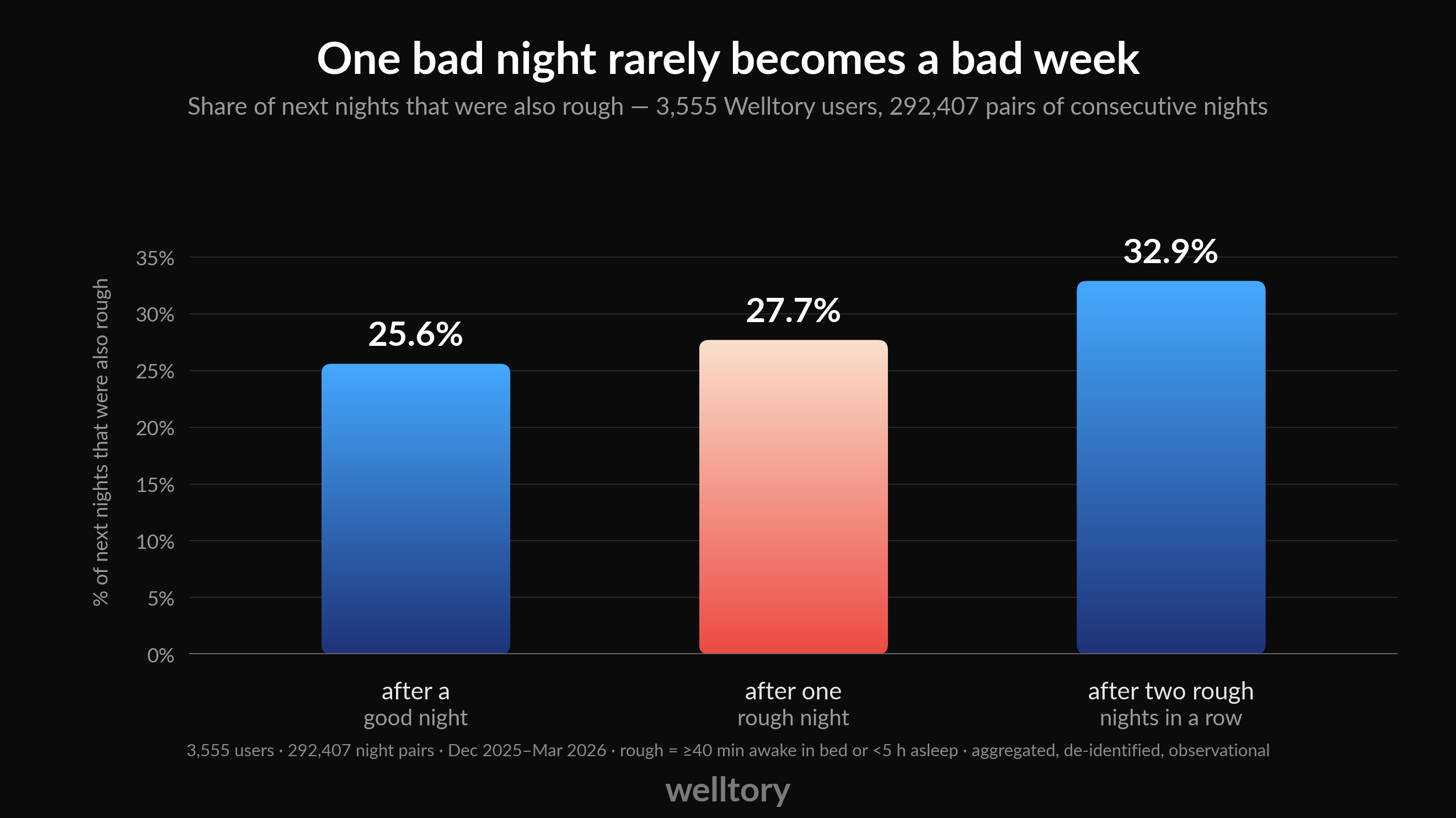
We looked at 3,555 Welltory users and 292,407 pairs of consecutive nights from December 2025 to March 2026, limited to people with at least 30 tracked nights and at least 3 rough nights. We called a night "rough" if the person spent 40 minutes or more awake in bed or slept under 5 hours. Rates were calculated per person, then averaged, so heavy users do not dominate.
Rough nights are common. For a typical user, 26.2% of all nights were rough — about one in four.
A single rough night barely moves the odds for the next. After a good night, 25.6% of next nights were rough; after one rough night, 27.7% — about two percentage points more. Put the other way, 72.3% of nights that followed a rough night were not rough.
Two in a row is where it sticks a little more. After two consecutive rough nights, 32.9% of next nights were also rough, about seven points above the rate after a good night. A real difference — and still, about two times in three, the third night was fine.
So the midnight forecast is mostly wrong. One bad night is weather, not climate. A second is worth noticing; a string of them, repeated over weeks, is worth acting on. That fits the diary research above, where most bouts of acute insomnia resolved within days to weeks (doi.org).
A note on the data. This is observational: we saw sleep, not the reasons behind it. The figures are aggregated and de-identified, and Welltory users are not a random sample of the population — they choose to track their health and may differ from others in age, habits and interest in sleep. "Rough" is our own threshold, not a clinical definition of insomnia. We cannot see whether people used sleep aids or changed their routine after a bad night, which could make recovery look faster or slower. Streaks of rough nights can reflect illness, travel or stress that lasts several days. And these are averages across users; your own pattern may differ.
How to read your sleep data without panicking
If you track your sleep, the data can calm the loop or feed it. Mostly that depends on how you look.
Look at the week, not the night. One night's number is noisy — alcohol, a warm room, a late meal and illness all move it. A 7- to 14-day trend tells you far more.
Check later, not first thing. Notice how you feel after getting up and having some daylight, then look. Reading the score first lets it set your mood.
Never check in the night. Opening the app at 3 a.m. is clock-watching with extra steps.
Treat sleep stages as a sketch. Consumer wearables estimate sleep from movement and heart rate; they are better at telling asleep from awake than at pinning down each stage. For what is going on under the hood, see how sleep trackers work.
If the data makes you more anxious, pause it for a week or two. The loop matters more than the numbers.
How to bring this up with your doctor
See a doctor if poor sleep happens three or more nights a week and has lasted about three months, or sooner if it is affecting your work, mood or relationships.
What to track for two weeks beforehand:
Roughly when you went to bed, fell asleep and got up
How long you think you were awake in the night
How you felt during the day, on a simple 1–5 scale
Caffeine and alcohol, and their timing
Anything unusual: a stressful day, travel, illness
What to say. Name the fear, not only the sleep: "I've started to dread going to bed. I lie there worrying that I won't sleep, and it makes it worse. It's happening about four nights a week, and has for months." That points a clinician toward the right treatment.
What to ask:
"Could this be chronic insomnia, and would CBT-I suit me?"
"Can you refer me to someone who delivers CBT-I, or recommend a structured programme?"
"Could anything else be disturbing my sleep — breathing, a medication, hormones, my mood?"
Raise these specifically, because they change the answer: loud snoring, gasping, or a partner noticing pauses in your breathing (possible sleep apnoea); restless, uncomfortable legs in the evening; low mood or loss of interest alongside poor sleep; night sweats; and any medications or supplements you take. If sleeping pills come up, the ACP guideline frames them as a shared decision, weighing benefits, harms and costs, when CBT-I alone has not been enough (doi.org).
If you are having thoughts of harming yourself, do not wait for an appointment: in the US, call or text 988, any time.
Before you blame yourself, check what your body already recorded
People with sleep anxiety are often hard on themselves. "I'm too sensitive." "Everyone else just sleeps — what is wrong with me?" The longer the loop runs, the more it feels like a personal failing rather than something that happened to you.
It usually has a visible cause, and the cause is often already in the record: a few short nights during a stressful stretch at work, a run of late nights before early starts, a cold that broke up your sleep, a week with more stress minutes than usual and resting heart rate a few beats above your normal. The fear of not sleeping is often a reasonable reaction to real nights that went badly — and then it outlives them. That is how learning works, not a flaw in you.
So, permission: you do not need to fix everything, or sleep perfectly tonight. Pick one lever and hold it for one to two weeks — a fixed wake-up time every day, or getting up when you have been awake for what feels like twenty minutes, or turning the clock away. Then watch the trend across those weeks, not single nights. Bad nights will still happen. The aim is that they stop carrying the same weight.
How Welltory helps — and what it cannot do
The limits first. Welltory is a general wellness product with no regulatory clearance. It does not diagnose insomnia, anxiety or any sleep disorder, and it is not a substitute for CBT-I or medical care. It cannot tell you why you slept badly, and its sleep estimates are not a sleep study.
What it can show is the record your body keeps — useful precisely because anxious memory exaggerates. Welltory displays your sleep across nights and weeks, stress minutes during the day, your Battery, your resting heart rate and your heart rate variability against your own baseline. You can add tags and notes to mark people, events or habits — a hard meeting, a late coffee, a night of worry — and My Patterns can show which tagged situations tend to come before stressful stretches.
For sleep anxiety, use it the opposite way to orthosomnia: not to chase a perfect score, but to see that rough nights are usually followed by ordinary ones, and that a bad week often lines up with a stressful one. If a number is worrying you, our guide to what a good sleep score is explains what it can and cannot tell you.
Two caveats. These signals are non-specific — alcohol, illness, a hot room and stress move them just as a short night does — so read one to two weeks, not one morning. And if checking the app has become part of the loop, check less, and never at night.
How we made it
Made with AI tools, then edited and fact-checked by the Welltory team. See our Editorial & AI policy.
Data analysis by Jane Smorodnikova, co-founder of Welltory and the person who built the methodology behind how we read physiological data.
Written by Tatsiana Yashyna.


Discounts for blog readers: up to 36% off
See what affects your energy, stress, sleep, and daily state with Welltory
This article is for educational purposes only and is not medical advice. Sleep anxiety is a descriptive term, not a diagnosis. Trouble sleeping three or more nights a week for three months, loud snoring with pauses in breathing, or low mood alongside poor sleep need clinical assessment. If you have thoughts of harming yourself, call or text 988 in the US. Welltory holds no regulatory clearance, is a general wellness product, and does not diagnose. Sources were retrieved on 1 October 2026.
Was this helpful?
Ask AI for a summary of page


Written by Jane Smorodnikova

The founder and CEO of Welltory. A recognized tech leader with two Master's degrees and experience at MIT, she has scaled Welltory to over 17 million users.
Written by Tatsiana Yashyna

Deputy COO at Welltory. With a background in medicine and years of working with health data, she translates research and real physiological signals — sleep, stress, heart rate, and hormones — into clear, evidence-based explanations that help people understand what their bodies are telling them.
References
- Harvey AG. A cognitive model of insomnia. Behaviour Research and Therapy 2002;40(8):869–893. https://doi.org/10.1016/S0005-7967(01)00061-4
- Tang NKY, Schmidt DA, Harvey AG. Sleeping with the enemy: clock monitoring in the maintenance of insomnia. Journal of Behavior Therapy and Experimental Psychiatry 2007;38(1):40–55. https://doi.org/10.1016/j.jbtep.2005.07.004
- Baron KG, Abbott S, Jao N, Manalo N, Mullen R. Orthosomnia: are some patients taking the quantified self too far? Journal of Clinical Sleep Medicine 2017;13(2):351–354. https://doi.org/10.5664/jcsm.6472
- Qaseem A, Kansagara D, Forciea MA, Cooke M, Denberg TD; Clinical Guidelines Committee of the American College of Physicians. Management of chronic insomnia disorder in adults: a clinical practice guideline from the American College of Physicians. Annals of Internal Medicine 2016;165(2):125–133. https://doi.org/10.7326/M15-2175
- Edinger JD, Arnedt JT, Bertisch SM, et al. Behavioral and psychological treatments for chronic insomnia disorder in adults: an American Academy of Sleep Medicine clinical practice guideline. Journal of Clinical Sleep Medicine 2021;17(2):255–262. https://doi.org/10.5664/jcsm.8986
- Trauer JM, Qian MY, Doyle JS, Rajaratnam SMW, Cunnington D. Cognitive behavioral therapy for chronic insomnia: a systematic review and meta-analysis. Annals of Internal Medicine 2015;163(3):191–204. https://doi.org/10.7326/M14-2841
- Jansson-Fröjmark M, Alfonsson S, Bohman B, Rozental A, Norell-Clarke A. Paradoxical intention for insomnia: a systematic review and meta-analysis. Journal of Sleep Research 2022;31(2):e13464. https://doi.org/10.1111/jsr.13464
- Perlis ML, Vargas I, Ellis JG, et al. The natural history of insomnia: the incidence of acute insomnia and subsequent progression to chronic insomnia or recovery in good sleeper subjects. Sleep 2020;43(6):zsz299. https://doi.org/10.1093/sleep/zsz299
- Sateia MJ. International classification of sleep disorders — third edition: highlights and modifications. Chest 2014;146(5):1387–1394. https://doi.org/10.1378/chest.14-0970
- American Academy of Sleep Medicine. Provider fact sheet: Brief Behavioral Treatment for Insomnia (BBTI). https://aasm.org/wp-content/uploads/2022/07/ProviderFS-BBTI.pdf


