

Short answer
Rejection sensitive dysphoria (RSD) is the name people with ADHD give to a specific experience: criticism, a short reply or an imagined slight lands as sudden, physical-feeling pain, out of proportion to what happened and hard to talk yourself out of. It is not a diagnosis. It is not in the DSM-5, and Cleveland Clinic says plainly that it "isn't an officially recognized symptom or diagnosis" (1).
What is well documented is the thing underneath it. Across 13 studies of 2,535 adults, emotion dysregulation was substantially more common in adults with ADHD than in controls, with a large pooled effect size of g = 1.17 (2). A 2024 review puts it bluntly: emotional dysregulation "affects up to two-thirds of adult patients" with ADHD (3).
So the honest version is this: the experience is real and common, the label is a description rather than a diagnosis, and the research behind the label itself is thin. That matters, because it changes what you can expect from treatment.
Note: this article explains what research and clinical guidance say; it is not medical advice, and a clinician decides what fits you. If rejection sends you into thoughts of harming yourself, treat that as urgent and contact a crisis line or your doctor the same day.
What rejection sensitive dysphoria actually is
"Dysphoria" comes from a Greek word for a strong, hard-to-bear discomfort, and that word choice is the whole point. People describing RSD do not describe feeling sad about rejection. They describe pain. In a 2023 study that ran nine focus groups with 43 young adults diagnosed with ADHD, one participant put it this way: "It's literal pain for me, I literally feel it in my chest and it hurts" (4).
Three things tend to travel together in these accounts:
The trigger can be small or ambiguous. A message left on read, a manager saying "let's talk later", a friend who seems a little flat. Cleveland Clinic notes that people with rejection sensitivity "have trouble seeing nonpositive interactions (such as neutral or vague reactions) as anything but rejection" (1).
The reaction arrives fast and whole. Not a build-up, a drop. Some people turn it outward as anger; others turn it inward, which can look like a sudden collapse into despair (1).
The shape of a life bends around it. Avoiding projects where failure is possible, over-preparing, people-pleasing, perfectionism (1).
Rejection sensitivity vs rejection sensitive dysphoria
These two terms get used interchangeably online, and they are not quite the same. Rejection sensitivity is the pattern of expecting rejection, reading neutral signals as rejection, and reacting strongly. RSD, as the term is used, adds one component on top: the intense emotional pain itself (1). Rejection sensitivity is a research construct with questionnaires behind it. RSD is mostly a clinical and community term.
Is RSD real, and is it in the DSM?
Both answers are true at once, and the confusion between them is why this topic is such a mess online.
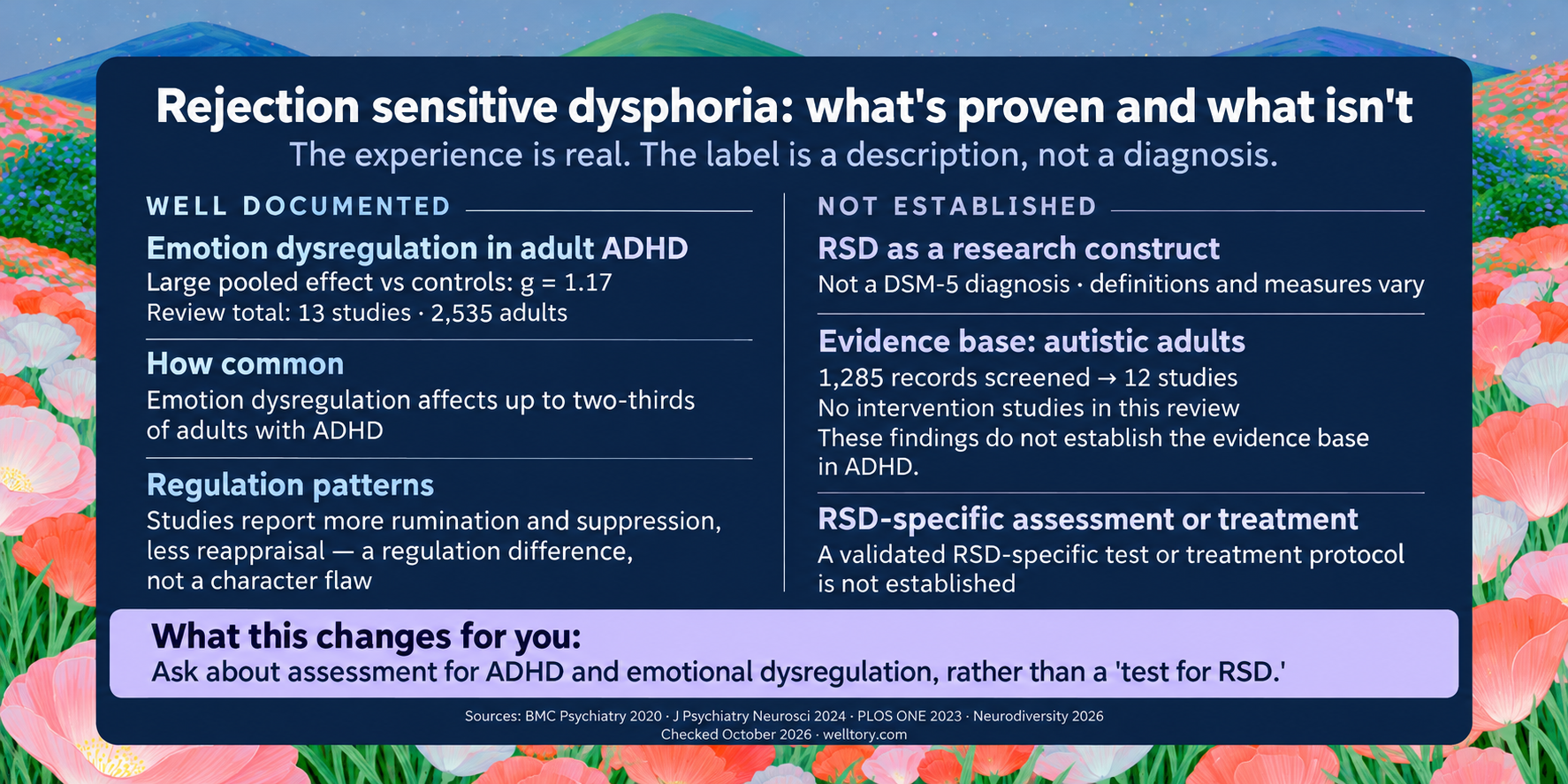
The label is not established. A 2026 scoping review screened 1,285 titles and abstracts, read 37 full texts, and found 12 eligible studies. Its summary of the field is that "RSD is not an established research construct, the evidence base is fragmented", that definitions "varied considerably" between studies, and that no studies evaluated interventions at all (5). That review looked at autistic adults, where the term is also widely used, and the same fragmentation applies to ADHD.
The underlying difficulty is established. The 2020 meta-analysis of 13 studies found a large average effect for general emotion dysregulation, g = 1.17 (95% CI 0.70 to 1.64), with emotional lability showing the strongest single effect, g = 1.20 (95% CI 0.57 to 1.83) (2). Two caveats belong next to those numbers rather than in a footnote: heterogeneity between the studies was 94%, which is very high, and a 2023 systematic review of 22 studies described the available research as "scarce and very heterogeneous both in aims and in sample features" (6).
Even the direct measurements disagree. The same 2023 focus-group paper that recorded participants describing RSD as physical pain also notes that while youth with ADHD score higher on rejection sensitivity questionnaires, "college men with ADHD did not score differently from controls" on the same type of measure (4).
What to do with all that: treat RSD as a useful description of something you are living with, not as a diagnosis you have. Participants in the focus-group study said the name itself helped — "naming something helps you feel like you're in power and control of it" (4). A name that helps you describe your experience to a clinician is doing real work. It just is not the same as a diagnosis that comes with a treatment protocol.
Why ADHD brains react this way
ADHD is usually described through attention and impulsivity, but emotion keeps turning up as a fourth piece. The 2023 systematic review notes that recent studies "point towards a fourth core symptom of the disorder related to the emotional information processing", and that this would help explain ADHD's effects on social, academic and professional life (6). Adult ADHD itself is common: the same review puts prevalence at 3% to 5% of adults (6).
Two mechanisms show up repeatedly.
Regulation, not feeling. Cleveland Clinic uses a volume-control metaphor: the brain normally keeps emotional signals at a manageable level, and emotional dysregulation is what happens when that control is stuck high, so emotions are "too loud for you to manage" (7). The feeling is not unusual. The volume is.
Strategy, not willpower. Adults with ADHD "show a more frequent use of non-adaptive emotion regulation strategies compared to people without ADHD symptoms" (6) — more rumination and suppression, less reappraisal. This is trainable, which is why the practical part of this article is not just about enduring the feeling.
There is also brain-imaging work. A 2024 study comparing adults with ADHD to matched controls found reduced emotion induction and regulation capacity, altered activation patterns during emotion regulation, and lower grey-matter volume in limbic and paralimbic areas (3). It is one clinical cohort, not a settled map, and imaging differences between groups say nothing about any individual.
RSD or something else?
Intense reactions to rejection are not unique to ADHD, and this is exactly where self-diagnosis goes wrong. Cleveland Clinic notes that when the reaction turns inward it can look like a sudden onset of severe depression and "sometimes, it's mistaken for sudden emotional shifts that can happen with bipolar disorder or borderline personality disorder" (1).
| What it might be | What the rejection reaction looks like | What usually sits around it | Who sorts it out |
|---|---|---|---|
| ADHD with emotional dysregulation | Fast, intense, passes relatively quickly once the trigger resolves | Lifelong attention, organisation and impulsivity difficulties | Psychiatrist or psychologist assessing ADHD |
| Social anxiety | Dread builds before social situations; avoidance is planned | Fear of scrutiny across many situations, not only rejection | Mental health clinician |
| Borderline personality disorder | Intense reaction tied to fear of abandonment, often with unstable self-image | Longstanding instability in relationships and identity | Specialist assessment, not a quiz |
| Depression | Rejection confirms a steady, pre-existing bleakness | Low mood most of the day, most days, for weeks | GP or mental health clinician |
| Autistic rejection sensitivity | Described similarly; research is at the same early stage | Sensory and social-communication differences | Specialist assessment |
Two or more can be true at once. The point of this table is not to let you pick a box; it is to give you words for the appointment.
Is there a test for rejection sensitive dysphoria?
No. There is no validated RSD test, because RSD is not a formal diagnosis — there is no agreed definition to test against, which is precisely what the 2026 review found when definitions "varied considerably" across studies (5). Online RSD quizzes are not diagnostic instruments. Research on rejection sensitivity uses questionnaires designed for research, and even those produce inconsistent results in ADHD populations (4).
What an assessment actually involves is broader: a clinician looks at ADHD symptoms across your lifetime, mood, anxiety, trauma history and personality patterns, because the same reaction can come from several places. Cleveland Clinic's RSD page is explicit that diagnosis here means diagnosing the conditions RSD is linked to, not RSD itself (1).
What actually helps, and what the research does not support
This section is shorter and less confident than most articles on this topic, and that is deliberate.
Medication for RSD specifically: no trial evidence. The 2026 scoping review found no studies evaluating any intervention for RSD (5). You will find confident online advice naming specific drugs for RSD; it is clinical opinion, not trial data. Medication decisions belong with your prescriber.
ADHD stimulants help ADHD, but may not fix the emotional part. A 2024 study tested exactly this, measuring emotion induction and regulation in adults with ADHD before and after a stimulant challenge. The conclusion: patients "may have impaired emotion induction and emotion regulation capacity, but these deficits are not reversed by stimulant medication" (3). This is one study and it does not mean stimulants are useless — it means that if your attention improves and the rejection pain does not, that is a known pattern and worth raising rather than hiding.
Skills-based therapy: real gains, honestly reported. A multicentre randomised controlled trial gave 121 adults with ADHD either 14 weeks of dialectical behaviour therapy-based group treatment or treatment as usual. Executive functioning improved clearly in the therapy group (BRIEF-A change of −12.8 versus −0.37, effect size 0.64), and the gains held at six months. But on the Difficulties in Emotion Regulation Scale, "change on DERS did not differ significantly between the groups" (8). Both halves of that result are worth knowing before you start a programme expecting the feelings to be the first thing to change.
What people actually do, in the meantime. None of these are treatments, and none are tested for RSD specifically. They come from how emotion regulation is usually taught, and from what the focus-group participants described as helpful.
Name it in the moment. Participants described the name itself as giving back a sense of control (4). "This is the rejection thing" is a different internal sentence from "they hate me."
Buy time before responding. The reaction arrives faster than the interpretation. A fixed personal rule — no replies to anything that stings for a set number of hours — removes the decision from the worst moment.
Check the evidence, in writing. What exactly was said, and what are three other readings of it? Written, because rumination does not survive specifics well.
Separate the pain from the verdict. The pain is real and the conclusion it arrives with ("I am about to be fired") usually is not. Both can be true: it hurt, and nothing happened.
Protect recovery after a hit. A rejection spiral costs sleep, and short sleep makes the next one worse. This is the loop most worth breaking.
Living with RSD: the questions people ask next
How do I deal with rejection sensitive dysphoria in a relationship?
The most useful move is agreeing on protocol before the next episode, not during it. Many couples settle on a short, boring phrase that means "I am in it right now" and a rule that the conversation pauses rather than escalates. Explain the mechanism, not just the feeling: emotional dysregulation is a regulation problem, as if the volume control were stuck high (7). Partners generally cope better with "this will pass in an hour and I am not leaving" than with reassurance-seeking in the moment. If the pattern is damaging the relationship, couples or individual therapy is reasonable — not because you are broken, but because you are trying to change a fast automatic reaction.
What do I do when feedback at work sends me into a spiral?
Assume the first reading is distorted and the second one, written down an hour later, is closer. Separate two tasks that feel like one: surviving the next hour, and deciding what to do about the feedback. For the hour, physical change of state helps more than argument — leave the desk, walk, do something with your hands. For the decision, write the feedback out in the sender's exact words, then list what it literally asks you to change. Perfectionism and avoiding projects where failure is possible are recognised parts of this pattern (1), so notice if your fix is "never be criticised again".
How long does an episode last?
There is no research answer, because RSD is not a defined construct with measured episode lengths (5). What people describe is a fast onset and a slower fade, often hours rather than days, with the tail depending on whether the trigger got resolved or just stopped being discussed. A useful personal question is whether your own episodes are getting shorter over time, which is something you can only answer if you note them somewhere. If low mood persists for weeks rather than hours, that is no longer this pattern and is worth a clinician's attention.
Can you have RSD without ADHD?
Yes, in the sense that intense reactions to rejection are not exclusive to ADHD. Cleveland Clinic notes that RSD "seems to happen most often in people with ADHD" but that experts have also linked it to other personality and mood disorders, and that research on who experiences it is limited (1). The term is also widely used by autistic adults, and a 2026 review of that literature found 12 studies with inconsistent findings on how intense the distress is (5). If you recognise the pattern and have never been assessed, the useful step is an assessment rather than a label.
Does it get better with age?
The research does not answer this for RSD specifically. What the focus-group study found is that many adults believed "their changing environments and behavioral adaptations influenced how their symptoms presented into adulthood" (4) — in other words, people build a life that triggers it less and handle it differently, which is not the same as the underlying sensitivity disappearing. Emotion regulation strategies are learnable, and the shift from suppression and rumination toward reappraisal is exactly the difference the research describes between adults with and without ADHD (6).
How do I explain this to someone who does not have it?
Skip the acronym and describe the mechanism. Something like: "When I think someone is disappointed in me, it doesn't feel like an emotion, it feels like being hit. It passes, but while it's happening I can't think straight." Adding that it is a regulation difference, not a character flaw, usually lands better than a diagnosis-shaped claim — especially since RSD is not an official diagnosis (1), and claiming one you do not have invites an argument you do not want to have.
How to bring this up with your doctor
Rejection sensitive dysphoria is not a diagnosis, so asking to be "tested for RSD" tends to stall the conversation. Ask instead to be assessed for ADHD and for emotional dysregulation, and describe the pattern in your own words (1, 5).
What to bring. A written list of your three most recent episodes: the trigger, how long the reaction lasted, what you did, and what it cost you — a missed deadline, a cancelled plan, a lost night. Add whether attention, organisation and restlessness difficulties have been present since childhood, because that history is central to an adult ADHD assessment. If you already take ADHD medication, note whether attention and emotional reactions responded differently: a 2024 study found that stimulant medication did not reverse emotion induction and regulation deficits (3), so that mismatch is a recognised pattern rather than a sign the medication is wrong for you.
What to ask for. A full assessment rather than a label: ADHD, mood, anxiety, trauma history and personality patterns, since the same reaction can come from several places (1). If emotional reactions are what is costing you most, ask specifically what is available for emotion regulation — skills-based group programmes have the best trial support, with the honest caveat that in a randomised trial they improved executive functioning while emotion regulation scores did not separate from treatment as usual (8).
If you are brushed off. Being told "everyone finds criticism hard" is common, and specifics are what move it: the number of episodes in the last month, the concrete losses, and how long symptoms have been present. Asking for a referral to a clinician who assesses adult ADHD, or for a second opinion, is reasonable. Bring the written record rather than trying to describe it from memory in a ten-minute appointment.
Get help sooner, not at the next appointment, if rejection brings thoughts of harming yourself, if low mood has lasted weeks rather than hours, or if the reactions are costing you your job or relationships.


Start understanding your body
Learn what affects your energy, stress, sleep, and daily state. Get the app.
How Welltory helps — and what it cannot do
The limits first. Welltory is a general wellness product, not a medical device. It does not diagnose, detect, predict, monitor, prevent or treat any condition, including ADHD, and it cannot tell you whether what you feel is rejection sensitive dysphoria. Nothing here replaces an assessment.
What it can do is hold a record of something that is very hard to remember accurately — because the episodes that hurt most are the ones you least want to review, and by the next week you have a story about them rather than a record.
Mark the episode while it is happening. When the Today screen detects a stress or rest stretch, it asks what was happening — "What happened?" or "What helped you rest?" You can answer by voice, by typing, or by tapping a suggested tag, and Welltory extracts the tags from your own words: things like criticism, message left on read, argument, walk, sleep (9). You are not picking from a fixed list, which matters for something this personal.
Then look at the days around it. Sleep analysis, resting heart rate, HRV, stress minutes and Battery are recorded the same way every day, against your own history rather than a population band. The question worth asking your own record is whether the episodes that floored you cluster after short nights, on high-stress days, or in weeks with no recovery in them. Battery and stress minutes need iOS with an Apple Watch or Oura; detailed sleep analysis needs an Apple Watch.
Over a month, My Patterns shows what your tags have in common. My Patterns collects the tags from those episodes and shows which ones recur before stress and which reliably help you recover (9). Patterns need roughly seven tagged events to appear, so a single bad week will not produce one, and two to three weeks of tagging is a realistic minimum. Tags added as standalone journal entries, without an episode attached, stay in your Journal but do not count toward patterns.
A record you made, for the appointment you were dreading. The Journal (Premium) keeps measurements, tags and notes together, and the web app exports a CSV (Dashboard → choose a chart → Export). Walking into an ADHD assessment with six weeks of tagged episodes and their aftermath is a different conversation from trying to describe the pattern from memory while feeling judged.
One boundary, stated plainly: a pattern in your tags is an association to discuss with a clinician, not proof that a trigger caused anything. And if the record shows the episodes are getting longer, or are bringing thoughts of harming yourself, that is a reason to get help now rather than to keep tracking.
How we made it
Made with AI tools, then edited and fact-checked by the Welltory team. See our Editorial & AI policy.
Data analysis by Jane Smorodnikova, co-founder of Welltory and the person who built the methodology behind how we read physiological data.
Written by Tatsiana Yashyna.


Discounts for blog readers: up to 36% off
See what affects your energy, stress, sleep, and daily state with Welltory
This article is for educational purposes only and is not medical advice; a clinician decides what fits you. Rejection sensitive dysphoria is not a formal diagnosis and cannot be self-diagnosed from an article or an online quiz. If rejection brings thoughts of harming yourself, contact a crisis line or your doctor the same day. Welltory is a general wellness product and does not diagnose, detect or predict any condition, including ADHD.
Was this helpful?
Ask AI for a summary of page


Written by Jane Smorodnikova

The founder and CEO of Welltory. A recognized tech leader with two Master's degrees and experience at MIT, she has scaled Welltory to over 17 million users.
Written by Tatsiana Yashyna

Deputy COO at Welltory. With a background in medicine and years of working with health data, she translates research and real physiological signals — sleep, stress, heart rate, and hormones — into clear, evidence-based explanations that help people understand what their bodies are telling them.
References
- Cleveland Clinic. Rejection sensitive dysphoria (RSD). Last updated August 30, 2022. https://my.clevelandclinic.org/health/diseases/24099-rejection-sensitive-dysphoria-rsd
- Beheshti A, Chavanon ML, Christiansen H. Emotion dysregulation in adults with attention deficit hyperactivity disorder: a meta-analysis. BMC Psychiatry 2020;20:120. https://doi.org/10.1186/s12888-020-2442-7
- Sklivanioti Greenfield M, Wang Y, Hamilton JP, Thunberg P, Msghina M. Emotional dysregulation and stimulant medication in adult ADHD. Journal of Psychiatry and Neuroscience 2024;49(4):E242–E251. https://doi.org/10.1503/jpn.240009
- Ginapp CM, Greenberg NR, MacDonald-Gagnon G, Angarita GA, Bold KW, Potenza MN. "Dysregulated not deficit": a qualitative study on symptomatology of ADHD in young adults. PLOS ONE 2023. https://pmc.ncbi.nlm.nih.gov/articles/PMC10569543/
- van Asselt A, Reekers D, Roke Y. Rejection sensitivity dysphoria in autistic adults: a scoping review. 2026. https://doi.org/10.1177/27546330261441753
- Soler-Gutiérrez AM, Pérez-González JC, Mayas J. Evidence of emotion dysregulation as a core symptom of adult ADHD: a systematic review. PLOS ONE 2023. https://pubmed.ncbi.nlm.nih.gov/36608036/
- Cleveland Clinic. Emotional dysregulation. https://my.clevelandclinic.org/health/symptoms/25065-emotional-dysregulation
- Halmøy A, Ring AE, Gjestad R, Møller M, Ubostad B, Lien T, et al. Dialectical behavioral therapy-based group treatment versus treatment as usual for adults with attention-deficit hyperactivity disorder: a multicenter randomized controlled trial. BMC Psychiatry 2022;22:738. https://doi.org/10.1186/s12888-022-04356-6
- Welltory. My patterns. https://welltory.com/blog/my-patterns/