

Short answer
Limerence is an intense, involuntary infatuation in which one person occupies your thinking almost constantly, your mood rises and falls on their smallest signals, and the uncertainty itself keeps the feeling burning. The term was coined by psychologist Dorothy Tennov in 1979, and for more than forty years it had no validated way to measure it — the first one, the Limerence Questionnaire-11, was published only in 2025 (1).
That research describes limerence as "an emotional and cognitive dysregulatory state" with "an acute onset," a profound attachment "akin to 'being in love'" but so obsessive that it can produce bad outcomes for the person experiencing it (1). When the measure was built, the experience split cleanly into two parts: an intense need for attachment, and neglect of yourself and the people around you (1).
If you have been searching at two in the morning for a word that explains this, you are not imagining it and it is not a character flaw. The state has a name, a measurable structure and a research literature, thin as that literature still is — and the people who end up reading about it are usually functioning adults blindsided by the intensity, not people who went looking for trouble. It is not weakness, and it is not your fault that it arrived.
What makes this worth understanding rather than just enduring: limerence is not a verdict on your relationship, your character or your partner. It is a state. States have a shape, a timeline and a physical footprint — and that footprint shows up in your sleep and your stress long before you are willing to say the word out loud.
Note: this article explains what research describes and is not therapy, diagnosis or relationship advice. It is written for adults. If someone is monitoring, pressuring, threatening or controlling you, that is not infatuation and this article does not cover it — in the US, the National Domestic Violence Hotline is 1-800-799-7233 (7). If thoughts about a person have become thoughts about harming yourself, treat that as urgent and contact a crisis line or your doctor the same day.
What is limerence?
Limerence is the state of being involuntarily fixated on one specific person — the "limerent object," in Tennov's original language — with an overwhelming desire for that person to feel the same way (1). The defining feature is not the strength of the attraction. It is that your attention is no longer yours to direct.
A 2024 scoping review of the field puts it bluntly: there is "extraordinarily limited literature" on this state, and what exists describes "a phenomenon characterised by limited self-awareness and restraint," involving obsession and fixation, and "motivated by a lack of reciprocation and rejection" (2).
That last phrase is the part most people miss. Limerence is not fuelled by closeness. It is fuelled by not knowing. The person who answers every message warmly and consistently is rarely the one who takes over someone's mind.
What are the signs of limerence?
The 2025 research found two clusters, and it is worth checking yourself against both rather than only the romantic-sounding one (1).
Intense need for attachment:
Thinking about the person involuntarily, through work, conversations, tasks that need your attention
Replaying interactions and scanning them for hidden meaning
Mood that swings on a reply, a glance, a delay before an answer
Rehearsing imagined future scenes in detail
Physical reactions when they appear — a jolt in the chest, shaking, difficulty speaking normally
Neglect of self and others:
Letting sleep, food, exercise or health appointments slide
Withdrawing from friends, or talking about nothing else when you see them
Work or study quality dropping
Deprioritising an existing partner, children or responsibilities while the state is active
The second cluster is the one that tells you this has moved from a feeling to a problem. One is an experience. Both together is what the research calls dysregulation.
Limerence vs love: what is the actual difference?
The clearest difference is what the state needs in order to continue. Love tends to be sustained by reality — knowing someone, being known, the ordinary accumulation of time. Limerence is sustained by uncertainty, and tends to weaken when uncertainty resolves in either direction.
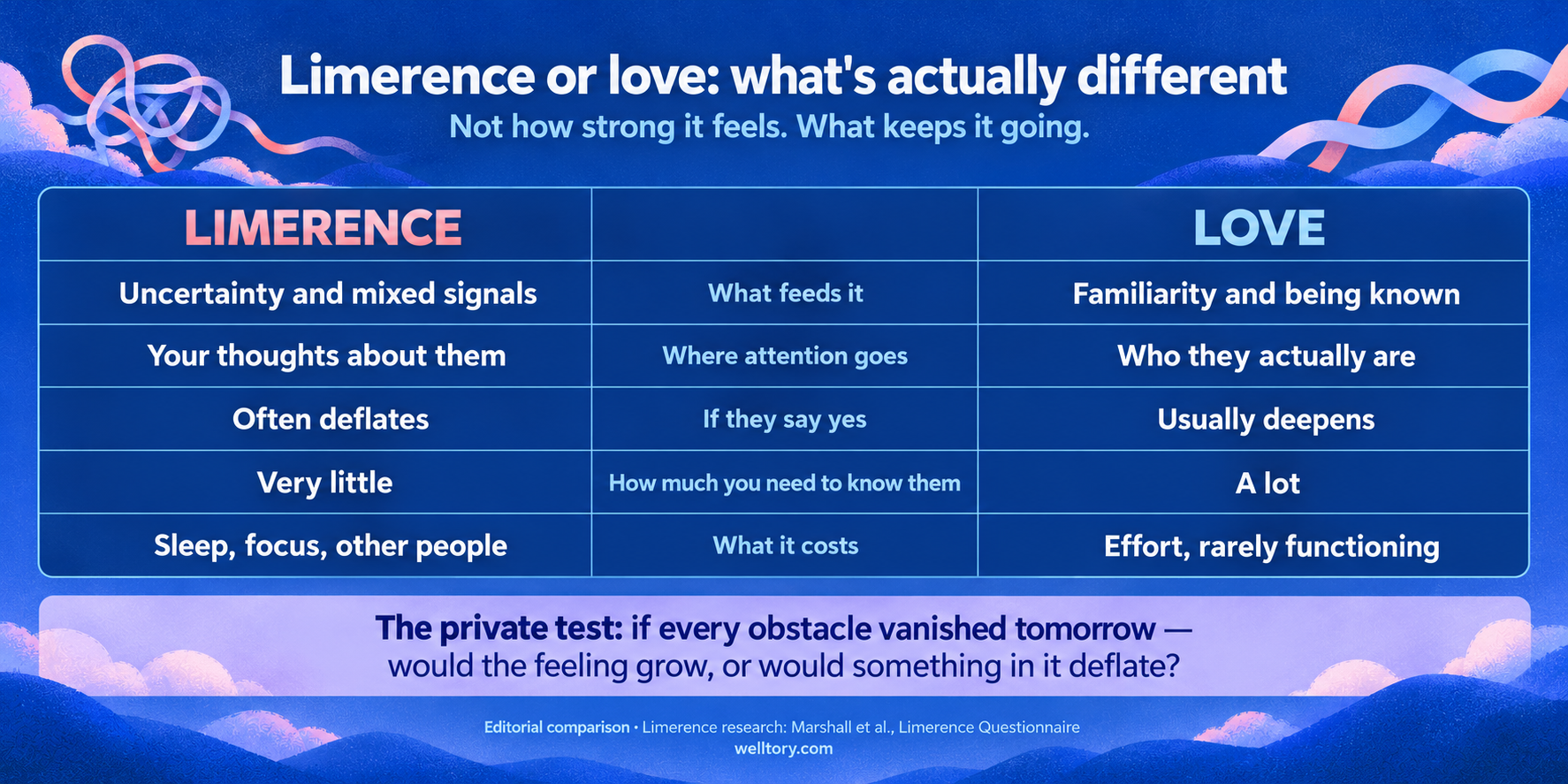
| | Limerence | Love |
|---|---|---|
| What feeds it | Uncertainty, ambiguity, intermittent signals | Familiarity, reliability, being known |
| Where attention goes | Inward: your thoughts about them, your hope, your interpretation | Outward: who they actually are, including the dull parts |
| Effect of reciprocation | Often fades once the outcome is certain | Usually deepens |
| Relationship to the real person | Can run on very little information | Requires knowing them |
| What it costs | Sleep, focus, other relationships (1) | Costs effort, but rarely functioning |
| How it ends | Resolves, decays or has to be survived | Changes form over time |
A useful private question: if you learned tomorrow that this person was definitively, permanently available to you, with no obstacles — would the feeling grow, or would something in it deflate? Limerence often struggles with a clear yes.
Why does a new person feel more intense than a partner of fifteen years?
Because you are not comparing two people. You are comparing two different states, and one of them is chemically loud.
The early phase of romantic love measurably resembles obsessive-compulsive disorder at the level of one serotonin marker. In a 1999 study, people who had fallen in love within the previous six months showed the same reduced density of the platelet serotonin transporter as unmedicated patients with OCD, and both differed from controls (3). That study compared 20 people per group, so it is small and decades old — but it was the first measurement of something people had only described, and it reframed intrusive romantic thinking as biology rather than weakness.
More recently, the same research group examined 212 patients whose OCD began around the start or end of a romantic relationship, and found differences in symptom profile depending on which of the two had happened (4). That is a clinical sample, not people in ordinary infatuation, and it does not mean limerence is OCD. It means the machinery that produces intrusive, circling thought can be switched on by a relationship event.
A long partnership does not run on that machinery. It runs on something quieter, which produces far less noise and therefore feels like less — though the comparison is unfair in the same way comparing a fire alarm to a radiator is unfair.
Can you be limerent while married or in a relationship?
Yes, and it is one of the most common ways people encounter the word for the first time — usually at two in the morning, searching for an explanation that is not "I am a bad person."
Here is what the research supports and what it does not. It supports the idea that limerence is a state with a known shape, that it can arrive without being invited, and that it is driven by uncertainty rather than by a deficiency in your partner (1, 2). It does not support any conclusion about what you should do. That is not a gap in the science that this article can fill; it is a decision about your life, and it belongs to you, ideally with a therapist rather than with a search engine.
Two things are worth separating, because people tend to collapse them. A feeling arriving is not a choice. What you do next is. Holding both is uncomfortable, which is exactly why the comfortable alternatives — deciding you are a monster, or deciding this must mean your relationship is over — are so tempting and so unreliable.
If the state is costing you sleep and attention while you are also running a household or a job, that cost is real whatever you decide, and it is worth treating as its own problem rather than waiting for the feeling to resolve first.
How long does limerence last, and how does it fade?
There is no reliable average, because until 2025 there was no validated way to measure the state and therefore nothing consistent to count (1). What is described, in Tennov's original work and in the accounts gathered since, is that it ends in one of three ways: the uncertainty resolves into a real relationship and the state converts into something steadier or evaporates; it resolves into a definite no and decays, usually slowly and in waves; or it persists without resolution, which is the version that does the most damage.
What people describe as helping, none of it tested as treatment:
Reducing contact that keeps the uncertainty alive. Intermittent, ambiguous contact is fuel. This is the hardest and most effective lever.
Protecting sleep first. Short sleep makes intrusive thought worse and self-control weaker, and the research on love and sleep points in the same direction (5).
Putting the fantasy in writing. Imagined scenes lose some charge when written plainly; they thrive on being rehearsed, not examined.
Rebuilding the neglected half. The second factor in the measure is neglect of self and others (1); deliberately reversing that is one of the few things fully in your control.
Telling one person. Secrecy and intensity feed each other.
When does limerence stop being a private feeling?
Some of this needs naming plainly, without labelling anyone. The 2024 review examined limerence as a possible precursor phase to stalking, and argued that behaviours in a limerent state "can serve as the building blocks" on which more harmful, externally focused behaviours could develop (2). The authors are explicit that their objective is not to label individuals experiencing limerence — and neither is this article's.
The line is behaviour, not feeling. Monitoring someone's movements or accounts, repeated unwanted contact, showing up where they will be, pressuring someone who has said no: these are harms to another person regardless of how the feeling is experienced from the inside, and they are the point at which this stops being something to manage alone.
Seek help sooner, not later, if the thoughts have become constant enough to interfere with work or caring for people who depend on you; if you are not sleeping; if you are drinking more to manage it; or if any thought of harming yourself has appeared.
Living with limerence: the questions people ask next
Is limerence a mental illness?
No. It is not a diagnosis and does not appear in the DSM-5. The first validated questionnaire for it was published in 2025, and its authors describe limerence as a dysregulatory state rather than a disorder (1). The 2024 review notes that limerent behaviours "do not fit into existing psychological classifications of obsession" (2). That said, a state that is wrecking your sleep, work and relationships is worth professional help whether or not it has a diagnostic code.
Can limerence be one-sided forever?
It can persist for years without reciprocation, and the research specifically describes it as motivated by lack of reciprocation and rejection rather than by closeness (2). This is the version most worth getting help with, because nothing in the situation will resolve it on its own — the uncertainty that fuels it is permanent by design.
Does limerence mean my relationship is wrong?
The research does not support that inference. Limerence is driven by uncertainty and novelty, which an established relationship cannot supply by definition (1). A long partnership can be genuinely wrong for you, and limerence can also arrive in a good one. The honest answer is that this state is bad evidence either way, and that is worth knowing before you make a decision while in it.
Why does it get worse when they pull away?
Because ambiguity is the fuel. Withdrawal increases uncertainty, which is the condition the state runs on — which is why the periods people describe as unbearable usually follow a cooling rather than a rejection. A clear, final answer is painful and tends to start the decay; an ambiguous one extends it.
I can't sleep and I can't eat. Is that part of it?
It is commonly described, and sleep variations are documented in people experiencing romantic love in adolescents and young adults (5) — though that review is narrative, describes association rather than cause, and covers romantic love broadly rather than limerence specifically. Practically it does not matter much whose fault the short nights are: the shortage makes intrusive thinking harder to interrupt, so sleep is worth defending on its own terms.
How do I talk to my partner about this?
That is a question for a couples or individual therapist rather than for an article, because what is safe and useful to say depends entirely on your situation, and disclosure can do real harm as well as real good. What this article can say: you do not have to have decided anything in order to get help, and "I am dealing with something I don't understand and it is affecting my sleep" is a true sentence you can say to a professional before you have language for the rest.
How is this different from the honeymoon phase?
The honeymoon phase happens inside a mutual relationship and fades as familiarity grows. Limerence is often one-sided, runs on uncertainty rather than closeness, and includes the neglect dimension — sleep, work, other people — that the validated measure treats as half the construct (1).
How to bring this up with a therapist
You do not need a diagnosis to ask for help, and limerence is not one. What gets a useful first session is description rather than the label: how many hours a day the thoughts take, how long it has been going on, what it has cost — sleep, work, a friendship, an appointment you skipped — and what you have already tried.
What to bring. A rough count of the last two weeks: hours slept, days when thinking about the person interfered with work, anything you dropped. Written notes beat memory here, because the state distorts recall in its own favour.
What to ask for. Help with the thinking pattern and the cost, not a verdict on your relationship. Approaches that target intrusive, repetitive thought and rumination are the relevant family; a therapist will tell you what fits. If you are in a relationship and considering disclosure, ask specifically about that before you do it.
If you are brushed off. "Everyone gets crushes" is a common response and an inadequate one when you are not sleeping. The number of hours and the concrete losses are what move the conversation — bring them written down, and ask for a referral if you are not taken seriously.
Sooner, not at the next appointment, if you are not sleeping at all, if you are using alcohol to manage it, if the thoughts have become thoughts of harming yourself, or if your behaviour toward the other person has started to override their stated wishes.


Start understanding your body
Learn what affects your energy, stress, sleep, and daily state. Get the app.
How Welltory helps — and what it cannot do
The limits first, and they matter more than usual here. Welltory is a general wellness product, not a medical device. It does not diagnose, detect or treat anything, it knows nothing about your relationships, and no number in it can tell you whether what you feel is limerence, love, or something that needs a therapist. Anyone promising that from a heart rate is selling something.
What it can do is give you a record of the cost — which is the part that is hardest to see from the inside, because the state argues its own case so persuasively.
Mark the day while it is happening. When the Today screen detects a stress or rest stretch, it asks what was happening — "What happened?" or "What helped you rest?" You answer by voice, by typing, or by tapping a suggested tag, and Welltory pulls the tags out of your own words (6). You are not picking from a fixed list, which matters for something you may not want to name precisely yet; bad night, argument, waiting, long walk are all legitimate tags.
Then look at what the weeks actually did. Sleep analysis, resting heart rate, HRV, stress minutes and Battery are recorded the same way every day, against your own history rather than a population band. The honest question for the record is not "does this mean it's love." It is narrower and more useful: how many nights in the last month were short, and did they cluster. Battery and stress minutes need iOS with an Apple Watch or Oura; detailed sleep analysis needs an Apple Watch.
Over a month, My Patterns shows what your tags have in common. It collects the tags from those episodes and shows which recur before stress and which reliably help you recover (6). Patterns need roughly seven tagged events to appear, so two to three weeks is a realistic minimum. What people find useful here is rarely a revelation about the other person — it is noticing that the recovery tags are all things they stopped doing.
A record you made, for a conversation you have been putting off. The Journal (Premium) keeps measurements, tags and notes together, and the web app exports a CSV (Dashboard → choose a chart → Export). Walking into a first appointment with a doctor or therapist holding six weeks of short nights is a different starting point than trying to describe it from memory while embarrassed — the diary does the remembering so you don't have to perform it.
One boundary, stated plainly: a pattern in your data is an association to talk about, not evidence about your feelings, your partner or the other person. And if the record shows the nights are getting shorter rather than longer, that is a reason to get help now rather than to keep tracking.
How we made it
Made with AI tools, then edited and fact-checked by the Welltory team. See our Editorial & AI policy.
Data analysis by Jane Smorodnikova, co-founder of Welltory and the person who built the methodology behind how we read physiological data.
Written by Tatsiana Yashyna.


Discounts for blog readers: up to 36% off
See what affects your energy, stress, sleep, and daily state with Welltory
This article is for educational purposes only and is not therapy, diagnosis or relationship advice; it is written for adults. Limerence is not a diagnosis and cannot be self-diagnosed from an article. Body data is one signal among many and says nothing about your feelings, your partner or another person. If someone is monitoring, pressuring, threatening or controlling you, contact the National Domestic Violence Hotline at 1-800-799-7233. If thoughts about a person have become thoughts of harming yourself, contact a crisis line or your doctor the same day. Welltory is a general wellness product and does not diagnose, detect or predict any condition.
Was this helpful?
Ask AI for a summary of page


Written by Jane Smorodnikova

The founder and CEO of Welltory. A recognized tech leader with two Master's degrees and experience at MIT, she has scaled Welltory to over 17 million users.
Written by Tatsiana Yashyna

Deputy COO at Welltory. With a background in medicine and years of working with health data, she translates research and real physiological signals — sleep, stress, heart rate, and hormones — into clear, evidence-based explanations that help people understand what their bodies are telling them.
References
- Marshall L, Waldeck D, Pancani L, Churchill S, Tyndall I. Development and validation of the Limerence Questionnaire (LQ-11). Psychological Reports 2025. https://doi.org/10.1177/00332941251394980
- Bradbury J, et al. Limerence, hidden obsession, fixation, and rumination: a scoping review of human behaviour. Journal of Police and Criminal Psychology 2024. https://doi.org/10.1007/s11896-024-09674-x
- Marazziti D, Akiskal HS, Rossi A, Cassano GB. Alteration of the platelet serotonin transporter in romantic love. Psychological Medicine 1999;29(3):741–745. https://pubmed.ncbi.nlm.nih.gov/10405096/
- Marazziti D, et al. Love is expensive: the impact of initiating versus terminating romantic relationships on the onset of obsessive-compulsive disorder. CNS Spectrums 2025. https://pubmed.ncbi.nlm.nih.gov/39885834/
- Bode A, Kowal M. Romantic love and sleep variations: potential proximate mechanisms and evolutionary functions. Biology 2021;10(9):923. https://pmc.ncbi.nlm.nih.gov/articles/PMC8468029/
- Welltory. My patterns. https://welltory.com/blog/my-patterns/
- National Domestic Violence Hotline. https://www.thehotline.org/