

Short answer
Welltory measures heart rate variability with your phone's camera. In a 2022 study in Computer Methods and Programs in Biomedicine, its readings showed no significant difference from a simultaneous ECG in 26 professional cyclists at rest, with correlations described as strong and reliability from good to excellent. As of October 2026, by our own count, 44 scientific papers mention Welltory; in 18 of them it was the measurement instrument.
Asking whether a number on a phone screen means anything is a reasonable question, not cynicism — a tool that has never been compared with a reference instrument gives you no way to tell. The useful answer is not "yes" or "no" but "accurate at what, and under which conditions."
Here is the honest version. The signal Welltory captures — the tiny gaps between your heartbeats — has been compared with an ECG and holds up at rest. It is less dependable when you move, talk, or take a reading in a noisy setting, and the app tells you so with an accuracy score on every measurement. And accuracy of the raw signal is a different thing from the interpretation layered on top of it — the Stress, Energy and Health scores are our own models, not a clinical standard.
What does "accurate" mean for an app that measures HRV?
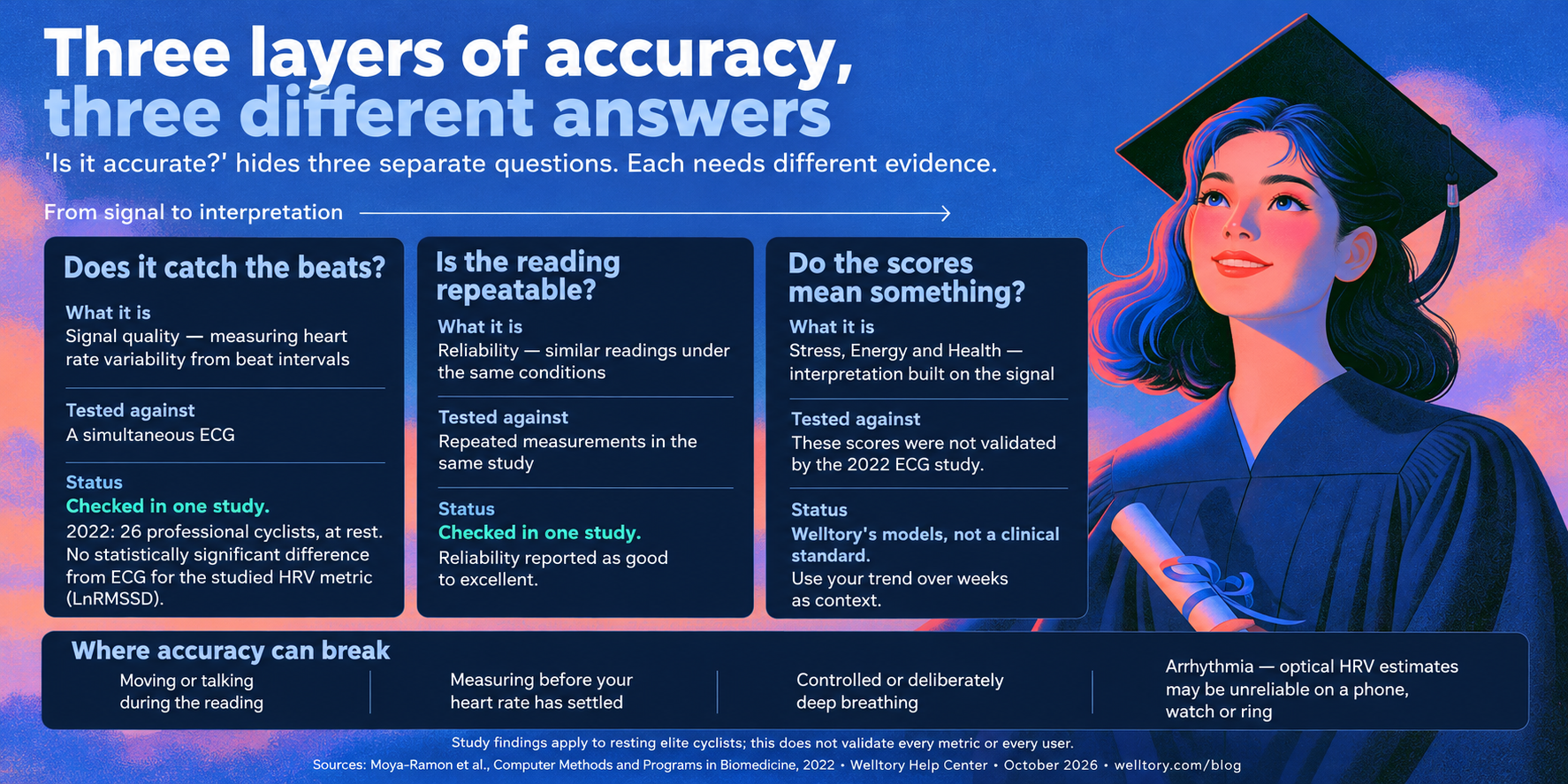
Three separate questions hide inside that one word, and conflating them is how both overclaiming and unfair dismissal happen.
Does it capture the beats correctly? This is signal quality — whether the intervals the app records match the intervals your heart actually produced. It is testable against an ECG, which is the reference standard, and it is the question the 2022 study answers.
Is the reading repeatable? A tool that gives you a different number every time under identical conditions is useless even if it is unbiased on average. This is reliability, and it is reported separately in validation studies.
Does the interpretation mean anything? Your SDNN or RMSSD is a physiological fact. "Your energy is at 64%" is a model's opinion about that fact. The first can be validated against hardware; the second is a product decision, informed by research and by our own data, and it should be judged on whether it is useful to you over weeks, not on whether it is "correct" on a Tuesday morning.
Most arguments about app accuracy online are really arguments about the third question dressed up as the first.
How does Welltory measure heart rate variability?
The method is photoplethysmography, or PPG — an optical technique that detects changes in blood volume. Your phone already has the two parts it needs: the flash as a light source and the camera as a detector. When your heart contracts, the capillaries in your fingertip fill with blood and absorb more light, so the image darkens; when it relaxes, the image brightens. The rhythm of that brightening and darkening gives the intervals between beats, and the variation in those intervals is HRV.
This is the same physical principle your smartwatch and your ring use. The difference is where the sensor sits — a fingertip pressed to a lens gives a stronger signal than a wrist or a finger ring, which is one reason a 60-second finger measurement can produce a cleaner signal, and also why it demands that you sit still.
Welltory also reads HRV from an Apple Watch, a Samsung Watch, or a chest strap, if you would rather measure that way. The published work on the engineering side — how the PPG waveform is cleaned, how beats are detected, how signal quality is assessed — is in Sensors (2021) and in the IEEE EMBC proceedings (2019).
Two limits worth knowing up front, both stated in our own documentation: camera measurements are less reliable if you are under 18 or pregnant, because the algorithm's assumptions about the autonomic nervous system do not hold as well in those bodies.
Has Welltory been compared with an ECG?
Yes — by a team we did not commission or fund.
In 2022, a team from Miguel Hernández University of Elche, the University of Granada and the Spanish cycling federation published a validation study in Computer Methods and Programs in Biomedicine. They recruited 26 professional cyclists and recorded HRV simultaneously with an electrocardiogram and with two apps — Welltory, which uses PPG through the phone camera, and Elite HRV, which uses a chest strap. Measurements were taken at rest in two positions, lying and seated, and analysed at both the standard five-minute length and an ultra-short one-minute length.
The findings, in the authors' framing: neither app differed significantly from the ECG in either position; both correlated strongly with it; neither showed meaningful differences between the five-minute and one-minute recordings; and reliability ranged from good to excellent. Their conclusion was that both apps can be used to monitor HRV in elite endurance athletes with short and ultra-short recordings.
The disclosure that belongs next to that: the Elche group holds Welltory academic licences, which we provide to research teams free of charge. We did not commission or fund the study, had no role in its design, conduct, analysis or write-up, and had no say in what it reported. Free licences are a material connection and you should weigh it — but it is a different thing from a sponsored trial.
What that study does and does not establish is worth being precise about, because this is the paper that gets cited — including by a review that goes on to list Welltory among validated apps.
It establishes that camera-based PPG, in a resting adult who stays still, produces beat intervals an ECG agrees with. It does not establish anything about measurements taken while moving, about children, about people with arrhythmias — whose irregular beats are difficult for any PPG device — or about the population at large, since the sample was 26 trained cyclists. And it says nothing at all about whether our Stress or Energy scores are meaningful. Those are separate claims requiring separate evidence.
That paper is also why Welltory turns up in other people's reference lists. A 2026 perspective article in Frontiers in Sports and Active Living by Schaffarczyk and Sperlich, reviewing HRV-guided endurance training, refers in passing to "validated smartphone applications [e.g., HRV4Training, Welltory, Elite HRV]." We did not write that sentence and had no involvement in the paper. It is the kind of citation that only accumulates when independent teams have checked your tool and found it usable.
Which studies have actually used Welltory?
This is the part that is harder to fake than a marketing claim. If an app is unreliable, researchers stop choosing it, because bad instruments cost them their results.
As of October 2026, we count 44 scientific publications that mention Welltory. Five are our own. In 18 of them, Welltory was the instrument that produced the data. Six more used our openly published anonymised datasets. The rest cite or list the app in reviews of the field.
A selection of the work where it was genuinely used:
University of Oxford (free academic licences). A 2026 study in the International Journal of Environmental Research and Public Health measured whether the volatile compounds plants release in botanic glasshouses were associated with health gains in 43 participants, using Welltory (v4.26.0) to record heart rate and SDNN alongside a standard anxiety inventory. The acknowledgments read: "The authors would like to thank Welltory for the use of their software."
Universidad de Sevilla. A randomised controlled trial protocol published in Healthcare in 2025 covers an exercise-based telerehabilitation programme for 147 adults with ME/CFS or post-COVID syndrome. Welltory is used for daily logging of fatigue, discomfort and post-exertional warnings, and for resting heart rate and HRV. The acknowledgments thank Welltory Inc. for complimentary premium licences and state explicitly that the company had no role in the design, conduct, analysis or write-up.
University College London (a paying academic customer). A 2022 doctoral thesis in the Department of Computer Science on supporting stress self-management used Welltory as a central instrument across two studies.
University of Wisconsin–Madison (a paying academic customer). A 2023 doctoral dissertation on anticipation and regulation in the face of racism collected vagally mediated HRV data through the app.
Miguel Hernández University of Elche (free academic licences — the group behind the validation study above). Beyond the validation paper, the same group published work in 2023 and 2025 on HRV-guided exercise prescription in sedentary adults, with participants recording HRV daily in Welltory.
University of Amsterdam and partners (no relationship with us at all). A 2025 study in Sociology of Health & Illness, funded by the EU's Horizon Europe programme, interviewed 33 people living with long COVID in the Netherlands, Austria and Switzerland about how they track their own health. Welltory appears among the apps participants had chosen for themselves, alongside Visible and Garmin Connect. Nobody handed them a licence; they picked it.
University of Almería (no relationship with us at all). A 2024 paper in Physiology & Behavior on HRV and memory function used lnRMSSD measured with Welltory — a team that simply picked the tool, with no agreement with us of any kind.
University of Jordan (free academic licences). A 2026 paper in the Journal of King Saud University – Computer and Information Sciences on emotion recognition from physiological signals names "mobile photoplethysmography (PPG) via the Welltory application" in the first line of its abstract.
Loma Linda University Health (free academic licences). A randomised trial comparing two treatments for diabetic peripheral neuropathy (NCT05577390, recruiting, 40 participants aged 45–85, primary completion estimated 2027) names Welltory in its primary outcome measure, which the registry describes as "a composite measurement combining electrocardiogram and Welltory App measurements" of heart rate variability. Participants measure morning and evening around each treatment session; a laboratory ECG is recorded at set visits alongside them. A trial that uses an app to collect data is not a trial of the app, and a registry entry is not an approval of anything — the registry states plainly that no FDA-regulated device product is under study. But it is a clinical research team willing to put phone-camera measurements into the same primary outcome as a laboratory ECG.
Separately, anonymised Welltory data has been published openly, including a dataset of 186 people who had COVID-19. Teams at KAUST, the University of Sharjah and elsewhere have used it in papers on pulse estimation and recovery monitoring without ever contacting us, which is what open data is for.
A different kind of check arrived in 2026, and it is worth more than any of the individual studies. A team at University College Dublin audited the HRV app market itself. They found 746 apps, of which 206 met their criteria — and then came the number that should give any reader pause: only 93 of those 206 disclosed enough about their own methods to be analysed at all. The remaining 55% of the market, in the authors' words, "lacks verifiable data regarding its technical protocols and scientific foundations."
Welltory is in the transparent 93. Within that group, 61.3% cited peer-reviewed science of any kind, and only 11 apps — 13.9% — cited a validation study specific to their own product rather than general HRV theory. The audit's own reference list includes the 2022 study described above, cited as an example of a camera-based app that has undergone scientific validation, and our 2019 engineering paper, cited among the evidence that photoplethysmography works under resting conditions. We had no part in that audit.
What that tells you, more usefully than any claim we could make: the hard part of this market is not whether an app's sensor works. It is whether the company will tell you how it works. Just over half will not.
The honest footnote to all of this: being used in a study is not the same as being endorsed by it. Most of these papers are about plants, music, nursing students or neuropathy, not about us. What they demonstrate is that ethics committees and methodologists repeatedly found this measurement acceptable for collecting real physiological data — which is a modest claim, and a true one.
One limit worth stating outright, because the list above names conditions: that researchers measured HRV with Welltory in studies of ME/CFS, post-COVID syndrome or neuropathy is not a claim that Welltory does anything for those conditions. It does not detect them, assess them or help manage them. It recorded a physiological signal for someone else's research question.
What happened in the study where it didn't work?
In 2025, a group music therapy study from McMaster University was published in PLOS Mental Health. The researchers collected HRV with Welltory and then reported that the data was too noisy to analyse. They published only descriptive statistics for it.
We could leave that out. It belongs in, both because leaving it out would be dishonest and because the reasons are the most useful thing in this article.
Start with what the same paper says about the tool. Its methods section describes "an almost perfect correlation of the Welltory phone application against the ECG gold standard" — their characterisation, not ours. These were not researchers who thought the app was inaccurate. They chose it precisely because it had been checked.
What went wrong was the protocol, and they say so themselves: they used the free version of the app, measurements were taken during group sessions where people were talking and distracted, and participants used a range of different devices. Any one of those is enough to degrade a photoplethysmography reading; together they are fatal. Their own recommendation for future work is individual app licences or a more traditional heart rate measure — not a different app.
The lesson generalises past the research setting. HRV measured while you are talking, moving or being interrupted is not a bad Welltory reading; it is not a reading at all. This is the single most common reason people conclude an app is "wrong."
Why doesn't my Welltory reading match my Apple Watch or Oura?
Because they are not measuring the same thing, and none of them is simply right.
Your watch and your ring measure overnight, passively, averaging across hours while you are asleep and your position changes. Welltory's camera measurement is a deliberate 60-second snapshot while you are awake, still and in a controlled position. Those two numbers describe different states of the same body, and expecting them to match is like expecting your weight before breakfast and after dinner to agree.
Three more reasons the numbers diverge even when both are working:
Different metrics with the same name. RMSSD, SDNN and "HRV" as a branded score are different calculations. Apple reports SDNN from short samples; many wearables report an RMSSD-derived nightly average; some report a proprietary index. Comparing the labels is not comparing the numbers.
Different sensor sites and sampling rates. A fingertip, a wrist and a finger ring see different signal strength and artefact profiles.
Genuine physiological variation. HRV is sensitive to breathing, posture, time of day, caffeine, alcohol and last night's sleep. A reading taken fifteen minutes later is legitimately different.
What this means in practice: pick one device, one position and one time of day, and read the trend rather than the absolute number. A tool that is consistently biased but stable will tell you more about your own direction of travel than a theoretically perfect tool used inconsistently.
What makes your own measurements accurate — or not?
Welltory scores the accuracy of every measurement you take, and it is worth looking at. The score has two components: behaviour quality, meaning what you were doing before and during the reading, and technical quality, meaning how clean the signal from your camera or device was. At 95–100%, the HRV data behind that measurement closely reflects what is going on in your body. The score is about the measurement itself, not about the Stress or Energy numbers built on top of it.
What raises it:
Lie down, or sit with your back against the chair.
Wait 10–15 minutes after any exertion before measuring, so your heart rate has settled.
Stay still, and do not talk.
Breathe normally. Do not take deliberately deep or even breaths — controlled breathing changes HRV substantially, which is a real effect and not a measurement error, but it means you are no longer measuring your baseline.
Keep the finger steady on the camera and flash, in light that is neither harsh nor dim.
What lowers it: an elevated heart rate, a heart rate that drifts during the reading, movement, speech, and a blurred or unstable image.
There is also a learning period. Welltory's interpretation runs on a self-learning algorithm that needs to establish your personal baseline, which takes a week or two of morning measurements taken at a consistent time, before food, coffee, a shower or a workout. Judging the app on your first three readings is judging it before it has met you.
On the interpretation itself, we have published what we use. The reference ranges in the app were derived from over 60,000 artefact-free RR intervals from more than 600 users who measured for at least 90 days, chosen against the broad and mutually inconsistent population ranges in the literature — the published normal ranges for RMSSD that our own documentation collects span roughly 13 to 107 ms across studies, which is too wide to tell you anything on a given morning. Welltory uses 20–89 ms. We also say plainly in our own documentation that even our narrowed ranges are not personalised enough, which is why the app leans on your trend against your own history rather than on where you sit against a population.


Start understanding your body
Learn what affects your energy, stress, sleep, and daily state. Get the app.
How Welltory helps — and what it cannot do
What the app can do for you: take a 60-second HRV measurement with your phone camera, your Apple Watch, your Samsung Watch or a chest strap, and tell you how reliable that specific reading was; keep every measurement in your Health Journal so you can see a trend instead of a single number; let you tag what was happening — a bad night, a drink, a hard session, a stressful call — so patterns become visible over weeks; run an orthostatic test in the Science Lab if you want to see how your body handles standing up; and pull in sleep, steps and activity from the apps and devices you already use, so the HRV number sits next to its likely causes.
What it cannot do, stated plainly: it is not an ECG and cannot detect, rule out or monitor heart rhythm disorders. It does not diagnose any condition — not stress-related illness, not dysautonomia, not burnout. It cannot tell you why your HRV dropped; it can only show you that it did, and give you a record detailed enough to work that out with a clinician. Readings during movement are not usable, and readings under 18 or during pregnancy are less dependable. And if you have an arrhythmia, PPG in any form — ours, your watch's, your ring's — is working against the signal rather than with it.
The thing it is genuinely good at is unglamorous: before you blame yourself for being tired, lazy or fragile, it shows you what your body already recorded. Often there is a third short night, a late glass of wine or two weeks of accumulated load sitting right there in the chart.
Using Welltory in your own research
If you run studies, Welltory has an academic licence programme. The current terms, documented in our help centre: for research involving up to 50 participants and intended for publication, licences and up to three standard data exports are free; studies with more than 50 participants or additional exports are arranged separately. Free-tier participants yield Stress, Energy, Focus, coefficient of variation, heart rate and SDNN; Premium adds ANS balance, coherence, HRV score and the full set of calculated metrics.
Two pieces of advice from watching how these studies go, since the difference between a usable dataset and the McMaster outcome is almost entirely protocol: give participants a written measurement protocol — same position, same time of day, no talking, before coffee — and give them individual licences rather than shared devices. HRV is as sensitive to method as it is to physiology.
The application details are in the help centre article on using Welltory for research.


Discounts for blog readers: up to 36% off
See what affects your energy, stress, sleep, and daily state with Welltory
This article is for educational purposes only and is not a substitute for medical advice, diagnosis, or treatment from a qualified clinician. Welltory is not a medical device.
Was this helpful?
Ask AI for a summary of page


Written by Jane Smorodnikova

The founder and CEO of Welltory. A recognized tech leader with two Master's degrees and experience at MIT, she has scaled Welltory to over 17 million users.
Written by Tatsiana Yashyna

Deputy COO at Welltory. With a background in medicine and years of working with health data, she translates research and real physiological signals — sleep, stress, heart rate, and hormones — into clear, evidence-based explanations that help people understand what their bodies are telling them.
References
- Moya-Ramon M, Mateo-March M, Peña-González I, Zabala M, Javaloyes A. Validity and reliability of different smartphones applications to measure HRV during short and ultra-short measurements in elite athletes — Computer Methods and Programs in Biomedicine, 2022;217:106696. https://doi.org/10.1016/j.cmpb.2022.106696
- Schaffarczyk M, Sperlich B. Heart rate variability-guided endurance training: evaluating strengths, weaknesses, opportunities, and threats for load prescription and adjustment — Frontiers in Sports and Active Living, 2026. https://doi.org/10.3389/fspor.2026.1858271
- Tucker MR, Kay W, Storer K, Lindström Battle A, Willis K. Smelling wellness: associations between botanic garden scentscapes and human health gains — International Journal of Environmental Research and Public Health, 2026;23(3):304. https://doi.org/10.3390/ijerph23030304
- Fricke-Comellas H, Infante-Cano M, Heredia-Rizo AM, Martín-Fernández A, Escudero-Pérez P, Fernández-Seguín LM. Safety and effectiveness of an exercise-based telerehabilitation program in myalgic encephalomyelitis and post COVID syndrome: protocol for a randomized controlled clinical trial — Healthcare, 2025;13(23):3062. https://doi.org/10.3390/healthcare13233062
- Finnerty R, Trainor L. Group music therapy for the proactive management of stress and anxiety — PLOS Mental Health, 2025;2(8):e0000312. https://doi.org/10.1371/journal.pmen.0000312
- Casanova-Lizón A, Manresa-Rocamora A, Sarabia JM, Pastor D, Javaloyes A. Impact of heart rate variability-based exercise prescription: self-guided by technology and trainer-guided exercise in sedentary adults — Frontiers in Sports and Active Living, 2025;7:1578478. https://doi.org/10.3389/fspor.2025.1578478
- Castillo-Escamilla J, Ruffo I, Carrasco-Poyatos M, Granero-Gallegos A, Cimadevilla JM. Heart rate variability modulates memory function in a virtual task — Physiology & Behavior, 2024;283:114620. https://doi.org/10.1016/j.physbeh.2024.114620
- Darabkh KA, Amro OM, Alshiyyab RM. Exploring machine learning and computational intelligence for emotion recognition through physiological signals during Quranic recitation — Journal of King Saud University – Computer and Information Sciences, 2026. https://doi.org/10.1007/s44443-026-00832-1
- Neshitov A, Tyapochkin K, Smorodnikova E, Pravdin P. Wavelet analysis and self-similarity of photoplethysmography signals for HRV estimation and quality assessment — Sensors, 2021;21(20):6798. https://doi.org/10.3390/s21206798
- Tyapochkin K, Smorodnikova E, Pravdin P. Smartphone PPG: signal processing, quality assessment, and impact on HRV parameters — 41st Annual International Conference of the IEEE Engineering in Medicine and Biology Society (EMBC), Berlin, 2019, pp. 4237–4240. https://doi.org/10.1109/EMBC.2019.8856540
- A physiologic comparison of two approaches to treating peripheral neuropathy — ClinicalTrials.gov, NCT05577390, Loma Linda University; record last updated November 2025. https://clinicaltrials.gov/study/NCT05577390
- de Jager E, Caulfield B, Angelidi E, Holden S. Mobile apps for heart rate variability: app store search and content analysis — JMIR Cardio, 2026;10:e84764. https://doi.org/10.2196/84764
- Algera E, Maukner AC, van Dorth J, Alblas MC, Sobel J, de Vries DH. ‘I do take the number seriously, but I don't let my moods depend on it’: negotiating self-tracking data with people living with long COVID in the Netherlands, Austria and Switzerland — Sociology of Health & Illness, 2025;47(8):e70102. https://doi.org/10.1111/1467-9566.70102
- How to take accurate heart rate variability measurements — Welltory Help Center. https://help.welltory.com/en/articles/3361520-how-to-take-accurate-heart-rate-variability-measurements
- What normal ranges and measurement standards we use to interpret your heart rate variability — Welltory Help Center. https://help.welltory.com/en/articles/4413231-what-normal-ranges-and-measurement-standards-we-use-to-interpret-your-heart-rate-variability