

Short answer
How often do you need a tetanus shot? Once every 10 years for adults, as a Td or Tdap booster, under CDC's adult schedule, and sooner after a dirty, deep or puncture wound if your last one was 5 or more years ago (2, 1). If you never had the primary series or don't know your history, any wound calls for vaccine.
Most adults don't need boosters for most other vaccines. Flu and COVID-19 are seasonal; tetanus and diphtheria repeat every decade; shingles, RSV, HPV and hepatitis B are done once; MMR and polio usually are (2, 24).
If you have no idea when your last tetanus shot was, you're not failing at being an adult. No national agency keeps vaccination records, CDC included (19).
Note: this article explains what guidelines and research say and is not medical advice; your doctor, pharmacist or the clinician treating your wound decides what fits you. Call 911 for jaw stiffness, painful muscle spasms, trouble swallowing or breathing, or a seizure in the days or weeks after a wound. An animal bite needs care the same day (rabies as well as tetanus). If you are pregnant, your obstetric clinician (OB-GYN or midwife) decides on vaccines.
How often do you need a tetanus shot?
Every 10 years for adults who completed the primary series, with Td or Tdap; adults who never had Tdap at age 10 or older get one Tdap dose first, then continue every 10 years (2).
The schedule in effect as of October 2026 (2, 3):
Childhood series done, had Tdap at 10 or older — Td or Tdap every 10 years
Childhood series done, never had Tdap at 10 or older — 1 Tdap now, then Td or Tdap every 10 years
Never vaccinated, or series incomplete — Finish 3 doses: Tdap, then Td or Tdap 4 weeks later, then Td or Tdap 6–12 months later; then every 10 years
Pregnant — 1 Tdap in every pregnancy, preferably early in weeks 27–36
The American Academy of Family Physicians' 2026 adult schedule, dated March 1, 2026, gives the same 10-year and wound rules (25). In pregnancy, Tdap can be given regardless of when your last tetanus shot was (6), and your obstetric clinician decides the timing.
Why the 10-year rule exists
Because antibodies fall with time. By 10 years, CDC's Pink Book says, most people's levels "only approach the minimal protective level," and a few fall below it sooner, hence the 5-year rule for dirty wounds (6). Having had tetanus may not protect you either, so even survivors need vaccination (10).
In CDC's surveillance report for 2009–2023, there were 402 cases and 37 deaths; 43.9% of patients with a known history had never had a tetanus vaccine, and among those who had, 58.8% had their last dose 10 or more years earlier (7). No deaths were reported among patients with three or more documented doses.
How long does a tetanus shot last, and how long is it good for?
Officially, 10 years for routine protection and 5 years after a dirty or major wound, if you completed the primary series (1). Measured antibodies often last longer.
A national blood survey from 2015–2016 found that 93.8% of Americans aged 6 and older had protective tetanus antibody levels (0.10 IU/mL or more); at least 90% did through age 69, falling to 75.8% at 80 and older (14). Adults 80 and older also have the highest tetanus incidence, and women in that age group the highest of all (7).
When to get a tetanus shot after a cut: the CDC wound table
Clean the wound right away, then check two things: the type of wound and the date of your last tetanus shot. CDC's clinical guidance, updated September 8, 2026, sorts it this way (1):
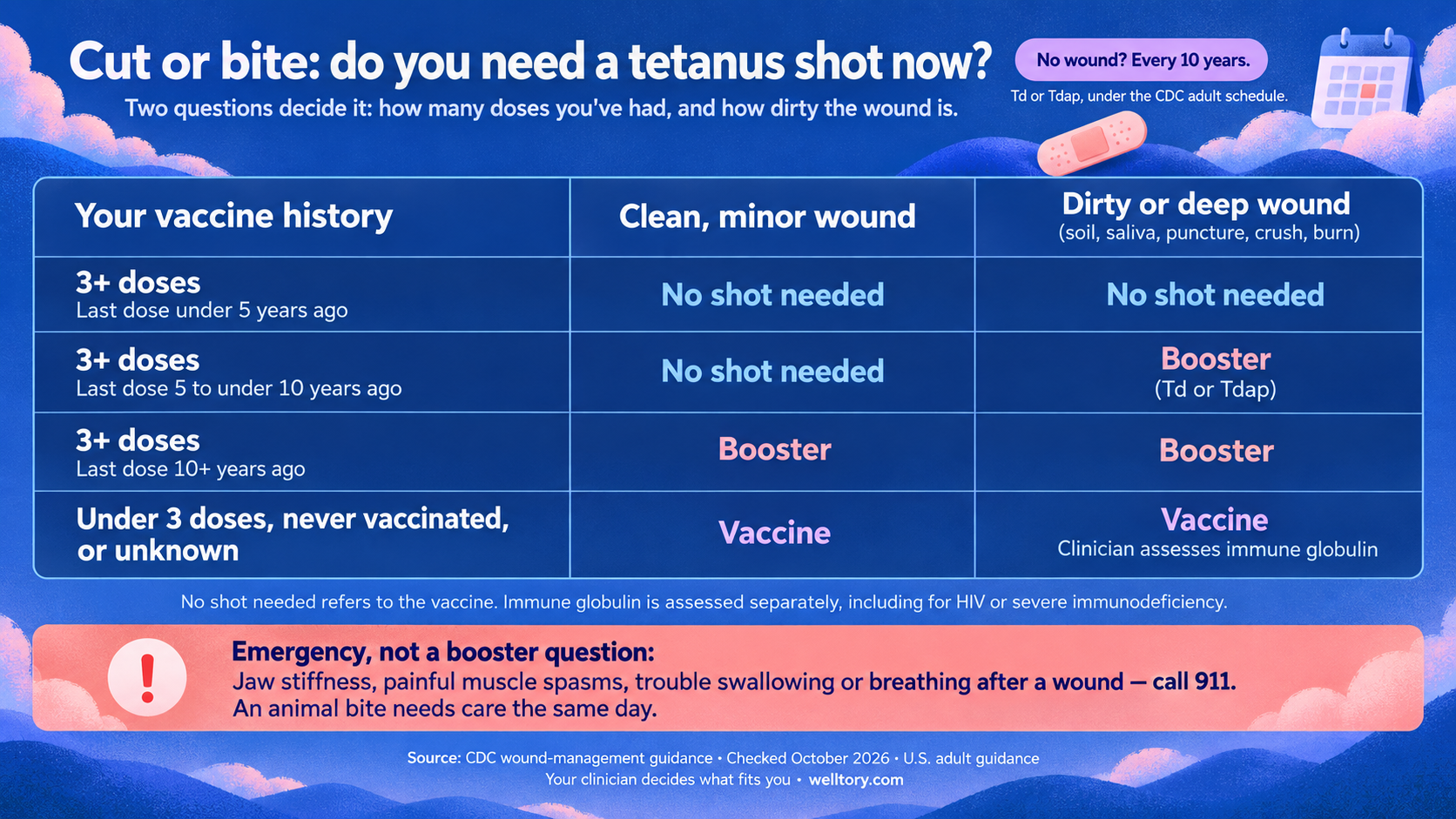
| Your tetanus history | Clean, minor wound | Dirty or major wound |
|---|---|---|
| 3 or more doses, last one less than 5 years ago | No shot needed | No shot needed |
| 3 or more doses, last one 5 to 10 years ago | No shot needed | Booster (Td or Tdap) |
| 3 or more doses, last one 10 or more years ago | Booster | Booster |
| Fewer than 3 doses, never vaccinated, or unknown | Vaccine | Vaccine; the clinician decides on tetanus immune globulin (TIG) |
| HIV or severe immunodeficiency | Vaccine per your history | Vaccine per your history; CDC lists TIG regardless of history, and the clinician decides |
\Dirty or major: puncture wounds; wounds with dirt, soil, feces or saliva, including animal and human bites; and wounds with damaged or dead tissue such as burns, compound fractures, crush injuries, frostbite or gangrene (1). TIG is never indicated for clean, minor wounds.*
TIG is a shot of ready-made antibodies that neutralize circulating toxin for a while; it can't undo toxin already bound to nerves (1). If a tetanus vaccine is due, Tdap is preferred if you've never had Tdap and is used if you're pregnant (2).
CDC advises contacting a healthcare provider for punctures, deep wounds, wounds with dirt or saliva, and wounds with dead tissue (8).
Red flag, same type size: a wound that becomes hot, swollen, increasingly red or painful, or comes with fever needs care the same day; jaw stiffness, muscle spasms or trouble swallowing in the days or weeks after any wound means 911.
When to get a tetanus shot if you're already late
As soon as you realize it, the same day. CDC's guidance sets no cutoff, but tetanus usually appears 3 to 21 days after the injury, about 8 days on average (11). In national data, fewer than half of tetanus patients with a wound sought care before symptoms, and only about a third of those due a vaccine got one (7).
Do I need a tetanus shot for a small puncture?
Possibly yes: CDC counts any puncture wound as dirty or major, whatever its size, so the 5-year rule applies (1). A nail, a garden fork, a deep splinter: if your last shot was 5 or more years ago, or you don't know, you're due.
Small punctures are exactly where tetanus starts. Of the US cases with a described wound in 2009–2023, 61.2% followed punctures, and more than 9 in 10 wounds were on an arm or leg (7). Rust isn't what matters; the spores live in soil, dust and manure and get in through broken skin, especially punctures and dirty wounds (10).
Tetanus shot for dog bite: two questions, not one
A bite is a dirty wound because of saliva, so you need a booster if your last tetanus shot was 5 or more years ago (1). The second question is rabies, and it is decided separately, by a clinician or your health department.
CDC's rabies steps after a bite or scratch from any wild or unfamiliar animal (21):
Wash the wound immediately with soap and water for 15 minutes.
Talk with a healthcare or public health professional about your risk.
Tell them what animal it was and whether it was acting abnormally.
If it was someone's pet, ask the owner for proof of rabies vaccination.
Get seen the same day: rabies is nearly always fatal once symptoms start, while prompt post-exposure care is nearly 100% effective (22). The clinician will also check the bite for ordinary infection.
Tetanus shot for injury with bruising
A bruise with unbroken skin is not a tetanus wound: the spores need a way in through broken skin (10). The picture changes if the skin is broken or the tissue is crushed. CDC lists crush injuries and wounds with damaged tissue among dirty or major wounds, so a crush injury that breaks the skin falls under the 5-year rule (1).
Severe swelling, deformity or being unable to use the limb needs urgent care regardless of tetanus.
What if you don't know when your last tetanus shot was?
Treat it as unknown, not as "probably fine." ACIP's recommendations say people with unknown or uncertain tetanus history "should be considered to have had no previous tetanus toxoid–containing vaccine" (5). In practice:
No wound, just unsure: ask your doctor or pharmacist. If records can't be found, CDC notes you may need some vaccines again and that it is safe to repeat them (19).
Clean, minor wound: vaccine is indicated when history is unknown (1).
Dirty or major wound: vaccine, plus a clinician's decision about TIG (1).
Never vaccinated at all: a three-dose series over 6 to 12 months, with Tdap first (2).
If you remember childhood shots but not your last booster, say exactly that; the clinician will weigh it.
Where your vaccine records are: state registries (IIS)
Start with your state's immunization information system (IIS), a confidential database of doses given by participating providers in a state (20). CDC keeps a list of every state's IIS contact, and some states have public portals where you can request your own record (20). Not every state registry includes adult doses, so check the state where you got your last shots, too (19).
CDC also suggests parents' records or baby books, school or college health services (often kept only 1–2 years), past employers or the military, and your doctor's office (19). Once you find the date, keep it on your phone and ask your provider to report future doses to the registry.
Tdap booster, Td and the tetanus shot name
The "tetanus shot" for adults is almost always Td or Tdap. Both protect against tetanus and diphtheria; Tdap also protects against whooping cough (pertussis) (9).
Is Tdap a tetanus shot?
Yes. The capital T stands for tetanus; the lowercase d and p mean reduced amounts of diphtheria and pertussis components (9, 6). Tetanus vaccines are given combined with vaccines for other diseases (15).
What is the tetanus shot called? Names you'll see
| Abbreviation | Who it's for | US product names (identification only) |
|---|---|---|
| DTaP | Children under 7 | Daptacel, Infanrix and combination shots |
| Tdap | Age 10 and up (routinely at 11–12), adults, pregnancy | Boostrix, Adacel |
| Td | Age 7 and up, adults | Tenivac, TDVAX |
Product list from CDC's Pink Book (6).
Tdap vs Td: which one for a booster?
Either, since 2019. In October 2019, ACIP voted 14 to 0 to allow Td or Tdap for the 10-year booster, for wound management and for catch-up doses, once a person has had at least one Tdap (4). Two cases call for Tdap specifically: an adult who has never had Tdap, and every pregnancy (2).
What does a tetanus shot do?
It teaches your immune system to make antibodies (antitoxin) against tetanus toxin, the nerve poison that blocks the signals letting muscles relax; after a complete series, essentially everyone reaches protective levels (6).
It doesn't treat tetanus that has already started. Tetanus is diagnosed from symptoms alone: no lab test can confirm or rule it out (8, 11).
Tetanus symptoms: when it's an emergency
Call 911 if jaw stiffness or other signs below appear after a wound, even a small one you'd forgotten. CDC lists (8, 6):
Spasms of the jaw muscles ("lockjaw"), usually the first sign
Stiff neck and trouble swallowing
Sudden, involuntary muscle spasms, often in the stomach
Painful stiffness all over the body
Seizures
Fever, sweating, and changes in blood pressure or heart rate
Tetanus is treated in hospital with TIG, medicines for spasms and sometimes a breathing machine (8). About 1 in 10 US cases is fatal (8).
Every 10 years, or every 30? The OHSU study and WHO's 6-dose approach
The US 10-year booster is the recommendation; the 30-year figure comes from research, not from any US guideline. Here is what each side says.
The OHSU study (2016). Researchers at Oregon Health & Science University measured antibodies in 546 adults. About 97% had tetanus antibodies at or above 0.01 IU/mL, which the study counted as protective; antibody levels fell with an estimated half-life of 14 years, and a model predicted 95% of people would stay protected for at least 30 years without boosters (12). The authors suggested the US schedule "should be revisited." Limits: it measured antibodies at one point in time rather than counting tetanus cases, and "protective" depends on the lab test: ACIP accepts 0.01 IU/mL by toxin neutralization but 0.1–0.2 IU/mL by standard ELISA, so cutoffs differ between studies (5).
The country comparison (2021). The same research group compared WHO case reports from 31 North American and European countries from 2001 to 2016 and found no significant difference in tetanus incidence between countries with and without routine adult boosters (13). It was observational; countries differ in reporting and wound care.
What has not changed. ACIP has not adopted a longer interval, and CDC's 2026 pages still describe boosters "every 10 years" (9).
| Approach | Childhood and teen doses | Adult routine boosters | After a wound |
|---|---|---|---|
| US (CDC, AAFP 2026) | 5 DTaP + Tdap at 11–12 | Td or Tdap every 10 years | Booster if 5+ years (dirty) or 10+ years (clean) |
| WHO | 6 doses total: 3 primary + 3 boosters by age 15 | None routinely after 6 doses | Per national wound guidance |
| UK (NHS) | Doses at 8, 12 and 16 weeks, 18 months, 3 years 4 months and 14 years | No adult dose listed in the routine schedule; may be recommended before travel if help is hard to reach and the last dose was more than 10 years ago | May need a vaccine or booster if not fully vaccinated (at least 5 doses) or history uncertain |
WHO says 6 doses give protection "throughout life" (15). In the US, the 10-year rule is what clinicians follow as of October 2026; ask about the research if it interests you, but a study is not a reason to skip a booster your clinician recommends after a wound.
Adult boosters: which vaccines repeat and which don't
Tetanus is one of the few adult vaccines on a fixed repeat cycle. This table summarizes the CDC adult schedule in effect as of October 11, 2026 (the July 2, 2025 version), with CDC's current COVID-19 page and where other bodies differ. It covers routine adult recommendations only; for side effects, see vaccine side effects.
Td/Tdap (tetanus, diphtheria, pertussis) — Repeats?: Yes, every 10 years; CDC adult schedule (as of October 2026): 1 Tdap as an adult, then Td or Tdap every 10 years; sooner for wounds (2); Where others differ, or exceptions: AAFP 2026 same (25); WHO: no routine adult booster after 6 doses; the NHS routine schedule ends at 14 (15, 16)
Flu — Repeats?: Yes, every season; CDC adult schedule (as of October 2026): Everyone 6 months and older, every season (35); Where others differ, or exceptions: AAFP adds an mRNA vaccine to the preferred options at 65+ (26)
COVID-19 — Repeats?: Yes, updated vaccine each season; CDC adult schedule (as of October 2026): The July 2025 schedule still lists 2024–25 doses; CDC's COVID-19 page, updated October 8, 2026, says a 2026–27 vaccine is recommended for all adults 18+, especially important at 65+ or high risk (24); Where others differ, or exceptions: AAFP (as reported September 2, 2026): adults 19+, especially 65+, with a second dose after six months at 65+ (26)
MMR (measles, mumps, rubella) — Repeats?: Usually no; CDC adult schedule (as of October 2026): At least 1 documented dose; 2 for college students, international travelers and some others; born before 1957 counts as immune except for health care workers (2); Where others differ, or exceptions: Extra dose during a mumps outbreak if public health advises; revaccinate if vaccinated 1963–1967 with killed or unknown-type vaccine (28)
Hepatitis B — Repeats?: No routine booster; CDC adult schedule (as of October 2026): One 2-, 3- or 4-dose series at 19–59; at 60+ with risk factors or on request (2); Where others differ, or exceptions: CDC: "Most healthy people do not need a booster dose" (29)
Shingles (Shingrix) — Repeats?: No; CDC adult schedule (as of October 2026): 2 doses once, 2–6 months apart, at 50+ (19+ if immunocompromised), even after past shingles or Zostavax (2, 33); Where others differ, or exceptions: —
Pneumococcal — Repeats?: Usually once; CDC adult schedule (as of October 2026): At 50+: PCV20 or PCV21 alone, or PCV15 then PPSV23; younger adults with risk conditions; past-history rules (2, 34); Where others differ, or exceptions: AAFP: after PCV20 or PCV21, "pneumococcal vaccinations are complete" (25)
RSV — Repeats?: No, single dose; CDC adult schedule (as of October 2026): 1 dose at 75+, or at 50–74 with increased risk; "not currently an annual vaccine" (32); Where others differ, or exceptions: IDSA adds immunocompromised adults 18+ (26)
HPV — Repeats?: No; CDC adult schedule (as of October 2026): Series through age 26; 27–45 by shared decision with a clinician (2); Where others differ, or exceptions: Protection followed for about 12 years without signs of decline (31)
Polio (IPV) — Repeats?: Usually no; CDC adult schedule (as of October 2026): US-raised adults can assume they were vaccinated; finish the series if incomplete (2); Where others differ, or exceptions: One lifetime booster for adults at increased risk, such as travel to a country with higher polio risk (30)
Meningococcal and some travel vaccines have their own booster rules for specific risks (2). For flu timing, see when to get a flu shot.
Measles booster for adults
Most adults don't need one. You count as immune with documentation of MMR vaccination, lab evidence of immunity, or birth before 1957 (health care workers excepted) (2); CDC says most people vaccinated with MMR are protected for life (28). Exceptions: no record of any dose; only one dose if you're a college student, international traveler or health care worker (a second is recommended); or a 1963–1967 shot of killed or unknown-type vaccine (2, 28). MMR is a live vaccine and is not given during pregnancy (2).
Who recommends what in October 2026
CDC's adult schedule in effect is the July 2, 2025 version (3), which CDC restored to comply with a March 16, 2026 federal court ruling (36); the federal government appealed to the US Court of Appeals for the First Circuit, and the case was pending there as of October 7, 2026 (37). The AAFP publishes its own 2026 schedule (25), which the American College of Physicians supports (27), and four societies issued respiratory-vaccine guidance in September (26). On tetanus boosters, CDC's schedule and the AAFP's give the same rules. Your doctor or pharmacist decides what fits you.
Where to get a tetanus shot
For a routine booster, CDC says a doctor's office or pharmacy is usually best for adults; federally funded health centers and local health departments are options if you don't have a regular source of care (9).
For a wound, go where someone can examine it: primary care, urgent care, or the emergency department for deep, heavily contaminated or bleeding wounds and serious bites. Decisions about TIG and rabies care belong to a clinician or the health department.
Cost and coverage. HealthCare.gov lists tetanus and diphtheria among the adult immunizations that all Marketplace plans and many other plans must cover without a copayment or coinsurance, generally when given by an in-network provider; it adds that coverage may vary and $0 isn't guaranteed in all cases (23). Check with your insurer for in-network locations.
Tetanus shot side effects, in one paragraph
Usually a sore, red or swollen arm, sometimes mild fever, headache, tiredness or an upset stomach, settling within a few days (18, 9). Signs of a severe allergic reaction after you leave the clinic (hives, swelling of the face and throat, difficulty breathing, a fast heartbeat, dizziness or weakness) mean 911 (17). Rates, timing and what to avoid afterward are in vaccine side effects.
Tetanus shots: the questions people ask next
Can I jog after a tetanus vaccine?
Yes, if you feel fine. No guideline restricts exercise after a tetanus shot; the American College of Cardiology, writing about COVID-19 vaccines, said vaccination "does not require a set time away from exercise training" (38), and moving the arm can ease soreness (39). If you have a fever or body aches, skip hard training until they pass; working out while sick explains how to judge. Chest pain, fainting or severe breathlessness means 911.
I had a booster 3 years ago and just stepped on a nail. Do I need another?
No, if you completed the primary series. CDC's guidance says no vaccine is needed for any wound type when your last dose was less than 5 years ago and the primary series is complete (1). The puncture itself still needs cleaning and watching for infection. Bring the date; clinicians are told to try to confirm the primary series (5).
Can you get too many tetanus shots?
Repeating a vaccine when records are lost is safe, CDC says (19), but more is not better. The main concern is the Arthus reaction, a rare, painful local swelling; after one, ACIP advises no tetanus vaccine more often than every 10 years, even for a wound (5). Recording your dates is the easiest way to avoid unneeded repeats.
Do I need a tetanus shot during pregnancy?
Yes, Tdap in every pregnancy, preferably early in weeks 27 to 36, regardless of your last tetanus date; and if a wound needs a tetanus vaccine while you're pregnant, Tdap is used (2). CDC recommends it to help prevent whooping cough in newborns (9). Your obstetric clinician (OB-GYN or midwife) decides the timing.
I'm traveling somewhere remote. Should I get a booster first?
If it's been close to 10 years, ask before you go. Even the UK's NHS, whose routine schedule ends with a dose at 14, says a tetanus vaccine may be recommended before travel to places where medical help is hard to reach if your last dose was more than 10 years ago (16). Polio and other travel vaccines may also apply (30).
When to seek care after a cut, bite or puncture
Call 911 for jaw stiffness or trouble opening your mouth, painful muscle spasms or stiffness, trouble swallowing or breathing, or a seizure after a wound (8). Also call 911 for hives, facial or throat swelling, trouble breathing or a fast heartbeat after a vaccine (17).
Get care the same day for any animal bite or scratch, because of rabies as well as tetanus (21); for a puncture, a deep or dirty wound, or a burn or crush injury when you're due for a booster or don't know your history (1); and for a wound that becomes hot, swollen, more painful or red, or comes with fever.
Book a routine visit or pharmacy appointment if it's been 10 years or more, you've never had Tdap as an adult, or you can't find your records.
What to say. "I had a [puncture/cut/bite] on [date], from [object or animal]. My last tetanus shot was [date / I don't know]. I [did / didn't] have my childhood shots." Mention pregnancy, a weakened immune system or HIV, and any past severe reaction to a tetanus shot.
What to ask. "Which row of the wound table am I in?" "Td or Tdap?" "Do I need tetanus immune globulin?" "Can you report this dose to the state registry?" After a bite: "Who decides about rabies care?"


Start understanding your body
Learn what affects your energy, stress, sleep, and daily state. Get the app.
How Welltory helps — and what it cannot do
The limits first. Welltory is a general wellness product, not a medical device. It does not diagnose, detect, predict, monitor, prevent, treat or mitigate any condition, including tetanus, wound infections or vaccine reactions. It can't tell you whether you need a tetanus shot or whether a wound is clean or dirty.
You note the day; the app keeps the date. "When was your last tetanus shot?" is a question you'll be asked after almost any wound. Add a tag from the plus sign at the top of the feed on the day you get it ("Tdap booster", "Td at urgent care") or the day you're injured ("stepped on nail", "dog bite"). When the Today screen marks a stress or rest stretch, it asks "What happened?"; tap a suggested tag, type or just talk, and correct the tags before saving.
Look at the next nights against your own history. Sleep analysis shows how your heart rate changed overnight and whether it ran higher than usual; resting heart rate, HRV, stress minutes and Battery are recorded the same way every day (Battery and stress minutes need iOS with an Apple Watch or Oura; detailed sleep analysis needs an Apple Watch). We found no wearable studies of tetanus shots; after flu shots, a smartwatch study found no statistically significant change in heart rate on average (40). Unchanged numbers are not a sign of anything. Any comparison is with your own recent days, not a population range or a line marked normal.
Over months, My Patterns shows what your tags have in common. My Patterns collects tags from stress and rest stretches (iOS with an Apple Watch or Oura); patterns start to become visible at around seven tagged events, so one booster won't make one. Any pattern is an association to discuss, not a cause.
A record you made, for an appointment. The Journal (Premium) keeps your measurements, tags and notes, and from the web app you can export a CSV (Dashboard → choose a chart → Export). A dated note such as "Tdap, left arm, pharmacy, sore for two days" answers that question in seconds, and it complements, not replaces, your state registry record.
The same red flags apply here, in the same type size: jaw stiffness, muscle spasms, trouble swallowing or breathing, or a seizure after a wound means 911; an animal bite, a puncture when you're due for a booster, or a wound that turns hot, swollen and red needs care the same day (8, 21).
How we made it
Made with AI tools, then edited and fact-checked by the Welltory team. See our Editorial & AI policy.
Data analysis by Jane Smorodnikova, co-founder of Welltory and the person who built the methodology behind how we read physiological data.
Written by Tatsiana Yashyna.


Discounts for blog readers: up to 36% off
See what affects your energy, stress, sleep, and daily state with Welltory
This article is for educational purposes only and is not medical advice; your doctor, pharmacist or the clinician treating your wound decides what fits you. Call 911 for jaw stiffness, painful muscle spasms, trouble swallowing or breathing, or a seizure in the days or weeks after a wound, and for hives, face or throat swelling or trouble breathing after a shot. An animal bite needs care the same day. Welltory is a general wellness product and does not diagnose, detect or predict any condition.
Was this helpful?
Ask AI for a summary of page


Written by Jane Smorodnikova

The founder and CEO of Welltory. A recognized tech leader with two Master's degrees and experience at MIT, she has scaled Welltory to over 17 million users.
Written by Tatsiana Yashyna

Deputy COO at Welltory. With a background in medicine and years of working with health data, she translates research and real physiological signals — sleep, stress, heart rate, and hormones — into clear, evidence-based explanations that help people understand what their bodies are telling them.
References
- Centers for Disease Control and Prevention. Tetanus: clinical guidance for wound management. Updated September 8, 2026. https://www.cdc.gov/tetanus/hcp/clinical-guidance/index.html
- Centers for Disease Control and Prevention. Adult immunization schedule: notes (addendum updated July 2, 2025). Accessed October 11, 2026. https://www.cdc.gov/vaccines/hcp/imz-schedules/adult-notes.html
- Centers for Disease Control and Prevention. Adult immunization schedule by age (addendum updated July 2, 2025). Accessed October 11, 2026. https://www.cdc.gov/vaccines/hcp/imz-schedules/adult-age.html
- Havers FP, Moro PL, Hunter P, Hariri S, Bernstein H. Use of tetanus toxoid, reduced diphtheria toxoid, and acellular pertussis vaccines: updated recommendations of the Advisory Committee on Immunization Practices — United States, 2019. MMWR 2020;69(3):77–83. https://doi.org/10.15585/mmwr.mm6903a5
- Liang JL, Tiwari T, Moro P, Messonnier NE, Reingold A, Sawyer M, Clark TA. Prevention of pertussis, tetanus, and diphtheria with vaccines in the United States: recommendations of the Advisory Committee on Immunization Practices (ACIP). MMWR Recommendations and Reports 2018;67(2):1–44. https://doi.org/10.15585/mmwr.rr6702a1
- Centers for Disease Control and Prevention. Epidemiology and prevention of vaccine-preventable diseases (Pink Book): tetanus. Updated April 25, 2024. https://www.cdc.gov/pinkbook/hcp/table-of-contents/chapter-21-tetanus.html
- Hughes MM, Amin AB, Rubis AB. Tetanus surveillance — United States, 2009–2023. MMWR Surveillance Summaries 2026;75(1):1–11. https://doi.org/10.15585/mmwr.ss7501a1
- Centers for Disease Control and Prevention. About tetanus. Updated September 8, 2026. https://www.cdc.gov/tetanus/about/index.html
- Centers for Disease Control and Prevention. Tetanus vaccination. Updated September 10, 2026. https://www.cdc.gov/tetanus/vaccines/index.html
- Centers for Disease Control and Prevention. Tetanus: causes and how it spreads. Updated September 10, 2026. https://www.cdc.gov/tetanus/causes/index.html
- Centers for Disease Control and Prevention. Clinical overview of tetanus. Updated September 8, 2026. https://www.cdc.gov/tetanus/hcp/clinical-overview/index.html
- Hammarlund E, Thomas A, Poore EA, Amanna IJ, Rynko AE, Mori M, Chen Z, Slifka MK. Durability of vaccine-induced immunity against tetanus and diphtheria toxins: a cross-sectional analysis. Clinical Infectious Diseases 2016;62(9):1111–1118. https://doi.org/10.1093/cid/ciw066
- Slifka AM, Park B, Gao L, Slifka MK. Incidence of tetanus and diphtheria in relation to adult vaccination schedules. Clinical Infectious Diseases 2021;72(2):285–292. https://doi.org/10.1093/cid/ciaa017
- Bampoe VD, Brown N, Deng L, Schiffer J, Jia LT, Epperson M, et al. Serologic immunity to tetanus in the United States, National Health and Nutrition Examination Survey, 2015–2016. Clinical Infectious Diseases 2024;78(2):470–475. https://doi.org/10.1093/cid/ciad598
- World Health Organization. Tetanus: fact sheet. Accessed October 11, 2026. https://www.who.int/news-room/fact-sheets/detail/tetanus
- NHS. Tetanus. Page last reviewed September 3, 2026. https://www.nhs.uk/conditions/tetanus/
- Centers for Disease Control and Prevention. Td (tetanus, diphtheria) vaccine: what you need to know (VIS). August 6, 2021. https://www.cdc.gov/vaccines/hcp/current-vis/td.html
- Centers for Disease Control and Prevention. Tdap (tetanus, diphtheria, pertussis) vaccine: what you need to know (VIS). Accessed October 11, 2026. https://www.cdc.gov/vaccines/hcp/current-vis/tdap.html
- Centers for Disease Control and Prevention. Staying up to date with your vaccine records. June 13, 2024. https://www.cdc.gov/vaccines/adults/vaccination-records.html
- Centers for Disease Control and Prevention. Contacts for IIS immunization records. Accessed October 11, 2026. https://www.cdc.gov/iis/contacts-locate-records/index.html
- Centers for Disease Control and Prevention. Rabies prevention and control. July 1, 2025. https://www.cdc.gov/rabies/prevention/index.html
- Centers for Disease Control and Prevention. About rabies. January 27, 2026. https://www.cdc.gov/rabies/about/index.html
- HealthCare.gov. Preventive care benefits for adults. Accessed October 11, 2026. https://www.healthcare.gov/preventive-care-adults/
- Centers for Disease Control and Prevention. Staying up to date with COVID-19 vaccines. Updated October 8, 2026. https://www.cdc.gov/covid/vaccines/stay-up-to-date.html
- American Academy of Family Physicians. Recommended adult immunization schedule for ages 19 years or older, United States, 2026. March 1, 2026. https://www.aafp.org/assets/image/upload/v1777392265/nyme0soclvvfkutpwgvh.pdf
- American Medical Association. Doctors united on respiratory virus vaccine recommendations. September 2, 2026. https://www.ama-assn.org/public-health/prevention-wellness/doctors-united-respiratory-virus-vaccine-recommendations
- American College of Physicians. National Immunization Awareness Month: American College of Physicians urges adults to get recommended vaccinations. August 6, 2026. https://www.acponline.org/acp-newsroom/national-immunization-awareness-month-american-college-of-physicians-urges-adults-to-get-recommended
- Centers for Disease Control and Prevention. Measles vaccine (MMR). April 29, 2026. https://www.cdc.gov/measles/vaccines/index.html
- Centers for Disease Control and Prevention. Hepatitis B vaccine. Accessed October 11, 2026. https://www.cdc.gov/hepatitis-b/vaccination/index.html
- Centers for Disease Control and Prevention. Polio vaccination. July 9, 2024. https://www.cdc.gov/polio/vaccines/index.html
- Centers for Disease Control and Prevention. HPV vaccine. August 20, 2024. https://www.cdc.gov/hpv/vaccines/index.html
- Centers for Disease Control and Prevention. RSV vaccine guidance for adults. February 20, 2026. https://www.cdc.gov/rsv/vaccines/adults.html
- Centers for Disease Control and Prevention. Shingles vaccination. August 19, 2025. https://www.cdc.gov/shingles/vaccines/index.html
- Centers for Disease Control and Prevention. Pneumococcal vaccination. February 25, 2026. https://www.cdc.gov/pneumococcal/vaccines/index.html
- Centers for Disease Control and Prevention. Flu vaccines. Updated September 1, 2026. https://www.cdc.gov/flu/vaccines/index.html
- Immunize.org. CDC restores official U.S. immunization schedules to July 2, 2025, versions to comply with March 16 court order. IZ Express, issue 1871, April 29, 2026. https://www.immunize.org/news/iz-express/issue/1871/
- Georgetown Law Litigation Tracker. American Academy of Pediatrics et al. v. Kennedy et al. Updated October 7, 2026. https://litigationtracker.law.georgetown.edu/litigation/american-academy-of-pediatrics-et-al-v-kennedy-et-al/
- Gluckman TJ, Bhave NM, Allen LA, Chung EH, Spatz ES, Ammirati E, et al. 2022 ACC expert consensus decision pathway on cardiovascular sequelae of COVID-19 in adults: myocarditis and other myocardial involvement, post-acute sequelae of SARS-CoV-2 infection, and return to play. Journal of the American College of Cardiology 2022;79(17):1717–1756. https://doi.org/10.1016/j.jacc.2022.02.003
- Centers for Disease Control and Prevention. What to expect after getting a COVID-19 vaccine (CS 321466-A). December 13, 2020. https://stacks.cdc.gov/view/cdc/98825/cdc_98825_DS1.pdf
- Yechezkel M, Qian G, Levi Y, Davidovitch N, Shmueli E, Yamin D, Brandeau ML. Comparison of physiological and clinical reactions to COVID-19 and influenza vaccination. Communications Medicine 2024;4:169. https://doi.org/10.1038/s43856-024-00588-7